
attraction · Cádiz
Alcázar de Jerez de la Frontera
Andalucía 365 · Updated 18 July 2026
Budget
Our Verdict
“This is not the Alhambra; it is smaller, distinctly quieter, and requires slightly more imagination to picture its past grandeur. However, the lack of intense crowds makes it a highly rewarding site. It provides an authentic look at Moorish and Christian heritage, suited perfectly to independent travellers who appreciate architectural evolution without the pressure of strict timed entry circuits.”
Last verified: July 2026
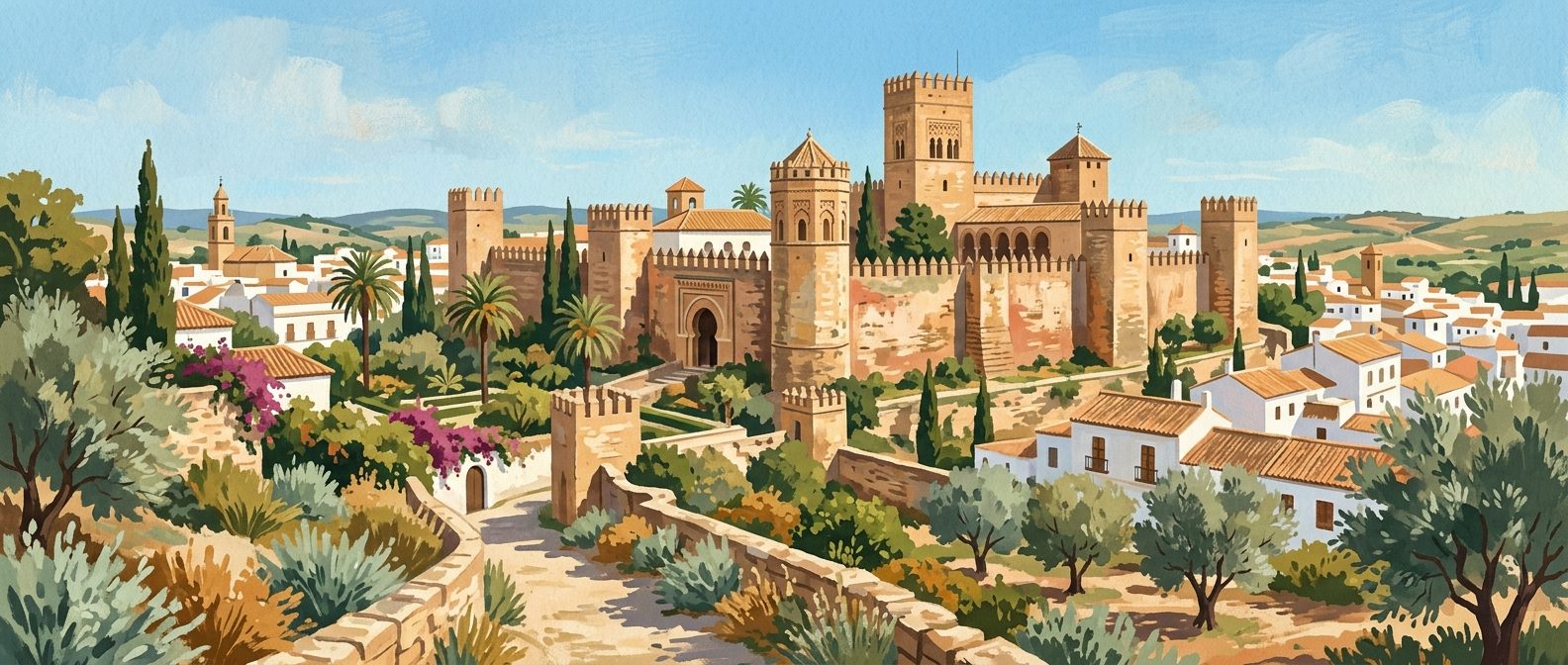
Thick, crenellated walls of pale stone cast sharp shadows over the Alameda Vieja, defining the imposing perimeter of the Alcázar de Jerez de la Frontera. Constructed primarily during the 12th century by the Almohad Caliphate, this defensive complex remains one of the most intact examples of Islamic military architecture in the Iberian Peninsula. It provides a physical record of the shifting power dynamics in western Andalucía, capturing the transition from a Moorish citadel to a Christian stronghold.
A Fortress of Layered History
The Alcázar served as the fortified seat of power for the local walí, protecting the city and housing its administrators. Following the Christian Reconquest in 1264, Alfonso X 'The Wise' took control of the citadel, initiating centuries of structural modifications. Today, the site matters because it presents an unpolished, legible timeline of the city. Rather than a singular architectural style, visitors encounter an enclosed settlement where stark Almohad military engineering sits alongside landscaped gardens, an intimate private mosque, and an imposing Baroque mansion added hundreds of years later. The complex originally featured a dozen towers and spanned a considerable perimeter, ensuring its autonomy from the surrounding medina.
Islamic Architecture and the Arab Baths
The heart of the complex retains the only surviving mosque of the eighteen that once served Islamic Jerez. Converted into a chapel dedicated to Santa María la Real after the Reconquest, the structure preserves a square prayer hall topped with an octagonal dome, a brick mihrab indicating the direction of Mecca, and its original minaret, which was subsequently repurposed as a Christian bell tower. The transition from Islamic worship to Christian use is plainly visible in the architecture itself. Outside the prayer hall, an ablutions courtyard features a central basin historically used for ritual purification.
Adjacent to the mosque are the Arab baths, or Baños Árabes, which were essential to both daily hygiene and religious life. These follow the traditional sequence of cold, warm, and hot rooms. The ceilings of these chambers feature heavy brick vaults punctured by distinctive star-shaped skylights. These geometric openings were highly functional, designed to regulate the intense steam of the baths while filtering shafts of natural light into the humid interior.
Defensive Ramparts and the Octagonal Tower
Walking the surviving defensive walls allows visitors to understand the strategic position of the fortress. The ramparts look out over the city and the surrounding sherry vineyards. The Almohad engineers utilised advanced defensive techniques, evident in the bent entrance gateways, such as the Puerta de la Ciudad and the Puerta del Campo, that slowed attacking forces and prevented direct cavalry charges. The most prominent military feature from the Islamic period is the Octagonal Tower, which stands at a key defensive angle and provides elevated views. A later addition, the Torre del Homenaje, was erected in 1471 by Rodrigo Ponce de León to reinforce the stronghold during internal nobility conflicts.
Villavicencio Palace and the Camera Obscura
Rising abruptly from the medieval courtyard is the Villavicencio Palace, an 18th-century Baroque mansion built directly upon the ruins of the original Moorish residential quarters. Commissioned by the city's ruling elite, the palace's grand halls and formal facade stand in stark contrast to the austere, functional stone of the military walls. Inside, the rooms frequently host temporary art exhibitions and preserve an antique municipal pharmacy dating back to the 19th century, featuring original wooden shelving and ceramic apothecary jars.
The highest tower of the palace houses the Camera Obscura. This optical device uses a periscope-like system of lenses and mirrors to project real-time, moving images of Jerez onto a white concave screen inside a completely darkened room. During a session, a guide manipulates the lenses to tour the city's skyline, zooming in on passing pedestrians, the rooftops of historic sherry bodegas, and the sprawling Andalucían countryside. It offers an engaging, live-action panorama of the city without the need to navigate the streets below.
The Verdict
This is not the Alhambra; it is smaller, distinctly quieter, and requires slightly more imagination to picture its past grandeur. However, the lack of intense crowds makes it a highly rewarding site. It provides an authentic look at Moorish and Christian heritage, suited perfectly to independent travellers who appreciate architectural evolution without the pressure of strict timed entry circuits.
Practicalities
To reach the complex, head to the southwestern edge of the historic centre, adjacent to the Alameda Vieja park. If arriving by rail or bus, the site is a straightforward 20-minute walk from the main transport hubs. If you are driving into Jerez de la Frontera, park in the underground facility at Plaza del Arenal, as street parking near the monument is heavily restricted and closely monitored.
Terrain within the fortress involves ancient stone ramps, uneven paved pathways, and narrow staircases, particularly when climbing to the ramparts or the Camera Obscura tower. While the main ground floor courtyards, the Patio de Armas, and the formal gardens are generally accessible for those with limited mobility, exploring the defensive perimeter requires sturdy footwear and good physical balance. Always confirm the current opening schedule, ticket inclusions, and availability for English language Camera Obscura sessions directly via the official Alcázar website before making the journey.
What to Pair it With
After exploring the military fortifications, shift your focus to the city's rich culinary and wine heritage. The traditional tabancos of the old town are essential; read our guide to eating and drinking in Jerez de la Frontera for the best places to taste fino sherry straight from the barrel. If the Villavicencio Palace's optical device piqued your interest, consider a trip to the coast to experience Exploring Cádiz Cathedral and Torre Tavira, which houses another famous Camera Obscura overlooking the Atlantic. Alternatively, expand your understanding of the region's fortified wines by visiting the coastal bodegas of El Puerto de Santa María or Sanlúcar de Barrameda.
Nearby worth your time
A few well-placed stops for extending the day without turning it into a checklist.

Continue through Costa de la Luz
Step back into the wider landscape with local guides, nearby places and the province overview.
Place guide · 7 min
Playa de La Caleta: A Guide to the Historic Heart of Cádiz
Playa de La Caleta is a historic urban bay in Cádiz, famous for its calm waters, ancient fortresses, and the stunning white Balneario spa building.
Place guide · 7 min
Playa de los Caños de Meca: A Guide to the Cádiz Coastline
Discover the wild Atlantic beauty of Playa de los Caños de Meca, from its freshwater springs to the historic Cape Trafalgar lighthouse.
Itinerary · 7 min
Three Days in Cadiz: The Ultimate Itinerary for Independent Travellers
Three days allows you to completely sink into the maritime rhythm of Europe's oldest city. You can cover the historic centre, explore the twin seaside fortresses, and still have time for a sherry tasting afternoon across the bay.