
attraction · Jaén
Baños Árabes Cultural Centre, Villardompardo Palace
Andalucía 365 · Updated 18 July 2026
Our Verdict
“A fascinating juxtaposition of Islamic water engineering and Spanish aristocratic ambition. The vast underground baths alone easily justify the visit, while the two eccentric upstairs museums offer a curious, if somewhat disjointed, cultural bonus. An essential stop for understanding the layered, complex history of provincial Jaén.”
Last verified: July 2026
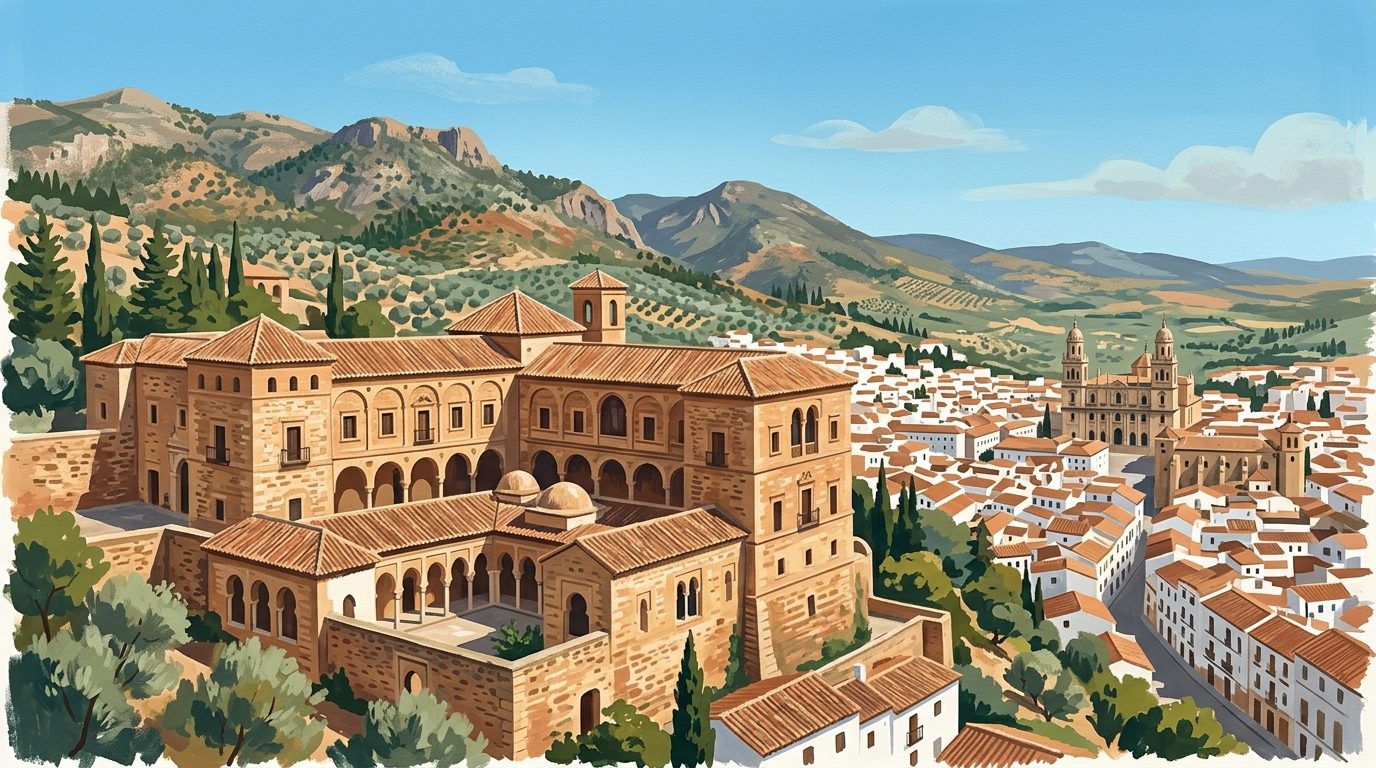
Under the heavy stone foundations of a sixteenth-century Spanish viceroy's residence lies a vast eleventh-century bathing complex. The Baños Árabes Cultural Centre, inside the Villardompardo Palace, represents a remarkable architectural intersection in Andalucía. For centuries, the largest surviving Arab baths in Spain remained concealed, buried beneath the aristocratic home of Fernando de Torres y Portugal, Viceroy of Peru. Rediscovered in the early twentieth century, the site offers a stark timeline of Jaén. Visitors move from the dimly lit Islamic underground to the bright Renaissance courtyard above. It is a necessary stop for anyone exploring the city, presenting a physical cross-section of Moorish ingenuity and subsequent Christian power.
The 11th-Century Subterranean Baths
The undisputed focal point of the complex is the Hammam al-Walad, covering an impressive 450 square metres beneath the palace floor. Built in the year 1002 on top of older Roman foundations, the complex served as a crucial social and hygienic hub during the Islamic period of the city. Following the traditional layout of a hammam, visitors descend into a sequence of vaulted brick chambers: the Cold Room, the Warm Room, and the Hot Room.
The Warm Room is the architectural high point. It features elegant horseshoe arches and stone floors, alongside surviving decorative elements that highlight the sophistication of later Almohad renovations. Looking up, you see signature star-shaped and lobed skylights piercing the thick vaults. These vents were part of a thermodynamic system, fitted with glass covers to regulate steam, retain heat, and filter natural sunlight into the humid air. Walking through these cool brick arches today, you can appreciate the precise geometry of eleventh-century Islamic builders. The sheer scale makes it one of the finest surviving examples of Islamic bath architecture in Europe.
The Villardompardo Palace Courtyard
Above the baths, the Villardompardo Palace offers a classic, rigorous example of sixteenth-century aristocratic design. Following the Christian conquest and subsequent centuries of changing architectural fashions, the Count of Villardompardo constructed his home directly over the hammam, using its robust stone vaults as foundational support. The building is centred around a broad square courtyard lined with double-storey arcades and heavy Tuscan columns.
Throughout its complex history, the building has served various civic purposes. It operated as a bank during the seventeenth and eighteenth centuries, and later functioned as a women's hospice under the provincial charity board. A Latin inscription and coats of arms above the main entrance still bear witness to its time as a charitable institution. Today, the bright, austere courtyard provides a sharp architectural contrast to the dark, intimate bathing chambers below. The upper terrace also offers expansive views across the rooftops of the old quarter, stretching towards the distant olive groves that define the provincial landscape.
Naïve Art and Ethnography Museums
The upper floors of the palace contain two unexpected and entirely distinct collections. The International Museum of Naïve Art was the first of its kind in Spain. It features a vast collection of works by self-taught artists from around the world. These paintings and sculptures are characterised by their flat perspectives, exceptionally bold colours, and recurring rural motifs. While it sits slightly at odds with the serious historical weight of the building, the collection is highly regarded in the art world and provides a bright, contemporary visual diversion.
Occupying another wing is the Museum of Popular Arts and Customs. This space provides an ethnographic survey of rural life in Jaén province over the last two centuries. Visitors can examine traditional agricultural implements, period clothing, and recreated historical workshops. It offers highly useful context for exploring the wider rural province, tying the aristocratic history of the city to the daily agricultural reality of the surrounding valleys. To understand the agricultural dominance of the region, pairing this museum with Exploring the Olive Oil Culture of Jaén City creates a strong thematic connection.
Accessibility and Terrain
The cultural centre sits in the Barrio de la Magdalena, one of the steepest historic neighbourhoods in Jaén. Arriving on foot requires navigating narrow cobbled streets with significant inclines. Visitors with mobility constraints should avoid attempting to drive directly to the door due to restricted access. Instead, park at the Teatro Infanta Leonor public car park, roughly 350 metres away. Inside the palace, accessibility is good for a heritage building. The structure features wooden ramps to bypass entrance steps and a lift to access upper galleries.
Practicalities and How to Visit
The complex requires roughly 90 minutes to two hours to explore fully. This allows sufficient time to split your attention evenly between the subterranean baths, the central courtyard, and the upstairs galleries. Morning visits are heavily recommended, particularly on clear days when the morning sunlight streams directly through the ceiling stars of the hammam to dramatic effect. Furthermore, due to the high heat of the Jaén summer, the cool underground chambers offer a welcome, naturally air-conditioned retreat during the middle of the day.
General admission is frequently free, though visitors should always verify current ticketing, seasonal opening hours, and temporary exhibitions directly on the official Baños Árabes website. After finishing the visit, the Cathedral is just a ten-minute walk away. This makes it easy to pair the baths with The Renaissance Masterpiece of Jaén Cathedral for an efficient morning itinerary. You can expand your understanding of the provincial capital by reading Beyond the Olive Groves: A Guide to the Renaissance Soul of Jaén City, or find clear architectural parallels when Exploring Baeza: The Golden Heart of the Spanish Renaissance.
Nearby worth your time
A few well-placed stops for extending the day without turning it into a checklist.
Continue through Jaén City
Step back into the wider landscape with local guides, nearby places and the province overview.
Things to do · 12 min
Golf in Jaén Province: A Practical Guide to Courses, Clubs, and Holidays
Discover the reality of playing golf in Jaén. From the 9-hole course at La Garza to local societies and combining rounds with olive oil tourism.
Nature & wildlife · 7 min
Sierra de Cazorla: Spain's Largest Protected Area
Covering over 200,000 hectares of rugged limestone peaks and deep river canyons, the Sierra de Cazorla forms the green heart of the Iberian Peninsula.
Itinerary · 11 min
5 Days in Jaén: Renaissance Cities and Cazorla
A realistic five-day driving itinerary through Jaén province, balancing the monumental Renaissance architecture of Úbeda and Baeza with the rugged mountain wilderness of the Sierra de Cazorla.