
attraction · Cádiz
Cádiz Museum
Andalucía 365 · Updated 18 July 2026
Our Verdict
“The Museo de Cádiz offers a vast, rewarding journey through three thousand years of Atlantic history, anchored by world-class Phoenician sarcophagi and exceptional Baroque masterpieces by Zurbarán. While the sheer volume of text-heavy archaeological exhibits requires significant patience, those who take their time will find a profound and meticulously curated tribute to Europe's oldest continuously inhabited city.”
Last verified: July 2026
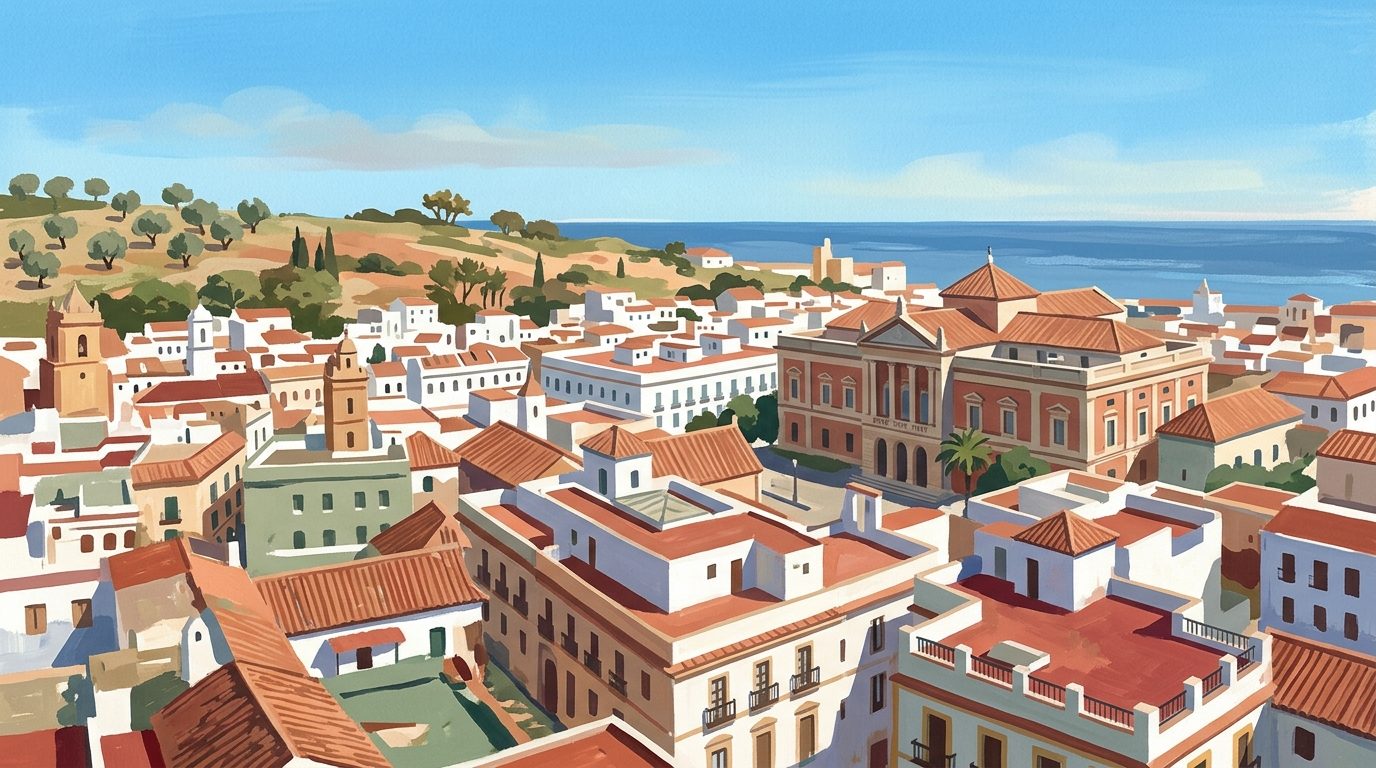
A late neoclassical facade overlooks the botanical canopy and shaded benches of Plaza de Mina, enclosing the structural remnants of a disentailed 19th-century Franciscan convent. Inside, the Museo de Cádiz organises three thousand years of Atlantic history around a bright central courtyard, distributing its vast municipal and provincial collections across three distinct levels. The museum traces the evolution of Europe's oldest continuously inhabited city, moving systematically from its foundation as the Phoenician trading outpost of Gadir, through its monumental Roman expansion as Gades, before exploring its artistic output during the Baroque era and the 19th century. Since 2011, the institution has also incorporated the nearby Casa Pinillos, a magnificent surviving example of 18th-century and 19th-century bourgeois architecture left to the city by a local maritime trading family.
The Phoenician and Roman Ground Floor
The archaeological collection occupies the entire ground floor, driven by two extraordinary chance discoveries. In 1887, workers excavating ground for a maritime exhibition near a local shipyard unearthed a fifth-century BC Phoenician male anthropoid sarcophagus, carved from white marble and depicting a bearded figure holding a pomegranate. This monumental discovery was the immediate catalyst for founding the city's archaeological museum. Nearly a century later, in 1980, a companion sarcophagus depicting a female clutching an alabastron vessel was discovered under the former house of the very archaeologist who had spent his life searching for it. Interestingly, modern analysis later revealed the skeleton inside was actually male. These two finely detailed Mediterranean imports, likely crafted by highly Hellenised artisans, form the undisputed centrepieces of the room, demonstrating the immense wealth and global reach of the ancient Phoenician elite.
The surrounding halls expand into the Roman era, presenting colossal marble statuary recovered from the ancient theatre of Cádiz and the coastal ruins of Baelo Claudia. Visitors who have spent time at the actual archaeological sites, perhaps after reading about Bolonia: A Guide to the Cádiz Coast’s Roman Ruins and Great Dune, will appreciate seeing the finest surviving sculptures preserved here. Beyond the monumental masonry, display cases hold delicate Phoenician goldwork, everyday Roman glassware, and Neolithic stone tools recovered from the inland Dolmen of Alberite.
The Fine Arts and Zurbarán Collection
Ascending to the first floor shifts the focus to fine arts, anchored by works recovered during the 1835 secularisation of Spanish monasteries. The highlight is a monumental series of paintings by Francisco de Zurbarán, originally commissioned for the Charterhouse of Jerez de la Frontera. Zurbarán’s signature command of shadow and intense, solemn colour is evident in his depictions of Carthusian monks and elegantly draped angels holding censers. A focal point of this collection is the Apoteosis de San Bruno, which portrays the saint in a state of ecstasy, looking toward heaven with a mitre and crozier at his feet to symbolise his rejection of earthly episcopal dignity.
This floor also features significant Baroque canvases by Bartolomé Esteban Murillo and Peter Paul Rubens, alongside later 19th-century works that illustrate the flourishing local school of Cadiz painters. These later works lean heavily into costumbrismo and historical painting, providing a romanticised visual record of life in Andalucía.
The Tía Norica Puppets and Local Lore
The top floor introduces a sharp contrast to the classical antiquities and sombre religious art below, presenting the museum's ethnographic and contemporary collections. The standout exhibit here is the Tía Norica puppet collection. These traditional marionettes were a central pillar of local popular culture throughout the 18th and 19th centuries, delivering biting social satire and theatrical entertainment to the working classes of the city. Their preservation offers a rare, tangible link to the historical wit and irreverent humour that still defines local festivals today. Visitors looking to understand this deeply ingrained cultural trait should explore The Wit of the Atlantic: A Guide to the Cádiz Carnival and Local Traditions, as the spirit of these puppets survives in modern street choirs.
A Candid Assessment
This is the premier cultural institution in the province, but it demands time and focus. The sheer volume of material, particularly in the dense archaeological sections, can easily overwhelm casual visitors. The chronological layout helps structure the experience, but the signage is heavily reliant on lengthy text panels that require patience. It best suits dedicated history enthusiasts and art lovers willing to read through the extensive background material. However, visitors with only a passing interest in history might prefer to focus strictly on the ground floor Phoenician sarcophagi and the Zurbarán canvases before moving on.
How to Visit and Accessibility
The museum building provides wheelchair access across its three main exhibition floors via lifts, though visitors with reduced mobility should use the step-free entrance on Calle Antonio López and notify staff. The most up-to-date practical details for planning a visit are available on the official Museo de Cádiz website. The galleries are quietest on weekday mornings, providing the best conditions for viewing the detailed artwork and reading the historical placards without competing for space.
A Sensible Nearby Pairing
Stepping out of the museum places you directly into Plaza de Mina, an expansive, tree-shaded square that is ideal for resting after a dense historical tour. From here, it is only a short walk through the pedestrianised historic centre to the waterfront. To continue exploring the city's maritime legacy, climb the watchtower detailed in the Exploring Cádiz Cathedral and Torre Tavira guide, which offers sweeping panoramic views over the old town and the surrounding ocean. Alternatively, delve deeper into the city's coastal atmosphere by Exploring the Historic Heart and Atlantic Shores of Cádiz, ending the afternoon watching the sunset by the sea.
Nearby worth your time
A few well-placed stops for extending the day without turning it into a checklist.
Continue through Cádiz City
Step back into the wider landscape with local guides, nearby places and the province overview.
Place guide · 7 min
Playa de La Caleta: A Guide to the Historic Heart of Cádiz
Playa de La Caleta is a historic urban bay in Cádiz, famous for its calm waters, ancient fortresses, and the stunning white Balneario spa building.
Place guide · 7 min
Playa de los Caños de Meca: A Guide to the Cádiz Coastline
Discover the wild Atlantic beauty of Playa de los Caños de Meca, from its freshwater springs to the historic Cape Trafalgar lighthouse.
Itinerary · 7 min
Three Days in Cadiz: The Ultimate Itinerary for Independent Travellers
Three days allows you to completely sink into the maritime rhythm of Europe's oldest city. You can cover the historic centre, explore the twin seaside fortresses, and still have time for a sherry tasting afternoon across the bay.