
attraction · Granada
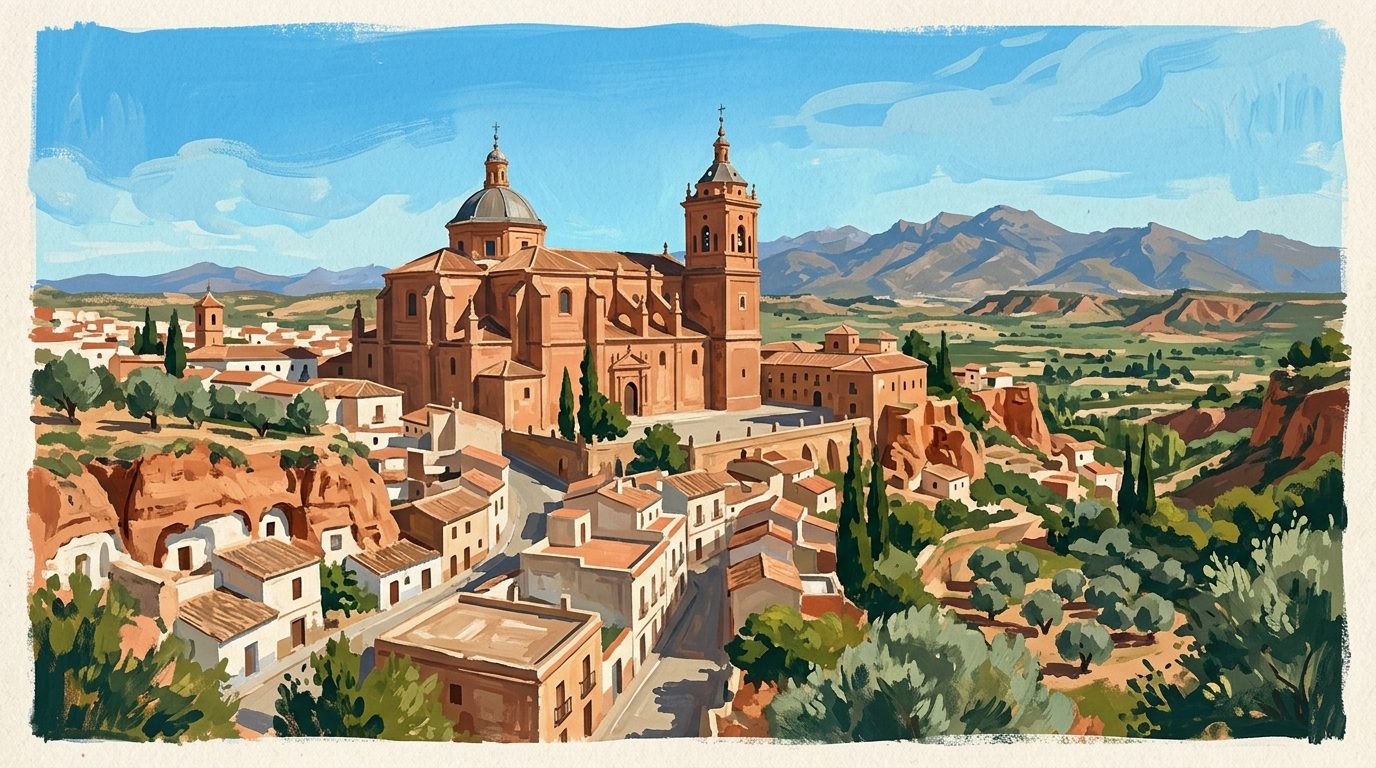
Catedral de la Encarnación de Guadix
Andalucía 365 · Updated 18 July 2026
Our Verdict
“Unlike the heavily frequented monuments of Granada, Guadix Cathedral offers an unhurried environment for studying historic architecture. The fusion of Gothic austerity and Baroque excess is striking, while the tower climb provides the best vantage point in the region. It is a highly rewarding visit for those interested in religious art.”
Last verified: July 2026
The Catedral de la Encarnación de Guadix announces itself from miles away. Its soaring bell tower, crowned by a massive statue of the Sacred Heart of Jesus, rises abruptly above a landscape of arid badlands and whitewashed cave chimneys. Built largely from local stone and brick, the exterior walls glow warmly under the high-altitude sun of Andalucía, shifting in colour from deep ochre to pale terracotta as the day progresses.
This cathedral sits on ground of immense historical weight. Tradition holds that Guadix, known to the Romans as Acci, was the very first diocese in Hispania, founded in the first century by San Torcuato. The current structure replaces a Hispano-Visigothic church, later converted into an Aljama mosque under Moorish rule. Following the Christian conquest, construction of the new cathedral spanned from the early 16th to the late 18th century, moving from late Gothic through the Renaissance, and culminating in a flamboyant Baroque facade.
A Complex Architectural History
The lengthy construction process was marked by changing tastes and economic delays, including a halt during the Morisco rebellion. Work began between 1510 and 1520 under Pedro de Morales with a late Gothic design. By 1549, Diego de Siloé was commissioned to introduce the Renaissance style, designing the apse, parts of the crossing, and the lower stone section of the bell tower. In the 18th century, backed by King Felipe V, architects Vicente Acero, Gaspar Cayón, and Domingo Thomas completed the vaults and highly ornamented facades, unifying the disparate styles.
The Baroque Facade and Nave
The main exterior, known as the Door of the Incarnation, is an exercise in Spanish Baroque theatricality. Designed like a stone retablo, it features concave and convex curves, a relief of the Annunciation, and sculptures of the Seven Apostolic Men. The secondary entrances, including the Door of San Torcuato and the Door of Santiago, are also richly decorated; the latter bears the royal initials of Felipe V and Isabel Farnesio. Inside, the floor plan mirrors the grand cathedrals of the era with three broad aisles, a spacious ambulatory (girola), and soaring ribbed vaults pointing to the building's earlier Gothic origins.
The Choir and La Piedad
At the centre of the main nave sits the choir, which contains stalls originally carved by the local 18th-century sculptor Torcuato Ruiz del Peral. Although his masterful lifelike wooden figures were tragically destroyed during the Spanish Civil War in 1936, a careful 21st-century restoration project has seen contemporary sculptors recreate the imagery, returning the choir to its intended grandeur. Nearby in the San Torcuato chapel, visitors will find a remarkable marble replica of Michelangelo’s Pietà, known locally as La Piedad de Guadix. Believed to be one of the most accurate copies in the world, it was restored in 2001. In 2023, the cathedral introduced a video mapping projection that casts animated light and colour directly onto the marble sculpture, adding a modern interpretive layer to the classical religious art.
Climbing the Bell Tower
For many visitors, the defining feature of the building is its bell tower. Ascending involves navigating a double-helix staircase, a rare architectural solution inspired by Leonardo da Vinci, which allowed the bell ringer and church officials to move simultaneously without crossing paths. On the way up, you pass the preserved living quarters of the resident bell ringer. The climb concludes at a projecting balcony, or balcón volado, wrapping entirely around the belfry. This 360-degree platform offers uninterrupted panoramic views. From here, the red-tiled roofs of the historic quarter merge into the clay hills of the cave district, with the jagged Sierra Nevada as a backdrop. Above, the tower is crowned by a rotating statue of the Sacred Heart of Jesus, installed in 1945.
The Cathedral Museum
The standard entry ticket includes an informative audio guide and access to the Cathedral Museum. Housed in the former Chapter House (Sala Capitular), the museum features original floor tiles and displays a rich collection of religious artefacts. Highlights include liturgical silver, embroidered vestments, the 16th-century Bible of St. Jerome, and centuries-old religious paintings from the Granada school of art. The space also houses the relics of San Torcuato, reinforcing the spiritual heritage of the site.
Practical Information
The cathedral sits at the exact centre of the old town, with a large public car park situated just behind the building. The ground floor is largely accessible to wheelchair users. Entry is typically via the San Torcuato door on the Paseo de la Catedral, involving one very small, manageable step. The aisles are wide, flat, and easy to navigate. However, the bell tower is entirely inaccessible for those with mobility issues, as reaching the viewing balcony requires climbing steep stairs. There are reserved parking bays on the surrounding streets.
Because the cathedral is an active place of worship, access is frequently altered at short notice for weddings, funerals, or religious festivals. You should always verify the latest schedules and ticket options directly on the official Guadix Cathedral website.
Sensible Pairings
No trip to this region is complete without stepping out of the monumental centre and exploring the surrounding clay hills. You can easily walk from the cathedral plaza to the famous cave district, making Guadix an excellent full-day destination. For a deeper understanding of this peculiar geology, spend time exploring The Marquesado, or take a short drive to the nearby subterranean village of Purullena. If you wish to extend your journey across the Altiplano, heading north to Baza provides further ancient history and highly preserved Arab baths.
Nearby worth your time
A few well-placed stops for extending the day without turning it into a checklist.
Continue through The Marquesado & Guadix
Step back into the wider landscape with local guides, nearby places and the province overview.
Place guide · 7 min
Playa de Calahonda (Granada) Beach Guide
Playa de Calahonda in Granada offers deep, crystal-clear waters and a dramatic limestone cliff backdrop. This Blue Flag beach is a favourite for snorkelling and authentic Andalucían seafood.
Place guide · 7 min
A Guide to Playa de Salobreña on the Costa Tropical
Playa de Salobreña is a vast stretch of dark sand and clear water on the Costa Tropical, overlooked by a historic Moorish castle and dramatic cliffs.
Itinerary · 10 min
Two Days in Granada: A Step-by-Step Itinerary
Two days in Granada gives you just enough time to explore the Alhambra and lose yourself in the steep alleys of the Albaicín. This itinerary balances major monuments with the city's legendary free tapas culture.