
attraction · Granada
Cueva Museo Centro de Interpretación Cuevas de Guadix
Andalucía 365 · Updated 18 July 2026
Our Verdict
“This highly effective, intimate domestic museum demystifies cave living without romanticising historical poverty. It suits independent travellers and architecture enthusiasts seeking crucial context for the region's peculiar geography. Taking less than an hour to explore, it serves as an essential introduction before walking through the wider troglodyte neighbourhoods of the high plateau.”
Last verified: July 2026
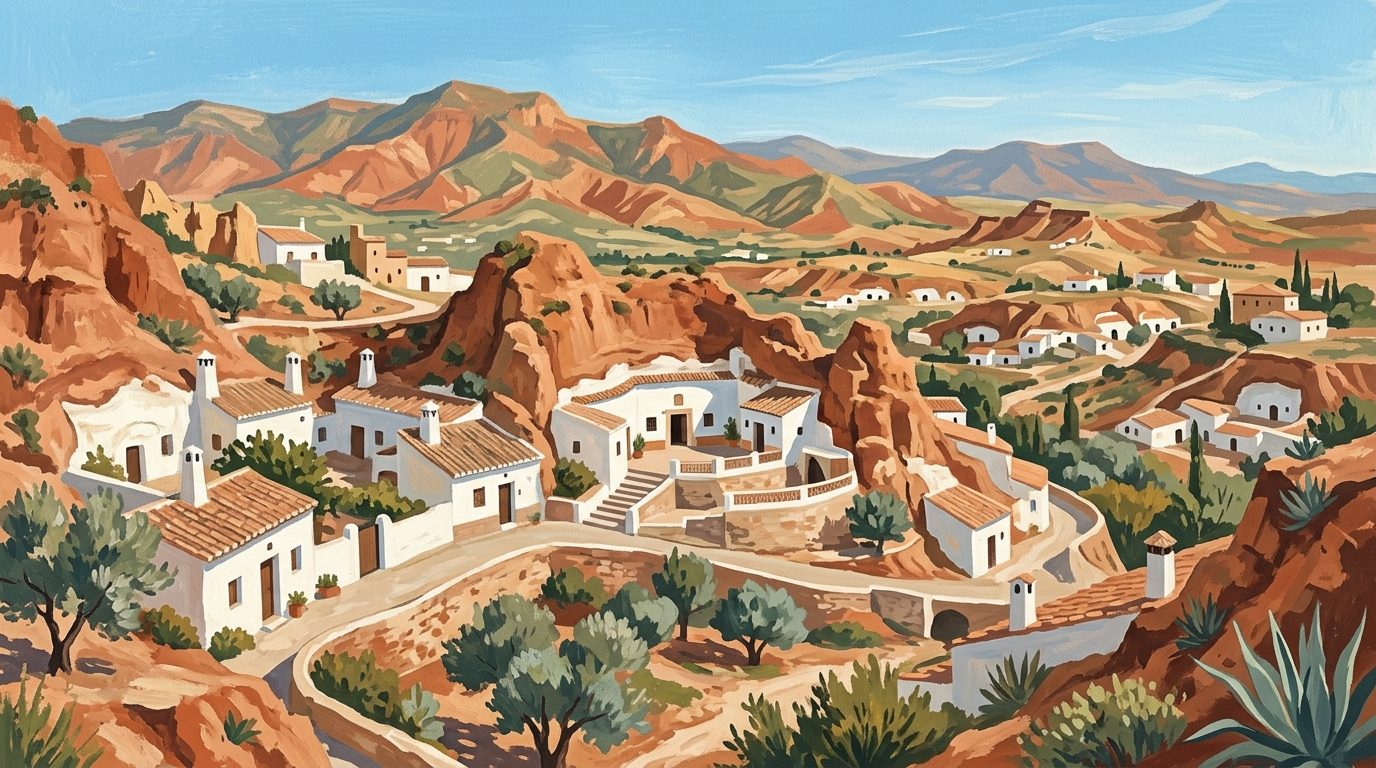
A thick whitewashed facade cut directly into a red clay hillside marks the entrance to the Cueva Museo Centro de Interpretación Cuevas de Guadix, a preserved subterranean dwelling documenting the enduring troglodyte culture of Andalucía's high plateau. Rather than occupying a conventional museum, the site comprises a series of authentic, interconnected cave rooms where generations of the Cruz Úbeda family lived between 1928 and 1980. Beyond a mere display of old artefacts, this site provides a tactile understanding of a vernacular housing style that has defined the region since the sixteenth century. For independent travellers, spending an hour inside these excavated walls anchors the visual spectacle of the surrounding landscape in the practical realities of daily life.
A Subterranean Heritage
For anyone arriving to explore the wider badlands of the Marquesado, this museum is the most effective primer on a housing style that still accommodates thousands of residents. The surrounding Barrio de las Cuevas is one of the largest inhabited cave districts in Europe, characterised by a surreal landscape of conical hills punctuated by hundreds of white ventilation chimneys.
The interpretation centre systematically explores the geological conditions that allowed residents to carve homes directly into the soft clay. Originally, these dwellings were excavated by marginalised communities, including displaced Moorish populations, who sought refuge in the hillsides following the sixteenth-century fall of Granada. A central figure in the display is Pedro, the "maestro picaor" (master cave-cutter), a character representing the tradesmen who carved these spaces by hand. Through his perspective, visitors learn how the clay-rich soil of the Guadix-Baza basin provided the perfect medium: soft enough to cut with simple tools, yet durable enough to remain structurally sound without beams.
Inside the Cave Dwellings
The layout preserves the original domestic zoning of the Cruz Úbeda home, featuring a traditional whitewashed facade, an outdoor courtyard with a communal well, and a central entry hall. Inside, the rooms branch off into specialized spaces: a kitchen with an open chimney hearth, a "despensa" (pantry) for curing meats, an "alacena" (built-in cupboard) carved into the rock, and a "cuadra" (stable) alongside a small "marranera" (pigsty) where livestock helped warm the home.
The most immediate sensation upon entering is the stark shift in temperature. Thanks to the immense thermal mass of the surrounding earth, the rooms maintain a stable climate of 18 to 20 degrees Celsius year-round, providing a vital shield against the extreme seasonal weather of the high plains. Authentic period furniture, iron bedsteads, esparto grass mats, and heavy woollen textiles illustrate how these spaces were furnished and heated before modern utilities.
Tools and Traditions
Beyond the domestic arrangements, the museum serves as an ethnographic archive. The outer chambers house agricultural implements that trace the regional cycle of wheat and olive cultivation. A dedicated section highlights the local ceramics industry, particularly the jarra accitana, a unique multi-handled clay vessel traditionally produced by local potters to carry water.
In addition to agriculture and pottery, the displays showcase deeply rooted customs of the Comarca de Guadix, such as the famous Cascamorras festival and traditional "Bailes de Rifa" (raffle dances). These elements demonstrate how a distinct cultural identity flourished in this semi-isolated troglodyte environment, turning what was once a refuge into a cohesive, self-sustaining community.
The Verdict
This highly effective, intimate domestic museum demystifies cave living without romanticising historical poverty. It suits independent travellers and architecture enthusiasts seeking crucial context for the region's peculiar geography. Taking less than an hour to explore, it serves as an essential introduction before walking through the wider troglodyte neighbourhoods of the high plateau.
Practicalities and Terrain
The museum is located in the Plaza del Padre Poveda, in the upper reaches of the cave district. Getting there on foot from the monumental centre of Guadix involves a steady, uphill walk over uneven, cobbled terrain that demands sturdy walking shoes. Drivers will find limited parking in the plaza itself, and the narrow, winding access roads can be challenging to navigate in larger vehicles.
In terms of accessibility, the museum has made key adaptations. While the main historic entrance has steps, a secondary step-free entrance is available for visitors with reduced mobility. There is a designated accessible parking space in the adjacent square, and the interior features adapted toilets. Visual and auditory aids, including Braille-printed guides and subtitled audiovisual displays, are provided. For verified details, consult the official Guadix tourism website before your visit.
What to Do Next
After exiting the museum, follow the directional signs a short distance uphill to the Mirador del Padre Poveda. This elevated public viewpoint offers sweeping panoramic views over the chimney forest of the cave district, set dramatically against the snow-capped peaks of the Sierra Nevada. Visitors should also consider visiting the nearby Ermita de Gracia, a historic cave-church just a short walk away, where Father Pedro Poveda began his educational work with the local cave-dwelling community in the early twentieth century. Alternatively, continue your exploration of subterranean architecture by driving ten minutes west to the neighbouring village of Purullena, where more contemporary cave homes line the main road alongside traditional pottery workshops.
Nearby worth your time
A few well-placed stops for extending the day without turning it into a checklist.
Continue through The Marquesado & Guadix
Step back into the wider landscape with local guides, nearby places and the province overview.
Place guide · 7 min
Playa de Calahonda (Granada) Beach Guide
Playa de Calahonda in Granada offers deep, crystal-clear waters and a dramatic limestone cliff backdrop. This Blue Flag beach is a favourite for snorkelling and authentic Andalucían seafood.
Place guide · 7 min
A Guide to Playa de Salobreña on the Costa Tropical
Playa de Salobreña is a vast stretch of dark sand and clear water on the Costa Tropical, overlooked by a historic Moorish castle and dramatic cliffs.
Itinerary · 10 min
Two Days in Granada: A Step-by-Step Itinerary
Two days in Granada gives you just enough time to explore the Alhambra and lose yourself in the steep alleys of the Albaicín. This itinerary balances major monuments with the city's legendary free tapas culture.