
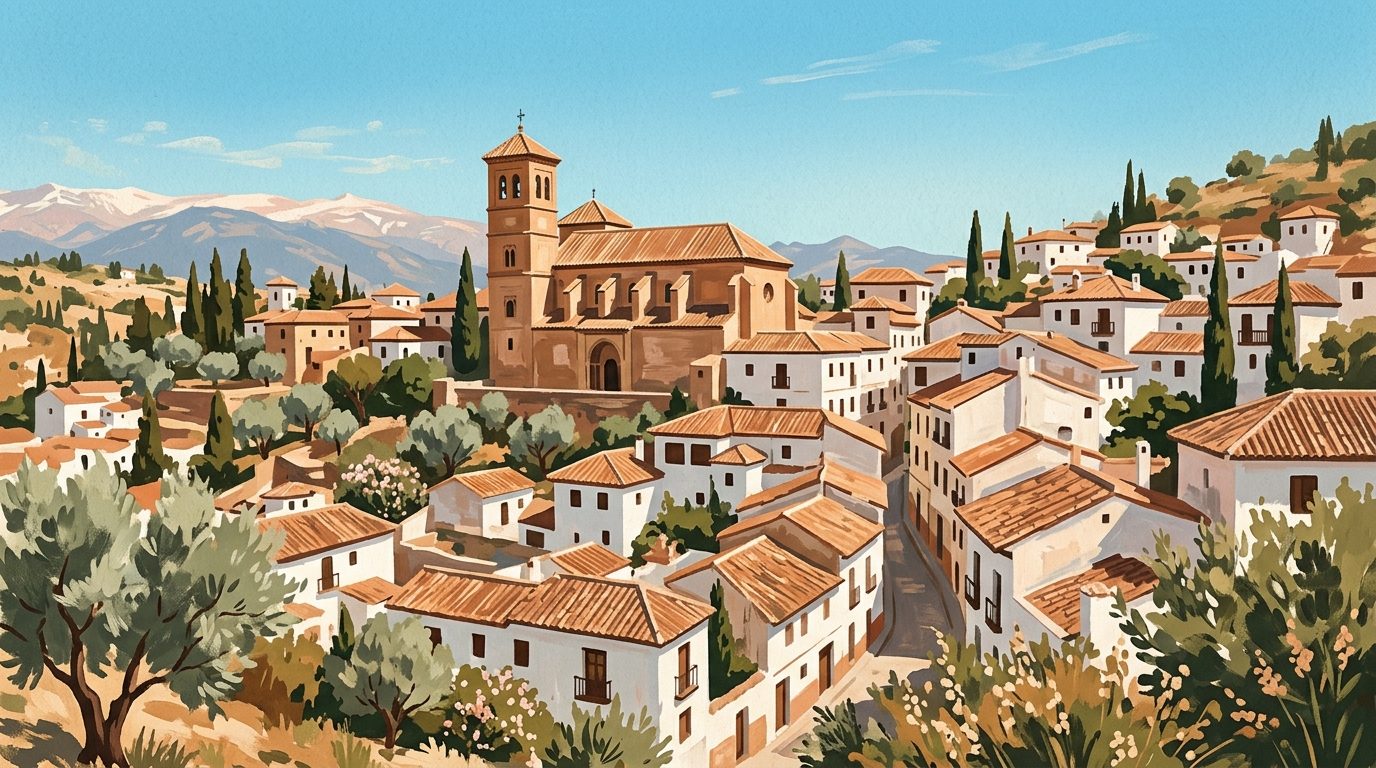
attraction · Granada
Iglesia de Santiago
Andalucía 365 · Updated 18 July 2026
Our Verdict
“A masterclass in Renaissance and Mudejar fusion by Diego de Siloé, showing Guadix's 16th-century wealth. Though opening hours are often frustratingly restricted to mass times, the exterior stone carving and striking glazed bell tower alone warrant the short walk from the cathedral.”
Last verified: July 2026
The Iglesia de Santiago asserts its presence in Guadix long before you reach its doors. Its Mudejar bell tower, topped with a striking pyramidal spire of green and white glazed ceramic tiles, cuts a distinct silhouette against the vast red clay landscape of the Granada badlands. Constructed in the 16th century on the site of a former mosque, this monumental church is an architectural timeline preserved in stone and wood. It captures the exact historical moment when the rigid structural rules of the late Gothic era gave way to the ornamental grace of the Renaissance, all while holding tight to the Moorish craftsmanship that defined post-Reconquest Andalucía. As a powerful symbol of a city in the midst of profound religious and cultural transformation, it stands as one of the most culturally significant and visually striking structures in the province.
The Masterful Legacy of Diego de Siloé
The church is inextricably linked to Diego de Siloé, the celebrated master architect who fundamentally shaped the Spanish Golden Age and left an indelible mark on the magnificent Granada Cathedral. Commissioned by the influential local bishop, Gaspar de Ávalos, Siloé laid out the foundational design for a building that was originally intended to serve as a grand family pantheon. His forward-thinking influence is most apparent in the spatial control of the interior and the elegant transition of the side chapels, which move away from heavy medieval forms. While Siloé provided the plans, the primary construction was contracted to Francisco de Centeno in 1533.
For most visitors, the immediate highlight is the Plateresque main facade. This spectacular portal is a masterpiece of early Renaissance stonework, largely attributed to the execution of Rodrigo de Gibata, who valued the work in 1546 following Siloé's concepts. The carving mimics the intricate, delicate detail of silversmithing. Set into the pale stone, you can spot the imperial coat of arms of Charles V, a clear signal of the deep pockets of crown patronage and the strategic importance of Guadix during the 1500s. This brilliant, highly textured entrance provides a stark visual contrast to the simpler, whitewashed brickwork found on the side walls, drawing the eye directly to the heavy main doors.
Mudejar Craftsmanship and the Interior Layout
Stepping through the wheelchair-accessible main entrance, the temperature drops noticeably, and the eye is immediately drawn upward. The Iglesia de Santiago features an exceptional collection of Mudejar coffered ceilings, known locally as artesonados. These dark, geometrically complex wooden structures are a direct legacy of Moorish carpenters who continued their highly specialised trade under Christian rule, blending Islamic geometric precision with Christian ecclesiastical requirements.
The church follows a classic basilican plan with three naves, where the central nave is notably wider and higher than the flanking aisles. Slender circular pillars without heavy capitals provide a surprising sense of lightness, supporting the arches that elegantly divide the space. Visitors should pay close attention to the interlacing star patterns in the wooden roof, which create a mesmerising optical effect. Furthermore, the side chapels, originally funded by wealthy noble families looking to cement their status in the city, feature pointed arches and their own ornate woodwork, serving as private memorials within the larger public space.
A Candid Assessment
From an architectural standpoint, the Iglesia de Santiago is undeniably impressive. The fusion of Plateresque stone carving and elaborate Mudejar wooden roofing represents the absolute pinnacle of 16th-century Andalucían design. However, independent travellers must manage their expectations regarding interior access. Because it serves as an active parish and the headquarters for local brotherhoods rather than a dedicated tourist museum, access is frequently restricted to the short windows immediately before mass. The lack of standard all-day opening hours can frustrate those on a tight schedule. Even if you arrive to find the heavy doors locked, the surrounding square offers a superb vantage point to photograph the exquisite facade, the convent walls next door, and the magnificent glazed spire. It is a highly rewarding stop for architecture and history enthusiasts, provided you are willing to appreciate the exterior alone if the interior happens to be closed.
How to Visit and Accessibility
The church sits securely on Plaza de Santiago in the historic centre of Guadix, just a short walk from the main cathedral and the imposing Palacio de Peñaflor. The streets surrounding the building are part of the old medieval quarter, meaning the paving can be narrow, cobbled and slightly uneven in places. However, the plaza itself provides a flat approach, and the church features a dedicated wheelchair-accessible entrance, making it more accommodating than many historical structures of its era.
If you are planning to go inside, you should generally aim for the times surrounding religious services. On the other hand, natural sunlight hits the Plateresque portal beautifully in the late morning, making that the ideal time for architectural photography. Before making a special trip across town, visitors must verify the current access rules on the official Diocese of Guadix website, as these routines are highly subject to change for religious holidays, private ceremonies and seasonal shifts.
Sensible Nearby Pairings
No trip to this fascinating part of the province is complete without exploring the broader context of the local landscape. Start your day reading up on the subterranean lifestyle of the Marquesado and Guadix, before heading to the famous cave district. Guadix itself is famous worldwide for its thousands of whitewashed chimneys protruding directly from the clay hillsides, offering a stark, vernacular contrast to the formal Renaissance architecture of the city centre churches. If you have a car and an appetite for further historical exploration, a drive north to Baza provides another fascinating look at the prehistoric and Moorish roots of the high plateau, complete with ancient Arab baths and Iberian archaeological sites.
Nearby worth your time
A few well-placed stops for extending the day without turning it into a checklist.
Continue through The Marquesado & Guadix
Step back into the wider landscape with local guides, nearby places and the province overview.
Place guide · 7 min
Playa de Calahonda (Granada) Beach Guide
Playa de Calahonda in Granada offers deep, crystal-clear waters and a dramatic limestone cliff backdrop. This Blue Flag beach is a favourite for snorkelling and authentic Andalucían seafood.
Place guide · 7 min
A Guide to Playa de Salobreña on the Costa Tropical
Playa de Salobreña is a vast stretch of dark sand and clear water on the Costa Tropical, overlooked by a historic Moorish castle and dramatic cliffs.
Itinerary · 10 min
Two Days in Granada: A Step-by-Step Itinerary
Two days in Granada gives you just enough time to explore the Alhambra and lose yourself in the steep alleys of the Albaicín. This itinerary balances major monuments with the city's legendary free tapas culture.