
attraction · Granada
Parque de las Ciencias
Andalucía 365 · Updated 18 July 2026
Budget
Our Verdict
“The Parque de las Ciencias is a world-class educational facility that trades dry observation for genuine interaction. While the sheer scale of the site can feel overwhelming if rushed, the meticulous BioDomo and the broad range of tactile physics experiments make it an essential, high-quality diversion from the historical monuments of Granada.”
Last verified: July 2026
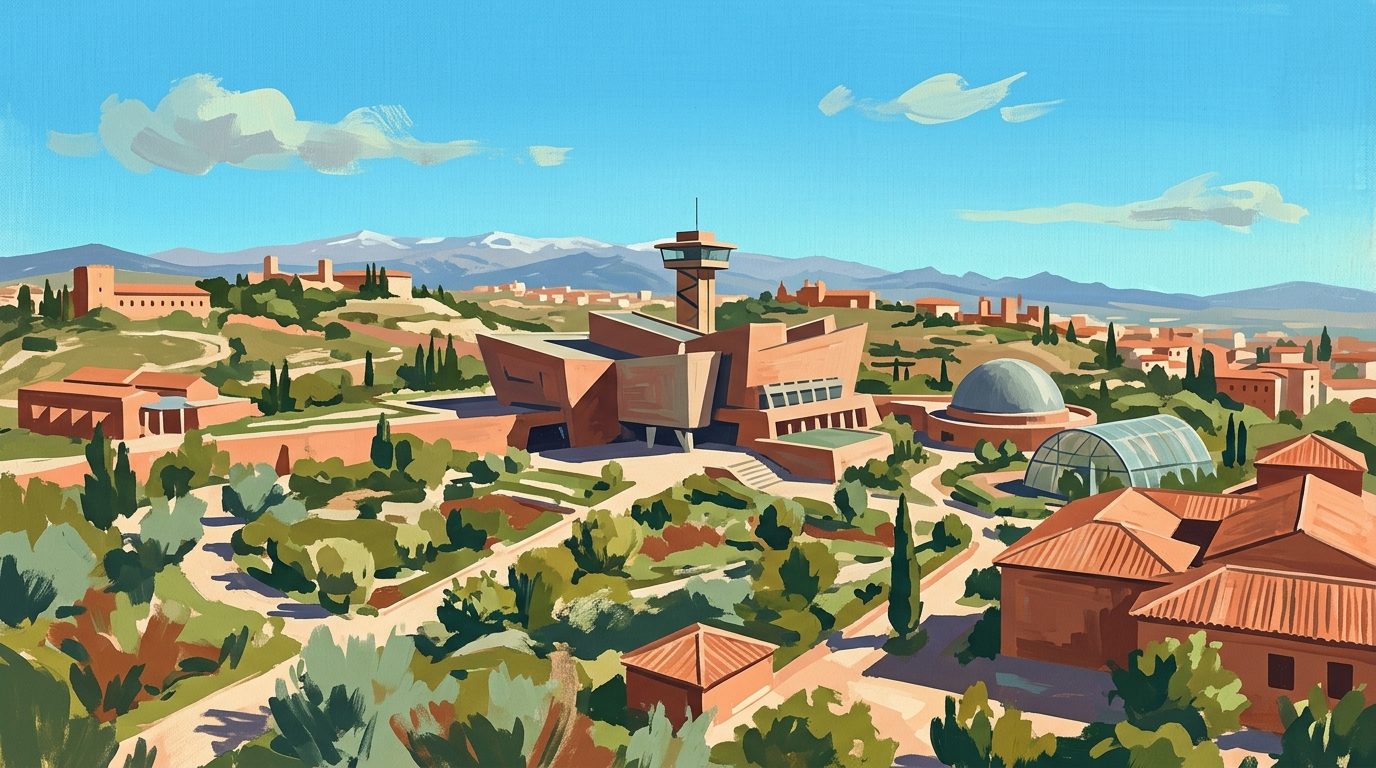
Located just south of Granada’s historic centre, the Parque de las Ciencias is an interactive science museum spanning 70,000 square metres that operates under a simple premise: it is forbidden not to touch. Designed in part by National Architecture Prize winner Carlos Ferrater, the striking Macroscopio building offers a stark contemporary contrast to the ancient Moorish palaces of the city. Opened in 1995 and heavily expanded since, the museum provides an expansive environment where physics, biology, and astronomy are translated into physical experiences. Instead of static display cases, visitors manipulate optical illusions, walk through recreated rainforests, and observe celestial movements. It is an essential counterbalance to a city steeped in antiquity, providing a sharp focus on the natural world and scientific heritage.
The BioDomo and Tropical Environments
The BioDomo functions as a controlled ecosystem dedicated to the biodiversity of Earth. Across three distinct levels, namely subaquatic, terrestrial, and an aerial canopy, the pavilion reconstructs the humid environments of the Amazon, Madagascar, and the Indo-Pacific. The subaquatic section features massive aquariums housing stingrays, sharks, and Indo-Pacific corals. Ascending to the terrestrial and canopy levels, visitors walk alongside freely moving sloths, lemurs, and toucans in a dense mangrove and tropical forest setting. The design prioritises animal welfare and environmental education, deliberately limiting visitor capacity to maintain a calm atmosphere. Nearby, a dedicated Butterfly House sustains a humid climate where multiple tropical butterfly species fly freely, while an outdoor raptor flight workshop demonstrates the hunting mechanics of falcons and eagles.
The Macroscopio Building and Human Biology
The Macroscopio building is the architectural anchor for the core interactive galleries of the museum, instantly recognisable by its angular, sweeping roofline. Inside, the Journey to the Human Body pavilion dissects anatomy and biomechanics through interactive modules that allow visitors to measure their own vital signs, test their sensory perceptions, and explore human evolution. The space also houses the Culture of Prevention pavilion, which uses practical simulations to highlight workplace and everyday safety. Alongside it is the Al-Andalus and Science Pavilion, which examines the technological and scientific legacy of the Moorish period, providing a clever thematic tie to the history of Granada. Temporary exhibitions, often international in scope, occupy the larger halls, covering subjects from robotics to palaeontology.
Astronomy and the Foucault Pendulum
The Foucault Pendulum building serves as the traditional core of the museum, named after the massive swinging weight in its foyer that visually proves the rotation of the Earth. Surrounding the pendulum, the Perception, Eureka, and Biosphere rooms challenge visitors with hands-on physics demonstrations, optical illusions, light experiments, and acoustic mirrors. The building also houses the Explora room, offering younger children a safe, tactile environment to experiment with water, sound, and simple machines. Beyond physics, the park excels in astronomy. The digital Planetarium projects over 7,000 stars and immersive cosmic journeys onto its domed ceiling, with regular sessions tailored for both children and adults. Outside, the Astronomy Garden features tactile astronomical instruments, giant sundials, and interactive models that map solar and lunar trajectories, allowing visitors to study celestial mechanics under the open sky of Andalucía.
Outdoor Gardens and the Observation Tower
The footprint of the museum includes 27,000 square metres of outdoor space that functions as an open-air exhibition. Botanical walks wind past dynamic kinetic sculptures and a plant maze, leading to the 50-metre-high Observation Tower. A lift ascends to the viewing deck, which provides an unmatched topographical perspective of Granada. From this vantage point, the visual relationship between the city, the fertile Vega plain, and the towering snow-capped peaks of the Sierra Nevada becomes immediately apparent. The panoramic views help contextualise the unique geographical basin in which Granada sits.
Accessibility and Practical Advice
The Parque de las Ciencias is explicitly designed as an inclusive space. The entire site, including the BioDomo and the Observation Tower, is accessible to wheelchair users, with wide, flat pathways and ramps connecting the pavilions. Lifts in the Macroscopio building feature Braille and audio cues, while specific tactile modules and sensory backpacks are available for visitors with visual or cognitive impairments.
Given the scale of the site, a visit requires at least four hours, though families can easily spend a full day here. Weekday afternoons or Sunday mornings typically offer a quieter environment. Once you have finished exploring the physical sciences, diving into the cultural legacy covered in our guide to exploring the historic heart of Granada provides a striking contrast. Those interested in the historical engineering of the region will find a guide to the Alhambra and Generalife a logical next step, while our area overview, Beyond the Red Fortress: Navigating the Highs and Lows of Granada, offers excellent background on the topography visible from the observation tower.
Because capacity for the BioDomo and Planetarium is strictly limited, it is best to confirm availability early. To plan a visit and check combined ticket options, consult the Parque de las Ciencias official website.
Nearby worth your time
A few well-placed stops for extending the day without turning it into a checklist.

Continue through Granada City
Step back into the wider landscape with local guides, nearby places and the province overview.
Place guide · 7 min
Playa de Calahonda (Granada) Beach Guide
Playa de Calahonda in Granada offers deep, crystal-clear waters and a dramatic limestone cliff backdrop. This Blue Flag beach is a favourite for snorkelling and authentic Andalucían seafood.
Place guide · 7 min
A Guide to Playa de Salobreña on the Costa Tropical
Playa de Salobreña is a vast stretch of dark sand and clear water on the Costa Tropical, overlooked by a historic Moorish castle and dramatic cliffs.
Itinerary · 10 min
Two Days in Granada: A Step-by-Step Itinerary
Two days in Granada gives you just enough time to explore the Alhambra and lose yourself in the steep alleys of the Albaicín. This itinerary balances major monuments with the city's legendary free tapas culture.