
attraction · Jaén
Paseo de las Murallas de Baeza
Andalucía 365 · Updated 18 July 2026
Our Verdict
“This promenade is not a standalone attraction requiring hours of dedicated time, but it serves as an essential counterpoint to the enclosed civic architecture in the town centre. It provides the necessary geographical context to understand why this settlement held such strategic importance. The walkway is best appreciated as a slow, contemplative stroll, offering a rare moment of visual release.”
Last verified: July 2026
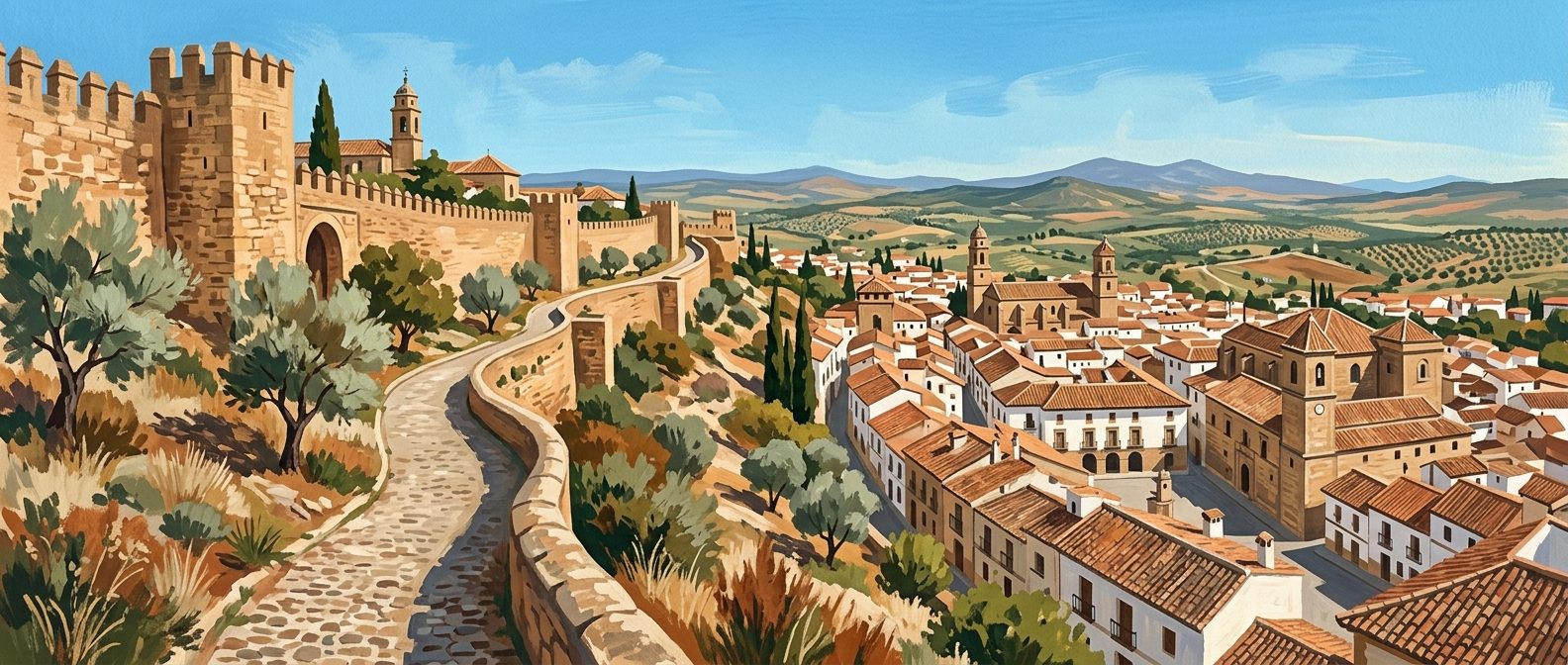
A cool wind sweeping up from the Guadalquivir valley carries the faint scent of crushed olive leaves. Here, at the southern edge of the historic centre, the golden stone of sixteenth-century palaces gives way to a sweeping agricultural horizon. This is the Paseo de las Murallas, a cliff-side promenade following the remnants of ancient defensive walls. It provides a sharp physical boundary between the monumental architecture of Baeza and the vast, rolling landscape that generated the region's wealth.
A Balcony Over the Sea of Olives
Walking this route offers a profound sense of scale and isolation from the main tourist squares. The path sits elevated above a landscape universally known as the "Mar de Olivos", a seemingly endless ocean of silver-green foliage stretching toward the distant mountains. On clear days, the rugged limestone peaks of the Sierra de Cazorla and the rocky outcrops of Sierra Mágina frame the horizon. This natural amphitheatre provides a stark topographical contrast to the rigid, geometric lines of the orchards below. Several paved vantage points are essential for anyone wanting to grasp the sheer agricultural dominance of the province, which forms the absolute core of Andalucía's olive oil route. At the base of the cliffs, you can trace the faint path of the Guadalquivir river as it cuts through the valley floor.
The Footsteps of Antonio Machado
The path is alternatively known as the Paseo de Antonio Machado, honouring the great Spanish poet who taught French grammar here between 1912 and 1919. Arriving shortly after the tragic death of his young wife, Leonor, Machado found essential solace in these quiet, elevated walkways. Away from the heavy academic environment, the poet walked these paths daily to process his grief. A solemn bronze bust of the writer, created by the sculptor Pablo Serrano in 1965 and installed in 1983 inside an open concrete cube designed by architect Fernando Ramón, marks his traditional route. Walking past the monument, visitors can easily appreciate how the silent valley and distant peaks inspired some of his most melancholic and enduring verses. Every February, the town commemorates his legacy during Machado Week with a literary walk that concludes at this spot.
The Surviving Fortifications
Long before it became a peaceful promenade, this cliff edge formed a formidable military barrier. Baeza was once a heavily fortified stronghold, fiercely contested by both Muslim and Christian forces during the prolonged centuries of the Reconquista. The Almohad dynasty constructed extensive defensive walls in the twelfth century, transforming the settlement into a critical garrison town. Much of this complex circuit was deliberately dismantled in 1476 under the strict orders of Queen Isabella I. This strategic demolition was ordered to put an end to the violent, ongoing feuds between rival local noble families, the Carvajales and Benavides, thereby stripping them of their military power and centralising authority under the Crown. Today, the walk reveals how the town integrated directly into the bedrock. The remaining golden sandstone walls act as massive retaining structures for the streets above, illustrating a volatile period when survival depended heavily on commanding high ground.
The Puerta de Úbeda and Albarrana Tower
The most substantial architectural remnant of the old perimeter stands proudly at the eastern end of the promenade. The Puerta de Úbeda was once the most heavily fortified gate in the city, guarding the crucial arterial road to the neighbouring stronghold of Úbeda. Originally featuring three defensive arches, visitors can now inspect the single surviving archway alongside a towering, square albarrana watchtower. The stone facade retains a weathered carved shield of the Catholic Monarchs and a small inset chapel dedicated to the Virgin of the Incarnation. The robust defensive tower houses a modest interpretation centre dedicated to medieval history. To access the panoramic rooftop views from the tower, visitors should consult the official local tourism network to confirm current opening times before arriving.
Terrain, Accessibility and Practical Advice
The Paseo de las Murallas is an open, public walkway accessible freely throughout the day and night. The path features a mixture of smooth, modern paving and slightly uneven historic cobblestones, making flat footwear a sensible choice. The route is largely flat, but those with limited mobility should be aware of occasional uneven patches near the older fortifications. There is very little shade along the exposed southern edge. During the summer months, the afternoon heat radiating upward from the valley floor can be intense, making midday walks uncomfortable. The most visually rewarding conditions invariably arrive in the final hour before sunset. During this time, the fading light turns the distant mountains deep purple, the olive leaves shimmer in the breeze, and the old stone walls cast long shadows.
An Honest Editorial Verdict
This promenade is not a standalone attraction requiring hours of dedicated time, but it serves as an essential counterpoint to the enclosed civic architecture in the town centre. It provides the necessary geographical context to understand why this settlement held such strategic importance. The walkway is best appreciated as a slow, contemplative stroll, offering a rare moment of visual release.
Pairing Your Visit
The walkway naturally connects with the Cathedral quarter, making it an easy addition to a broader exploration of the upper town. After following the defensive walls, head slightly inland through the narrow stone alleys to find the Antigua University. You can visit the carefully preserved classroom where Machado taught his French lessons, bridging the gap between his solitary outdoor reflections and his structured academic life.
Nearby worth your time
A few well-placed stops for extending the day without turning it into a checklist.
Continue through Renaissance Cities
Step back into the wider landscape with local guides, nearby places and the province overview.
Things to do · 12 min
Golf in Jaén Province: A Practical Guide to Courses, Clubs, and Holidays
Discover the reality of playing golf in Jaén. From the 9-hole course at La Garza to local societies and combining rounds with olive oil tourism.
Nature & wildlife · 7 min
Sierra de Cazorla: Spain's Largest Protected Area
Covering over 200,000 hectares of rugged limestone peaks and deep river canyons, the Sierra de Cazorla forms the green heart of the Iberian Peninsula.
Itinerary · 11 min
5 Days in Jaén: Renaissance Cities and Cazorla
A realistic five-day driving itinerary through Jaén province, balancing the monumental Renaissance architecture of Úbeda and Baeza with the rugged mountain wilderness of the Sierra de Cazorla.