
attraction · Granada
Plaza de la Constitución
Andalucía 365 · Updated 18 July 2026
Our Verdict
“Plaza de la Constitución offers a surprisingly formal, classical centrepiece to a city famous for its subterranean dwellings. While much of its Renaissance stonework is a meticulous post-war reconstruction, the shaded arcades and hidden archaeological layers make it an essential, highly accessible starting point for exploring Guadix.”
Last verified: July 2026
A Renaissance Order in a Troglodyte City
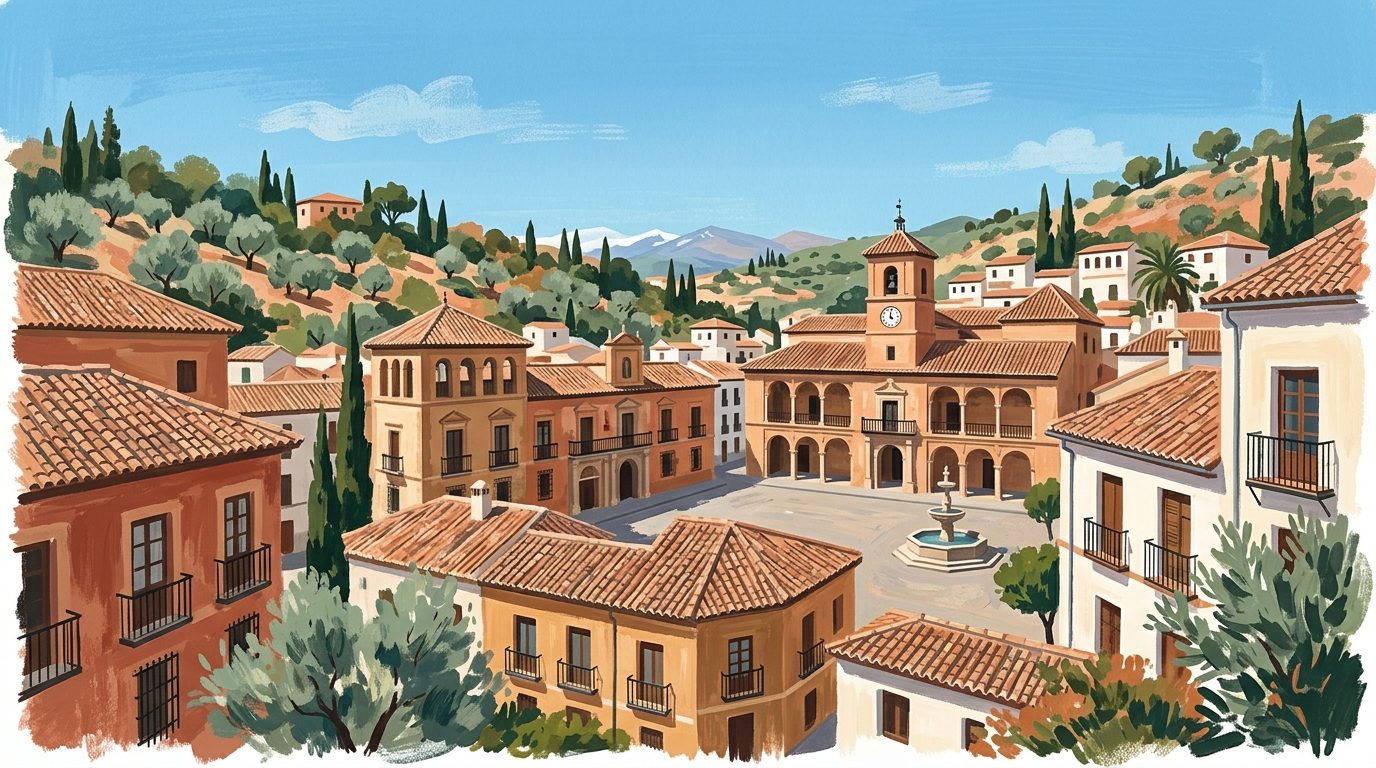
The colonnaded Plaza de la Constitución stands in orderly, geometric contrast to the sprawling clay hills and troglodyte dwellings of the surrounding region. Known locally as Plaza de las Palomas, this rectangular expanse is the historic and social heart of Guadix. Framed by Renaissance arcades supported on smooth columns with Ionic capitals, it feels more like a classical Castilian square than a typical Andalusian plaza. Its construction in the late sixteenth and early seventeenth centuries marked a deliberate urban shift, transforming a former Moorish stronghold into a showcase of imperial Spanish authority. Historians believe the site originally served as the headquarters for the Nasrid ruler El Zagal before the Christian conquest. Today, the warm stone of the square provides a sophisticated urban anchor for travellers exploring the broader, prehistoric landscape of the Marquesado and Guadix. The space is particularly atmospheric in the early evening, when local families gather for the traditional paseo.
The Legacy of the Corregidores and Post-War Reconstruction
The architecture of the plaza is defined by its elegant porticoes, featuring wide segmental arches that provide deep shade during the intense Andalusian summer. While the symmetry of the square appears flawless, the stonework holds deep historical scars. A devastating fire during the Spanish Civil War in 1936 reduced much of the space to rubble. In the 1940s, the national reconstruction agency known as Regiones Devastadas meticulously rebuilt the perimeter, attempting to recapture its sixteenth-century grandeur.
During this restoration, the monumental Balcón de los Corregidores was relocated from its original position on the cathedral side to the opposite side of the square. This double-tiered gallery, originally built for local dignitaries to view public festivities, bullfights and processions, now forms the imposing facade of the Ayuntamiento, or Town Hall. Above its arches, visitors can easily spot the double-headed eagle and imperial crown of Emperor Charles V, carved into the stone as a lasting symbol of royal patronage.
Roman Ruins and Almohad Walls
Not all of the square is a twentieth-century reconstruction. The northern side retains eight original sixteenth-century arches. This specific section houses the local tourist office, which serves as a compact, free archaeological interpretation centre. Stepping inside to collect a map reveals layers of antiquity far older than the Renaissance plaza. Integrated directly into the modern building are the excavated remains of first-century Roman structures from the colony of Acci.
Alongside these Roman foundations sits a preserved section of an Almohad defensive wall, which once enclosed the medieval medina of Wadi-As. This unique juxtaposition allows visitors to trace the physical evolution of the city from a Roman settlement to a Moorish stronghold, ending with the Renaissance civic centre outside the door. The interpretation centre also offers a virtual reality reconstruction of the city's Roman history, helping visitors visualise the scale of the ancient settlement.
A Candid Assessment
Plaza de la Constitución is an unexpectedly formal and harmonious piece of urban planning in a landscape famous for its organic, subterranean architecture. It is compact enough to explore thoroughly in a matter of minutes, yet its shaded arcades and terrace cafes make it a rewarding place to linger over a coffee. The fact that its current appearance relies heavily on mid-twentieth-century reconstruction does not detract from its overall impact. The square successfully preserves the civic scale and historical atmosphere intended by its original Renaissance designers, offering a polished, highly photogenic counterpoint to the rugged badlands beyond the city limits.
Practicalities and Accessibility
The square is an open public space, accessible around the clock and free to enter. Unlike the steep, uneven terrain found in the upper cave districts detailed in our guide to the underground city of Guadix, the plaza is entirely flat and smoothly paved. This level surface, combined with ramped access points to the surrounding pavements, makes it highly accessible for wheelchair users and those with limited mobility.
The square serves as an excellent starting point for any visit, particularly to utilise the resources inside the interpretation centre. Visitors should verify current opening hours for the tourist office, the virtual reality experiences and specific municipal monuments directly via the official Guadix municipal website. For those arriving by car, navigating the narrow streets of the historic core can be difficult. The most practical solution is to use the large, public surface car park located near the adjacent cathedral, which leaves you just a short walk from the plaza.
What to Pair it With
The plaza forms part of a remarkably dense historic triangle. A narrow pedestrian passage leads directly from the square to the Cathedral of the Incarnation. This towering edifice dominates the skyline, blending Gothic proportions with elaborate Renaissance and Baroque design elements. Directly beside the cathedral lie the extensive excavations of a first-century Roman theatre, discovered entirely by accident in 2007 during the construction of a car park.
After absorbing the classical and religious architecture of the city centre, the natural progression is to walk or drive up into the surrounding clay hills to witness the famous troglodyte lifestyle. Travellers looking to extend their subterranean exploration can easily reach the nearby cave house museums and pottery workshops of Purullena, or head further east to discover the remarkably preserved Arab baths detailed in our guide to exploring Baza.
Nearby worth your time
A few well-placed stops for extending the day without turning it into a checklist.
Continue through The Marquesado & Guadix
Step back into the wider landscape with local guides, nearby places and the province overview.
Place guide · 7 min
Playa de Calahonda (Granada) Beach Guide
Playa de Calahonda in Granada offers deep, crystal-clear waters and a dramatic limestone cliff backdrop. This Blue Flag beach is a favourite for snorkelling and authentic Andalucían seafood.
Place guide · 7 min
A Guide to Playa de Salobreña on the Costa Tropical
Playa de Salobreña is a vast stretch of dark sand and clear water on the Costa Tropical, overlooked by a historic Moorish castle and dramatic cliffs.
Itinerary · 10 min
Two Days in Granada: A Step-by-Step Itinerary
Two days in Granada gives you just enough time to explore the Alhambra and lose yourself in the steep alleys of the Albaicín. This itinerary balances major monuments with the city's legendary free tapas culture.