
attraction · Granada
Plaza de Toros de Granada
Andalucía 365 · Updated 18 July 2026
Our Verdict
“An imposing 1928 Neo-Mudéjar arena that remains a functioning piece of Granada’s civic life. While the focus on bullfighting polarises visitors, the architecture and integrated tapas bars provide a genuine look into twentieth-century Spanish traditions, free from the polished veneer of the typical tourist circuit.”
Last verified: July 2026
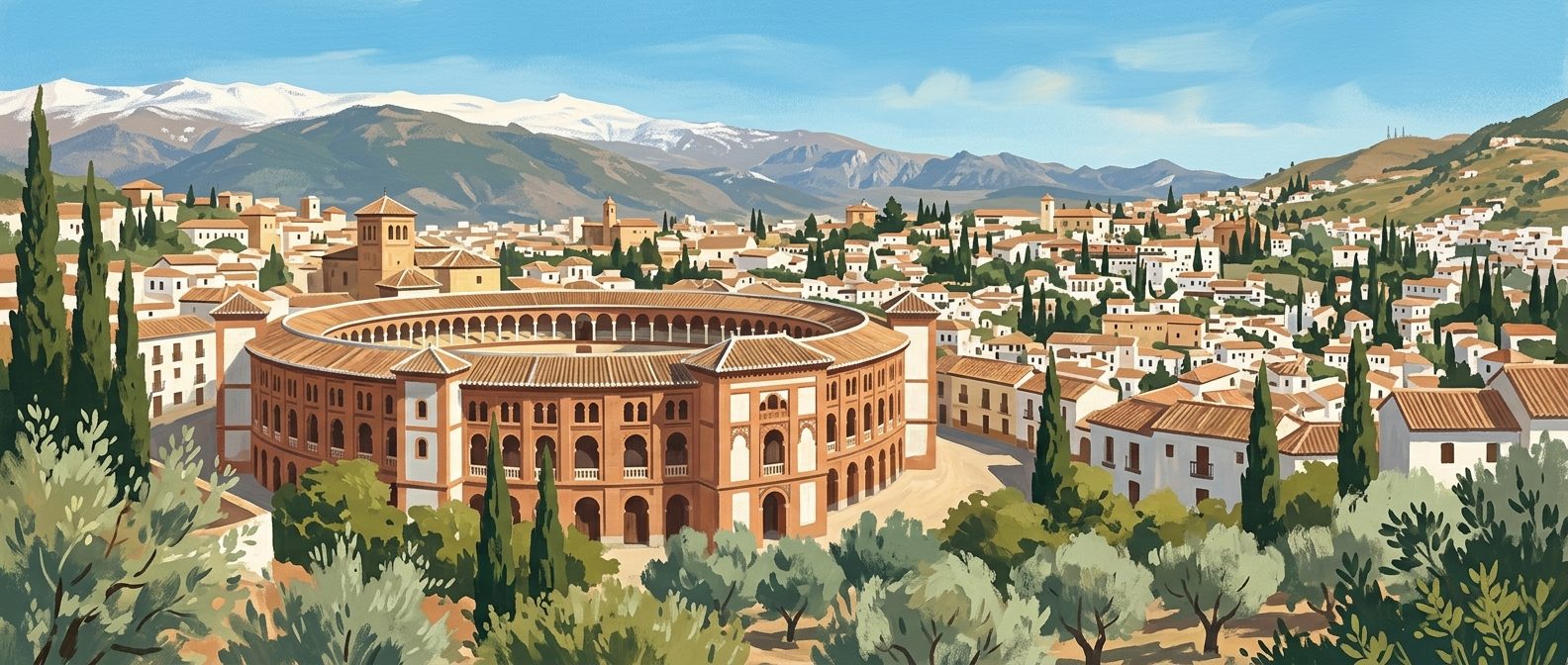
The Plaza de Toros de Granada, often referred to as the Monumental de Frascuelo, commands attention long before you approach its heavy wooden doors. Completed in 1928, the massive structure is wrapped in intricate red brickwork, glazed ceramic tiles, and a rhythmic succession of horseshoe arches. Designed by the architect Ángel Casas Vílchez, it stands as one of the most prominent examples of Neo-Mudéjar architecture in Andalucía, deliberately echoing the region's Islamic past while serving a thoroughly twentieth-century function. Beyond its role as a sporting arena, the building is a designated Cultural Asset and an integral part of Granada’s urban fabric, housing an active museum, behind-the-scenes spaces, and a perimeter of integrated tapas bars.
An Architectural Statement in Brick
To understand the significance of the plaza, visitors must first examine its exterior. In the late nineteenth and early twentieth centuries, the Neo-Mudéjar style swept across Spain, heavily favoured for public entertainment venues. Casas Vílchez employed this aesthetic to give the Granada bullring a distinct, monumental character. The three-storey façade features elaborate brick patterns that create contrasting textures, punctuated by ceramic detailing that catches the intense Andalucían sun. Symmetrical towers flank the main entrances, while the high, narrow windows are framed by Moorish-inspired horseshoe arches. The sheer scale is immediately apparent: the ring was originally designed to accommodate over 14,000 spectators and still holds 12,000 today, making it one of the ten largest in the country. The design goes beyond mere decoration; it is a conscious nod to the city's Moorish heritage, aligning a modern concrete structure with the historic visual language of Granada's palatial citadel, the Alhambra.
Behind the Spectacle: The Interior and Museums
While the arena remains the focal point for bullfighting during the annual Corpus Christi festivities in June, the interior is accessible year-round through guided or self-guided visits. Stepping inside, the vast circular space is dominated by the sweep of the stone seating and the stark, sun-bleached expanse of the sand floor, known as the albero.
The tour route leads visitors away from the public stands and into the operational underbelly of the arena. You can walk through the callejón, the narrow defensive corridor separating the sand from the front-row spectators, providing a visceral sense of the ring's scale. The path continues through the dimly lit stables and holding pens, the small infirmary equipped with vintage medical instruments, and the austere chapel where toreros pause before entering the ring. An internal museum space charts the regional history of the spectacle, displaying elaborate, heavy costumes (trajes de luces), historic promotional posters, and the preserved heads of notable bulls.
The Ring's Outer Life
One of the most defining characteristics of the Plaza de Toros de Granada is its integration into the daily life of the Beiro district. Unlike many historic monuments that empty out after visiting hours, the ground floor of the bullring is heavily occupied. Successive renovations have allowed the outer perimeter of the stadium base to be hollowed out and converted into a continuous ring of traditional pubs, restaurants, and tapas bars. These establishments, which open outwards onto the wide pavements of Avenida del Doctor Olóriz and the surrounding plazas, are heavily frequented by university students, local families, and hospital workers from the nearby medical complexes. They provide a practical, unpretentious setting for lunch or dinner.
A Candid Assessment
The Plaza de Toros is an impressive, slightly imposing architectural monument that polarises visitors due to the nature of its primary function. For those deeply opposed to bullfighting, the presence of the museum and the focus on the mechanics of the spectacle may be off-putting. However, for those interested in historical civic architecture, twentieth-century Spanish social history, or the Neo-Mudéjar movement, the site provides a highly detailed, well-preserved environment. It is an honest, working building that avoids the polished veneer found in heavily touristed historic centres, offering a stark contrast to the medieval streets of the Albaicín.
Practicalities for Visiting
The arena is located in the Beiro neighbourhood, north of the historic heart of Granada. It is a straightforward 20-minute walk from the cathedral. For those using public transport, the Granada Metro stops nearby at the Estación Ferrocarril and Caleta stations, both within a ten-minute walk. Several local bus lines, including the 4 and 33, serve the immediate area with stops along Avenida del Doctor Olóriz and nearby avenues.
Tours operate regularly, though access to certain areas is restricted on days when events, concerts, or bullfights are scheduled. The arena floor is fully exposed to the elements, so morning visits are recommended during the summer months to avoid the midday heat. The stone steps in the stands are steep and uneven, meaning comfortable, flat footwear is highly recommended. Wheelchair users can access the ground-level museum, chapel, and portions of the outer corridor, but the upper tiers and certain operational rooms are reached only by stairs. Visitors should verify current tour availability and access conditions directly on the official Plaza de Toros website.
Sensible Nearby Pairing
After exploring the bullring and perhaps stopping for a drink at one of its built-in bars, visitors can head south towards the centre of the city. Alternatively, for a different perspective on Granada's diverse neighbourhoods, a short taxi ride or a steady walk uphill leads to the cave dwellings of Sacromonte. This provides an immediate shift from the structured, formal grandeur of the 1920s arena to the organic, subterranean homes that have defined the city's eastern hills for centuries.
Nearby worth your time
A few well-placed stops for extending the day without turning it into a checklist.
Continue through Granada City
Step back into the wider landscape with local guides, nearby places and the province overview.
Place guide · 7 min
Playa de Calahonda (Granada) Beach Guide
Playa de Calahonda in Granada offers deep, crystal-clear waters and a dramatic limestone cliff backdrop. This Blue Flag beach is a favourite for snorkelling and authentic Andalucían seafood.
Place guide · 7 min
A Guide to Playa de Salobreña on the Costa Tropical
Playa de Salobreña is a vast stretch of dark sand and clear water on the Costa Tropical, overlooked by a historic Moorish castle and dramatic cliffs.
Itinerary · 10 min
Two Days in Granada: A Step-by-Step Itinerary
Two days in Granada gives you just enough time to explore the Alhambra and lose yourself in the steep alleys of the Albaicín. This itinerary balances major monuments with the city's legendary free tapas culture.