
attraction · Granada
Puerta de la Justicia
Andalucía 365 · Updated 18 July 2026
Our Verdict
“Serving as the monumental front door to the Alhambra, the Puerta de la Justicia offers an immediate immersion into Nasrid military engineering. It is free to walk through, making it a highly rewarding prelude to the main palatial complex and a stark physical record of Granada’s complex religious transition.”
Last verified: July 2026
Architectural Authority and Islamic Symbolism
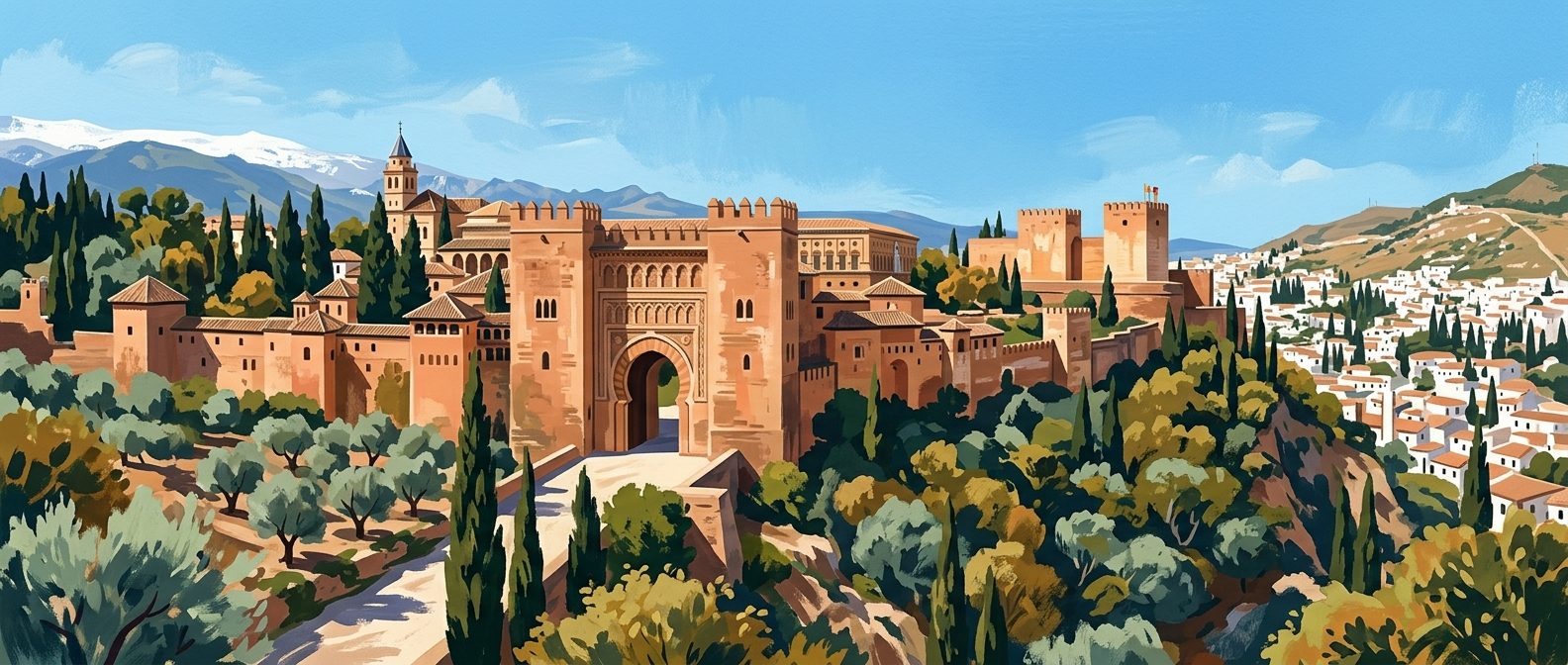
The Puerta de la Justicia, or Gate of Justice, serves as the most imposing entrance to the Alhambra fortress in Granada. Constructed in 1348 during the reign of Sultan Yusuf I, this monumental structure is a profound architectural statement of Nasrid power and religious identity. It offers an immediate transition from the modern streets into the medieval world of Al-Andalus. The gate was historically known as the Bab al-Sharia, or Gate of the Esplanade, referring to the wide open space before it where citizens gathered for civic events and where informal justice was dispensed.
Before stepping inside, you are confronted by a vast horseshoe arch framed by an elegant alfiz. Look closely at the keystone of this exterior arch to see a carved hand, representing the five precepts of Islamic law and signifying divine protection. On the keystone of the inner arch, a carved key symbolises faith and the authority to grant justice. Together, these symbolic elements established the theological supremacy of the Nasrid rulers to anyone approaching the palatine city. Recent restoration efforts have revealed traces of original ceramic panels, which featured striking emerald greens and deep blues against a white background, adding visual brilliance to the defensive architecture.
The Layering of Faiths
The gate stands as a physical record of the city's complex religious transition. Following the conquest of Granada in 1492 by the Catholic Monarchs, Christian symbols were immediately integrated into the existing Islamic framework. Above the inner arch, positioned deliberately over the original Arabic foundation inscription carved in white Macael marble, sits a Gothic statue of the Virgin and Child. Commissioned by Ferdinand and Isabella and sculpted by Roberto Alemán, this addition was an assertion of Christian dominance over the conquered Nasrid kingdom, contrasting with the severe geometry of the Moorish stonework below.
Inside the passage, a small chapel was constructed to commemorate the first Catholic mass held on the site after the city fell on the second of January, 1492. An altarpiece dedicated to Nuestra Señora de la Antigua, crafted by Diego Navas 'el joven' in 1588, remains visible on the interior walls. This deliberate juxtaposition of a Catholic altar within a Nasrid defensive tower illustrates the layered history of Granada, where contrasting faiths claimed the exact same monumental spaces to project their temporal authority.
Nasrid Military Engineering
Beyond its immense symbolic weight, the Puerta de la Justicia demonstrates the highly sophisticated defensive tactics employed during the fourteenth century. The interior passage features a sharp double turn, creating a classic bent entrance layout. This architectural configuration was an effective military deterrent, specifically engineered to prevent enemy cavalry from mounting a direct charge through the portal. Intruders managing to breach the first heavy doors would find themselves trapped in a confined, shadowed space, unable to swing their weapons effectively and vulnerable to defenders stationed on the vaulted levels above.
As you walk through the dimly lit passage, notice the massive original wooden doors, which remain heavily reinforced with iron plates and have stood firm for centuries. Look up at the soaring vaulted ceilings above. The transition from a purely functional military space to a decorative royal precinct is evident in the painted finishes that simulate red brickwork across the upper vaults. Spending a few minutes inside allows you to appreciate the remarkably thick stone walls, providing instant relief from the intense Andalucían heat during summer.
Practical Advice for Visitors
As one of the few monumental sections of the Alhambra that remains fully accessible without a paid ticket for the main palaces, the gate provides a spectacular introduction to the scale of the site before you reach the ticketed enclosures. It operates today as a highly practical entry point into the wider monumental complex.
The most atmospheric way to reach the gate is on foot. Starting from Plaza Nueva in the historic heart of Granada, you can walk up the steep, wooded incline of the Cuesta de Gomérez. This route takes roughly fifteen to twenty minutes under a dense canopy of mature trees. Alternatively, local red minibuses stop immediately outside the gate, saving you the uphill climb.
Inside the gate and on the slopes leading up to it, the original stone paving is notoriously uneven and polished completely smooth by centuries of foot traffic. Wear sturdy footwear with excellent grip, especially if it has been raining, as the incline becomes treacherous when wet. If you already hold digital tickets, use this gate as your primary entry point, as it leads directly to the core of the monument. For heritage maps and estate guidelines, consult the official Alhambra website before travelling.
What to Pair it With
Passing through the Puerta de la Justicia naturally deposits you into the heart of the citadel. From the exit, it is a very short walk to the expansive Plaza de los Aljibes. This square serves as the perfect starting point to embark on a guide to the Alhambra and Generalife, allowing you to explore the intricate Nasrid Palaces, the imposing military ramparts of the Alcazaba fortress, and the circular Renaissance courtyard of the Palace of Charles V.
If you are exploring the cityscape rather than the palaces, the gate offers a direct, scenic walking route down into the lower city. A short journey across the Darro valley brings you to the steep, winding streets of the opposing hill, perfect for exploring the Albaicín. Alternatively, taking the varied paths downward allows you to experience the highs and lows of Granada, moving seamlessly from the elevated medieval fortress to the traditional tapas bars and narrow merchant alleys that define the modern city below.
Nearby worth your time
A few well-placed stops for extending the day without turning it into a checklist.



Continue through Granada City
Step back into the wider landscape with local guides, nearby places and the province overview.
Place guide · 7 min
Playa de Calahonda (Granada) Beach Guide
Playa de Calahonda in Granada offers deep, crystal-clear waters and a dramatic limestone cliff backdrop. This Blue Flag beach is a favourite for snorkelling and authentic Andalucían seafood.
Place guide · 7 min
A Guide to Playa de Salobreña on the Costa Tropical
Playa de Salobreña is a vast stretch of dark sand and clear water on the Costa Tropical, overlooked by a historic Moorish castle and dramatic cliffs.
Itinerary · 10 min
Two Days in Granada: A Step-by-Step Itinerary
Two days in Granada gives you just enough time to explore the Alhambra and lose yourself in the steep alleys of the Albaicín. This itinerary balances major monuments with the city's legendary free tapas culture.