
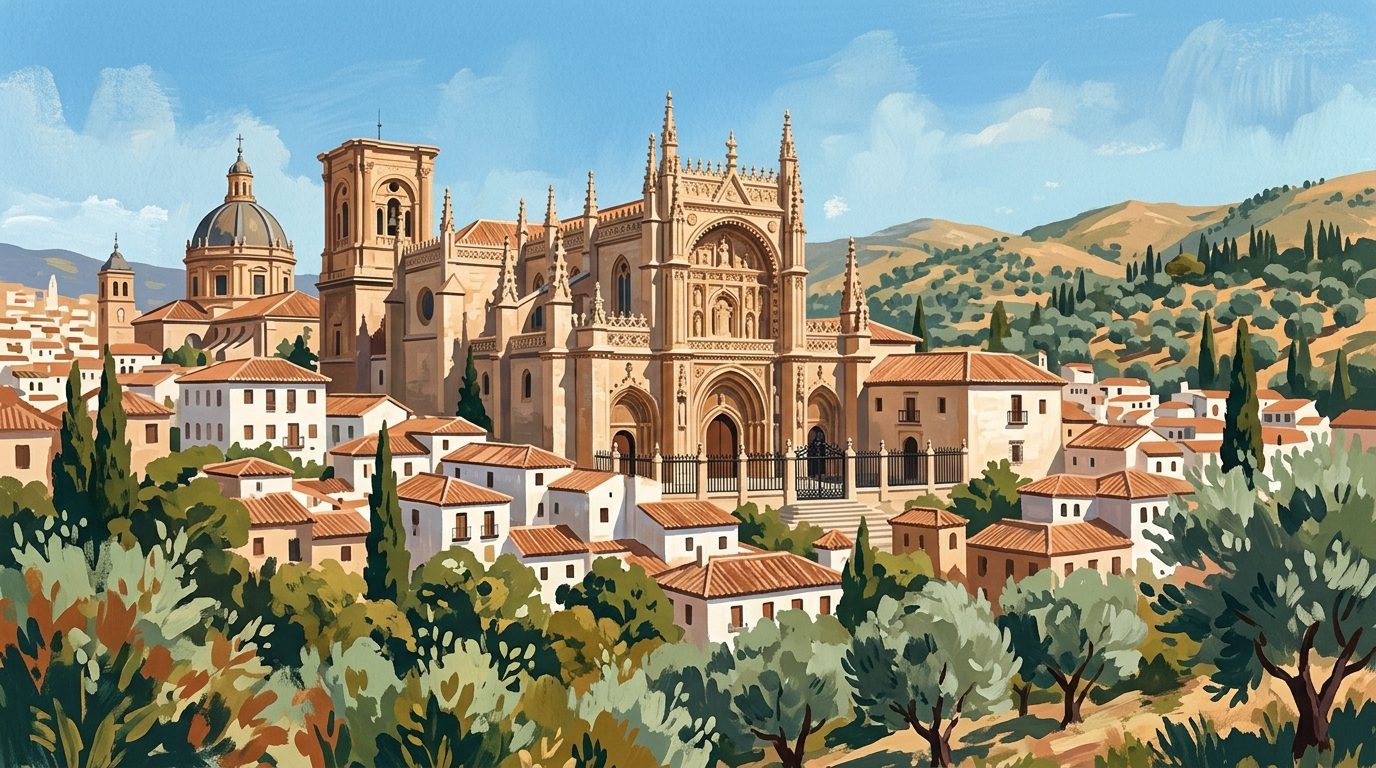
attraction · Granada
Royal Chapel of Granada
Andalucía 365 · Updated 18 July 2026
Our Verdict
“The Capilla Real is a solemn, highly structured monument essential for anyone interested in the legacy of the Catholic Monarchs. While the strict no-photography rule and sombre atmosphere can feel rigid, the magnificent marble tombs and the astonishing collection of Flemish paintings reward careful observation.”
Last verified: July 2026
Five unadorned lead coffins rest on plain stone shelves in a small, austere crypt deep beneath the soaring Isabelline Gothic vaults of the Capilla Real. This stark reality contrasts sharply with the monumental grandeur above, setting the tone for one of the most historically significant sites in Andalucía. Commissioned by a 1504 Royal Warrant shortly after the conquest of Granada, the Chapel serves as the final resting place for the Catholic Monarchs, Isabella I of Castile and Ferdinand II of Aragon. Their marriage unified Spain and paved the way for the modern Spanish state. For curious independent travellers, this chapel provides a profound, tangible connection to the rulers who shaped European history and sponsored the voyages of Christopher Columbus.
The Royal Tombs and the Crypt
The focal point of the chapel nave is the pair of magnificent marble monuments dominating the space before the altar. The larger tomb, crafted by Florentine sculptor Domenico Fancelli and finished in 1517, depicts Isabella and Ferdinand resting side by side. Fancelli carved the monarchs with solemn dignity, depicting the King in military armour and the Queen in simple dress, surrounded by reliefs of apostles and heraldic shields. Adjacent rests a second, slightly higher monument carved by Bartolomé Ordóñez. This tomb holds the remains of their daughter, Joanna the Mad, and her husband, Philip the Handsome, and features the four Doctors of the Church at its corners.
While these ornate monuments celebrate the worldly power of the royal family, the actual burial site tells a different story. Visitors can descend a short, narrow staircase into a small crypt directly beneath the marble structures. Here, five simple lead coffins sit in plain view, marked only by the initials of the deceased. This includes a smaller coffin belonging to Michael, the young grandson of the monarchs. The contrast between the glory of the marble monuments and the humble reality of death remains highly evocative.
The Masterful Grille and Main Altarpiece
Separating the public nave from the royal burial sanctuary is a towering wrought-iron screen, known as a reja, created by Master Bartolomé in the early sixteenth century. This Plateresque masterpiece is widely considered one of the finest examples of decorative metalwork from the Spanish Renaissance. The intricate gilded ironwork features floral motifs, biblical figures, and the prominent coats of arms of the Catholic Monarchs.
Beyond the grille sits the Retablo Mayor, the main altarpiece carved by Felipe Vigarny between 1520 and 1522. This towering wooden structure incorporates powerful political narratives alongside traditional religious iconography. The lower panels feature highly detailed, polychrome wooden reliefs depicting the final surrender of the Moorish kingdom of Granada. Viewers can identify King Boabdil handing over the keys to the city, providing a rare contemporary visual record of the concluding moment of the Reconquista. Beside it sits a panel depicting the baptism of Morisco women. The upper tiers display detailed scenes from the lives of Christ, Saint John the Baptist, and Saint John the Evangelist.
The Sacristy Museum and Royal Legacy
The adjoining sacristy houses an extraordinary collection of personal items and artwork, offering a glimpse into the private devotions of Queen Isabella. As a dedicated patron of the arts, the Queen amassed a significant collection of Flemish Primitives. The intimate Sacristy Museum displays masterpieces by Rogier van der Weyden, Hans Memling, and Dieric Bouts, alongside Italian works including pieces by Sandro Botticelli and Pietro Perugino. The close proximity to the paintings allows visitors to appreciate the astonishing detail and luminous oil techniques of the fifteenth-century masters.
In addition to fine art, the museum displays several deeply personal artefacts. Visitors can view Queen Isabella's silver and gold crown and her beautifully crafted sceptre. King Ferdinand is represented by his ceremonial sword, forged in an Italian workshop and featuring an ornate hilt. The collection also includes illuminated missals and intricately embroidered liturgical vestments.
A Candid Assessment and Practical Advice
The Capilla Real offers a dense, highly structured historical experience. It is an essential visit for those fascinated by European history, Renaissance art, and the complex narrative of the Spanish empire. However, the strict atmosphere can be demanding. The chapel operates as a place of active worship and requires respectful dress, meaning shoulders and knees must be covered.
Photography and video recording are strictly prohibited throughout the complex to protect the delicate artworks and maintain solemnity. Staff enforce this rigorously. To make the most of the dense artistic and historical symbolism, visitors should utilise the audio guide, which unpacks the complex iconography of the altarpiece and the Flemish paintings. For the most accurate details regarding entry requirements, current policies, and admission fees, visitors must consult the official Capilla Real website.
Accessibility and Terrain
The main nave, the Sacristy Museum, and the area housing the marble tombs are situated on a single level and are accessible to wheelchair users. The flooring consists of original stone slabs, which can be slightly uneven in certain places, requiring a degree of caution. However, accessing the subterranean crypt involves descending a narrow, relatively steep flight of stone stairs, making this specific historical feature inaccessible to visitors with significant mobility restrictions.
What to See Nearby
The chapel sits directly in the historic heart of Granada. It is physically attached to the immense Renaissance structure of the Granada Cathedral, although they function as separate entities requiring independent tickets. Opposite the chapel entrance stands the Madraza, the beautifully restored remains of a fourteenth-century Moorish university. A short walk away lies the Alcaicería, a network of narrow streets that once served as the great Moorish silk market. To understand the shifting powers that defined the city, pair your visit with a trip to the Alhambra and an afternoon exploring the steep streets of the Albaicín.
Nearby worth your time
A few well-placed stops for extending the day without turning it into a checklist.

Continue through Granada City
Step back into the wider landscape with local guides, nearby places and the province overview.
Place guide · 7 min
Playa de Calahonda (Granada) Beach Guide
Playa de Calahonda in Granada offers deep, crystal-clear waters and a dramatic limestone cliff backdrop. This Blue Flag beach is a favourite for snorkelling and authentic Andalucían seafood.
Place guide · 7 min
A Guide to Playa de Salobreña on the Costa Tropical
Playa de Salobreña is a vast stretch of dark sand and clear water on the Costa Tropical, overlooked by a historic Moorish castle and dramatic cliffs.
Itinerary · 10 min
Two Days in Granada: A Step-by-Step Itinerary
Two days in Granada gives you just enough time to explore the Alhambra and lose yourself in the steep alleys of the Albaicín. This itinerary balances major monuments with the city's legendary free tapas culture.