
attraction · Córdoba
Alcázar de los Reyes Cristianos
Andalucía 365 · Updated 18 July 2026
Our Verdict
“While its austere interior lacks the ornate Moorish detailing of its regional counterparts, this formidable fortress compensates with monumental defensive architecture, museum-quality Roman mosaics, and expansive, water-fed terraced gardens. It is an essential stop for understanding the shifting political power and deep historical layers of the city.”
Last verified: July 2026
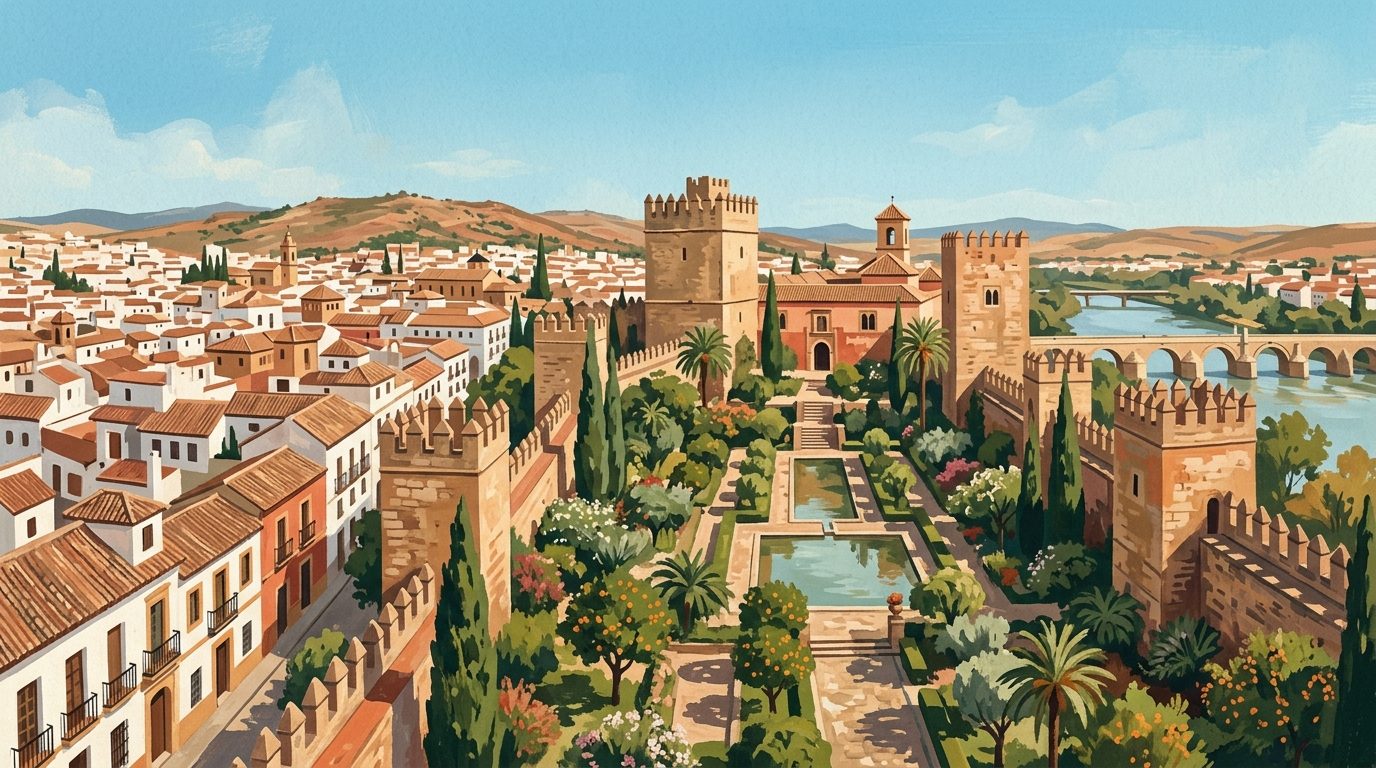
Behind imposing honey-coloured stone walls on the banks of the Guadalquivir river, the Alcázar de los Reyes Cristianos presents a stark military facade that conceals an expanse of precise, water-fed gardens. Built over extensive Roman and Visigothic ruins, the current structure was ordered by King Alfonso XI in 1328. It is a building defined by its immense political weight. For eight pivotal years, Isabella I of Castile and Ferdinand II of Aragon made this fortress their primary residence, directing the final stages of the Reconquista from its halls. It was also within these walls that Christopher Columbus presented his plans for a westward voyage to the Indies, altering the course of global history.
A Fortress of Shifting Power
The Alcázar acts as a physical timeline of Cordoban history, recording seismic shifts in religious and political authority across Andalucía. The site transitioned from a Roman customs house to a Caliphal palace before being rebuilt as a Christian stronghold. Following the fall of Granada in 1492, the Catholic Monarchs departed, and the fortress entered a darker period.
For over three centuries, it served as the regional headquarters for the Spanish Inquisition. The tribunal operated from the fortress, using underground holding cells for prisoners. Following the abolition of the Inquisition, the complex found use in the nineteenth and early twentieth centuries as a civil prison and a military garrison. Today, the estate is a prominent fixture in Córdoba, offering a monumental contrast to the dense streets of the surrounding old town.
Defensive Towers and Roman Mosaics
The architectural footprint is heavily defensive, characterised by thick masonry walls and four distinct corner towers. Visitors typically enter near the Torre de los Leones (Tower of the Lions), the oldest of the towers, notable for its intricate Gothic vaulted ceilings. The imposing Torre del Homenaje (Homage Tower) dominates the exterior skyline, while the Torre de la Inquisición and the rebuilt Torre de la Paloma complete the square layout. Climbing the stone steps to the battlements provides an exceptional vantage point, laying out clear sightlines to the Roman Bridge and Calahorra Tower.
Inside, the rooms are largely austere, with one spectacular exception: the Salón de los Mosaicos (Hall of Mosaics). This grand vaulted space, once used as an Inquisition chapel, now displays a remarkable collection of Roman floor mosaics. Discovered beneath the Plaza de la Corredera in the 1950s, these geometric and figurative designs date back to the second and third centuries AD and are exceptionally preserved. Displayed alongside them is a detailed third-century Roman marble sarcophagus, reinforcing the deep archaeological layers on which the medieval fortress rests.
The Mudéjar-Inspired Terraced Gardens
The exterior spaces occupy a vast portion of the grounds and are arguably the estate's most memorable element. Spread across three terraces, the gardens draw heavy inspiration from Mudéjar landscaping, historically relying on a hydraulic system that drew water from the river using large wooden wheels.
Tranquil reflection pools form the spine of the upper and middle terraces, flanked by rhythmic fountains, manicured hedges, and slender cypress trees. Citrus groves provide welcome shade, filling the air with the scent of orange blossom during spring. Walking along the Paseo de los Reyes (Walk of the Kings), visitors encounter stone statues depicting the monarchs associated with the fortress. At the far end of the lower gardens, a large monument immortalises the meeting between Isabella, Ferdinand, and Columbus.
A Candid Assessment
If you expect the delicate stucco work of the Alhambra or the Alcázar of Seville, the interior of the Córdoba Alcázar may feel bare. The original Moorish palace was largely destroyed during the Christian conquest, and subsequent centuries of use as an Inquisition tribunal and a civil prison effectively stripped the inner halls of royal finery.
However, the military architecture is immensely well-preserved, the Roman mosaics are undeniably museum-quality, and the water gardens are spectacular in their scale and precision. The site heavily rewards visitors who appreciate monumental defensive structures and botanical landscapes rather than intimate decorative arts. It is an essential stop for anyone wanting to grasp the sheer defensive scale of medieval Andalucía.
Practicalities and Accessibility
Reaching the fortress is straightforward, sitting prominently on the southern edge of the historic centre beside the river. The complex frequently reaches visitor capacity during spring weekends and public holidays. Visitors can find authoritative information via the official Alcázar de los Reyes Cristianos portal.
Accessibility is mixed due to the nature of the historic military architecture. While the Hall of Mosaics and the broad pathways of the gardens can be navigated by wheelchair users, the wider terrain includes uneven gravel tracks and occasional stone steps. The corner towers and the upper defensive ramparts are inaccessible to those with limited mobility, requiring visitors to navigate steep, narrow stone staircases. Bring drinking water during the summer months, as the extensive gardens offer little refuge from the intense midday heat.
Sensible Pairings
A visit naturally complements a morning spent exploring the Mezquita-Cathedral of Córdoba, located just a short walk away along the riverfront. Directly adjacent to the fortress walls, the Caballerizas Reales (Royal Stables) offer an excellent follow-up activity. Founded by Philip II, this historic complex is where the famous Andalusian horse breed was formally established. From here, it is a brief stroll into the whitewashed alleyways of the Judería for a traditional lunch or an evening of local wine and tapas.
Nearby worth your time
A few well-placed stops for extending the day without turning it into a checklist.
Continue through Córdoba City
Step back into the wider landscape with local guides, nearby places and the province overview.
Things to do · 10 min
Golf in Córdoba Province: Courses, Holidays, and Shops
Discover practical tips, course details, and holiday planning advice for playing golf in Córdoba province, from the mountain fairways of Sierra Morena to the historic greens of Los Pedroches.
Feature · 8 min
The Caliphate of Córdoba
In 929, Abd al-Rahman III declared himself Caliph, breaking religious ties with the Middle East and launching an era of unparalleled architectural and intellectual achievement.
Itinerary · 9 min
A Weekend in Cordoba: Two Days in Andalucía's Caliphate City
Spend 48 hours in Cordoba exploring the mesmerising Mezquita, getting lost in the whitewashed streets of the Judería, and eating excellent salmorejo.