
attraction · Almería
Cathedral Encarnación de Almería
Andalucía 365 · Updated 18 July 2026
Our Verdict
“The Cathedral of Almería trades the ornate splendour of typical Spanish religious monuments for muscular, pragmatic architecture. While the dimly lit interior is relatively modest, the structure is a fascinating reflection of 16th-century geopolitical conflict. It rewards visitors who appreciate the severe beauty of military engineering over traditional ecclesiastical art.”
Last verified: July 2026
A Fortress Wrought in Stone
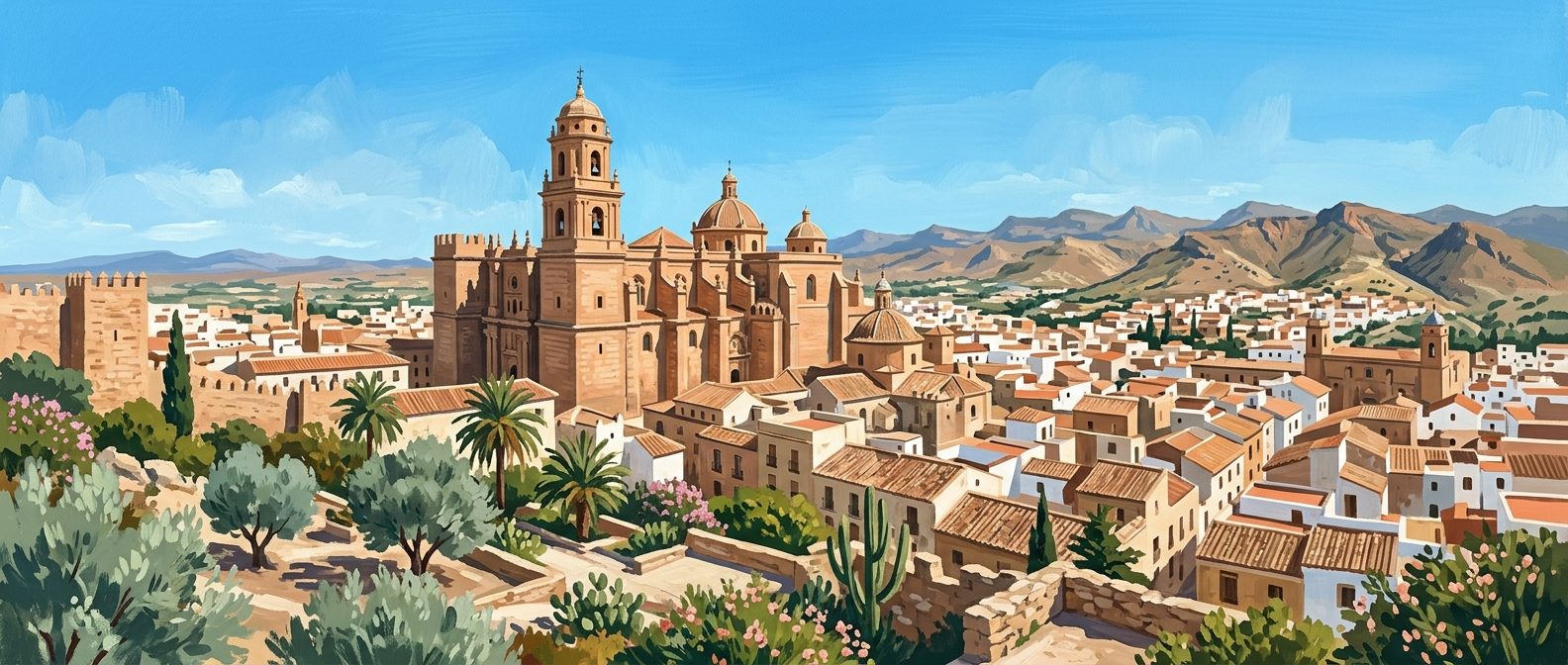
The Cathedral of Almería, officially the Catedral de la Encarnación, rises from the historic centre not with soaring spires, but with sheer, windowless walls of ochre limestone. Thick buttresses and crenellated battlements crown the roofline, while sturdy circular towers stand at the corners. This is an ecclesiastical building unequivocally designed for warfare. Following a devastating earthquake in 1522 that flattened the original coastal church, which had been constructed on the site of the city's former Great Mosque, Bishop Fray Diego Fernández de Villalán commissioned a replacement that could double as a military refuge. Barbary pirate raids from North Africa, led by corsairs who frequently scoured the coast for loot and captives, were a persistent threat along this stretch of the Mediterranean. This geopolitical reality dictated a design that prioritised survival over orthodox religious grandeur. Initiated in 1524, the structure merges the robust mass of a coastal citadel with a functioning place of worship, remaining the only true fortress-cathedral built during the 16th century in Spain.
Reading the Defensive Exterior
Walking around the perimeter reveals the distinct military logic of the original architect Diego de Siloé, whose initial plans were later executed and modified by Juan de Orea. The lower walls are entirely devoid of large stained-glass windows, a deliberate omission to prevent structural weakness against artillery fire and to eliminate easy entry points for attackers. Instead of a traditional pitched roof, the cathedral features a flat roof designed specifically to mount cannons to repel Moorish and corsair invaders, whilst the thick towers provided strategic vantage points for armed guards.
On the eastern wall facing Calle del Cubo, visitors will find the Sol de Portocarrero. This stone carving of a human-faced sun surrounded by ribbons was originally commissioned as an emblem for a side chapel by Bishop Villalán, though it later took the name of a subsequent bishop. It has since been widely adopted as the official symbol of the province and city of Almería. On the northern facade, a beautifully detailed Renaissance portal provides a stark, refined contrast to the severe military stonework that surrounds it. This main entrance features the prominent coats of arms of both Emperor Charles V and Bishop Villalán, perfectly summarising the juxtaposition of defensive necessity, royal patronage, and artistic ambition that defines the external character of the building.
The Artistic Interior
Stepping inside the cathedral reveals a surprising transition. The austere, heavy exterior gives way to a delicate, well-proportioned space structured as a hall church, where the three naves reach the same height. The vaulted ceilings feature intricate, interlocking Late Gothic ribbed tracery, while the supporting columns employ classical Renaissance forms, illustrating the transitional period during which the cathedral was constructed.
The artistic focal point is the Sillería del Coro, or choir stalls, carved from rich walnut between 1558 and 1561 by Juan de Orea. These intricate seats display a masterful grasp of early Renaissance sculpture, featuring highly detailed reliefs of saints, prophets, and martyrs. Above the stalls sit two imposing Baroque organs that contribute to the grandeur of the central nave. Behind the High Altar, the Capilla del Santo Cristo de la Escucha houses the imposing alabaster tomb of the cathedral's founder, Bishop Villalán. Visitors should also explore the Neoclassical cloister, designed in the late 18th century by Juan Antonio Munar and completed in 1795. Originally intended as a military parade ground, the space was transformed into an elegant quadrangle framed by Ionic columns, introducing a serene, light-filled courtyard of palm trees to the otherwise heavy stone complex.
A Candid Assessment
The Cathedral of Almería lacks the overwhelming ornate splendour of its counterparts in Granada or Seville. Its appeal lies instead in its muscular, pragmatic architecture. The interior is relatively modest, and the lighting can be quite dim due to the deliberate absence of large windows. However, for those interested in the intersection of military history and religious architecture, it is a fascinating, highly specific structure. It immensely rewards visitors who take the time to understand the geopolitical threats and maritime raids that shaped its very foundations.
Practicalities and Accessibility
The cathedral sits in a pedestrianised square lined with tall palm trees, providing a clear, unimpeded view of its fortress-like dimensions. The surrounding streets of the old quarter are narrow and often closed to general traffic, so arriving on foot is the most sensible approach. If driving into the city centre, use the underground public car parks located at Plaza Marín or Calle Real, both of which are just a short walk away.
The layout is largely on a single level, making the main naves, choir, and chapels easily accessible to wheelchair users, though visitors should watch for stone anti-parking bollards in the exterior Plaza de la Catedral. Audio guides are typically provided with entry and offer crucial historical context for the unique architectural choices. Because this remains an active seat of the Diocese of Almería, liturgical services may temporarily restrict tourist access to certain areas. For current entry fees, guided tour availability, and live opening times, always consult the official Cathedral of Almería website.
Who It Suits and Nearby Pairings
This monument appeals directly to architecture enthusiasts, military history buffs, and cultural explorers looking for a unique response in Andalucía to Mediterranean conflict. It is less suited to visitors expecting traditional, highly decorative ecclesiastical art or soaring, light-filled Gothic aisles.
To fully grasp the historical defensive network of the city, pair a morning at the cathedral with an afternoon exploring the Moorish stronghold on the hill above. A short walk through the old quarter leads to the monumental complex detailed in our guide to the Alcazaba de Almería. The surrounding streets also feature some of the best traditional tapas bars, as noted in our comprehensive overview of Almería City. For a broader exploration of the immediate area, you can follow our dedicated guide to Almería Cathedral and the Historic City Centre.
Nearby worth your time
A few well-placed stops for extending the day without turning it into a checklist.
Continue through Almería City
Step back into the wider landscape with local guides, nearby places and the province overview.
Place guide · 8 min
A Local Guide to Playa de Mojácar: Sands, Spirits and Almerían Soul
Experience the diverse 17-kilometre coastline of Mojácar Playa, where volcanic sands meet clear waters and lively chiringuitos offer the perfect Almerían escape.
Place guide · 7 min
Playa de los Genoveses: A Guide to the Wild Heart of Cabo de Gata
Experience the untouched beauty of Playa de los Genoveses, a vast volcanic bay in Almería where golden sands meet shallow turquoise waters in a protected natural park.
Itinerary · 13 min
5 Days in Almería: City, Desert and Cabo de Gata
A realistic five-day driving itinerary through Almería province, balancing the historic capital, the cinematic Tabernas badlands, and the protected volcanic shores of Cabo de Gata.