
attraction · Córdoba
Córdoba Synagogue
Andalucía 365 · Updated 18 July 2026
Budget
Our Verdict
“This 14th-century prayer hall offers a rare, intimate look at Sephardic heritage in Andalucía. While the visit is brief, the intricate Mudéjar stucco work and Hebrew calligraphy are exceptional. It is an essential stop for anyone exploring Córdoba, providing a quiet counterpoint to the monumental scale of the nearby Mosque-Cathedral.”
Last verified: July 2026
A Sanctuary in Miniature
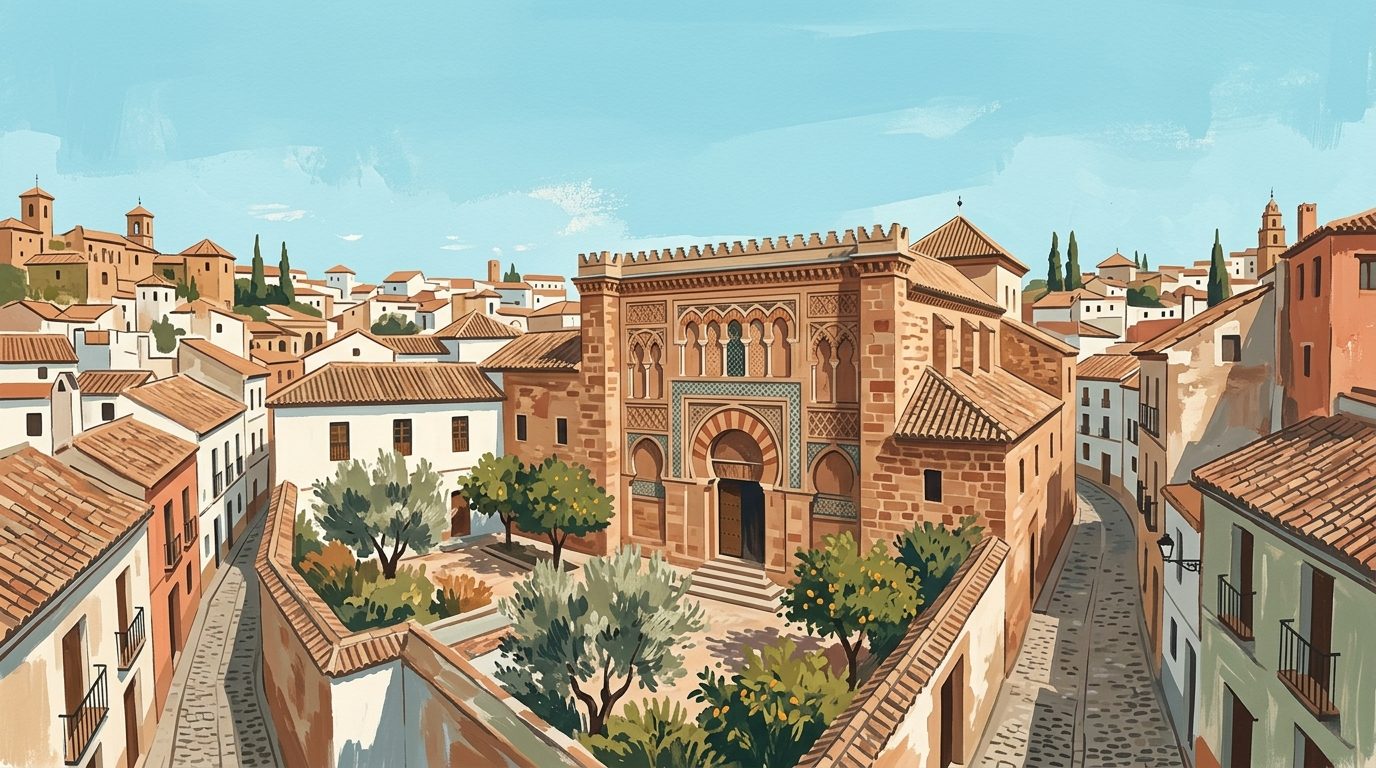
In 1315, an inscription was carved into the eastern wall of a new prayer hall in Córdoba. It reads, "A sanctuary in miniature and dwelling of the Testimony that Isaac Moheb finished." Commissioned just inside the western defensive walls of the city, this compact structure is one of only three significant medieval synagogues surviving in Spain, alongside two in Toledo. Unlike the monumental dimensions of the nearby Islamic and Christian religious complexes, this building is defined by its intense intimacy. A nearly square footprint of just over forty square metres is bounded by towering walls, creating a space that draws the eye upward to some of the most intricate Mudéjar stucco work in Andalucía.
The Talmudic Threshold
The approach to the building is deliberate and deeply rooted in religious text. Talmudic tradition required that a place of worship should not open directly onto the public street. To achieve this, the fourteenth-century builders designed a distinct architectural buffer. Visitors step off the narrow thoroughfare of Calle Judíos, passing through a modest stone doorway into a small, shaded courtyard, followed by a transitional vestibule. These spaces were originally designed to quiet the mind before entering the main sanctuary. This layout served to separate communal devotion from the daily noise of the medieval city, while also connecting adjacent buildings that would have housed the rabbinical quarters and the Talmudic school. Today, the courtyard still provides a moment of pause before stepping into the central hall.
Inside the Prayer Hall
The main room is striking for its verticality, contrasting sharply with its modest floor area. The lower walls are largely bare, drawing attention to the upper registers, which are heavily decorated with deeply carved plasterwork. These yeserías display a complex matrix of interlocking geometric stars of four, six and eight points, interspersed with finely detailed plant motifs. Bordering these decorative panels are extensive Hebrew inscriptions, primarily excerpts from the Book of Psalms. While the plaster appears uniformly pale today, these motifs were originally painted in bold, vivid shades of lapis lazuli blue, deep red and black.
On the eastern wall, oriented towards Jerusalem, sits the hejal. This small, vaulted niche once securely held the Torah scrolls. The surrounding plasterwork demonstrates how Islamic architectural aesthetics were adapted by Jewish builders of the period. Opposite, on the western wall, a pointed multifoil arch frames the area where the bimah, or reading pulpit, was likely positioned. High on the southern wall, three small balconies open from the women's gallery. This upper floor allowed female congregants to participate in services while remaining visually and physically separate from the men below, accessed via its own dedicated staircase in the vestibule.
Survival and Rediscovery
Following the Alhambra Decree in 1492, which ordered the expulsion of practising Jews from the Iberian Peninsula, the building was immediately stripped of its religious function. Over the following four centuries, the structure underwent multiple physical and functional transformations. It served as a hospital for rabies patients, a chapel for the shoemakers' guild and a primary school. The original medieval stucco work was entirely hidden under thick layers of plaster.
It was not until 1876, during routine structural repairs, that a local priest named Mariano Párraga noticed the medieval craftsmanship beneath the whitewash. The building was declared a National Monument in 1885, prompting extensive restoration efforts to uncover the Hebrew calligraphy and geometric patterns. Today, it remains a rare, tangible link to the Sephardic heritage of Andalucía.
How to Visit
The synagogue sits in the heart of the pedestrianised Jewish Quarter of Córdoba. Visitors arriving by car should park well outside the medieval walls, as the immediate streets are impassable for vehicles. The site is highly popular, especially among groups exploring the former Caliphate capital, so the small interior can quickly become congested. To appreciate the intricate details in relative quiet, plan to arrive exactly as the doors open in the morning or during the late afternoon. The brief visit is ideal for independent travellers interested in medieval architecture and religious history, though those expecting a vast museum may find the single room underwhelming.
The layout is entirely step-free on the ground floor, making the courtyard and main prayer hall accessible to wheelchair users, though the cobblestone streets leading to the entrance are notoriously uneven. Access to the upper women's gallery is restricted to protect the historic floorboards. Visitors can verify the location and background details directly on the official Junta de Andalucía Enclave Monumental page.
Nearby Pairings
After examining the Mudéjar craftsmanship, take the ten-minute walk through the whitewashed alleys to the Mezquita-Cathedral of Córdoba. Comparing the intimate scale of the Jewish prayer hall with the sprawling, infinite arches of the Great Mosque provides a striking perspective on the diverse religious architecture that defined the city. Alternatively, Casa de Sefarad, located directly opposite the synagogue, offers a helpful contextual museum dedicated to Sephardic domestic traditions, philosophy and music, making it a logical next stop.
Nearby worth your time
A few well-placed stops for extending the day without turning it into a checklist.
Continue through Córdoba City
Step back into the wider landscape with local guides, nearby places and the province overview.
Things to do · 10 min
Golf in Córdoba Province: Courses, Holidays, and Shops
Discover practical tips, course details, and holiday planning advice for playing golf in Córdoba province, from the mountain fairways of Sierra Morena to the historic greens of Los Pedroches.
Feature · 8 min
The Caliphate of Córdoba
In 929, Abd al-Rahman III declared himself Caliph, breaking religious ties with the Middle East and launching an era of unparalleled architectural and intellectual achievement.
Itinerary · 9 min
A Weekend in Cordoba: Two Days in Andalucía's Caliphate City
Spend 48 hours in Cordoba exploring the mesmerising Mezquita, getting lost in the whitewashed streets of the Judería, and eating excellent salmorejo.