
attraction · Almería
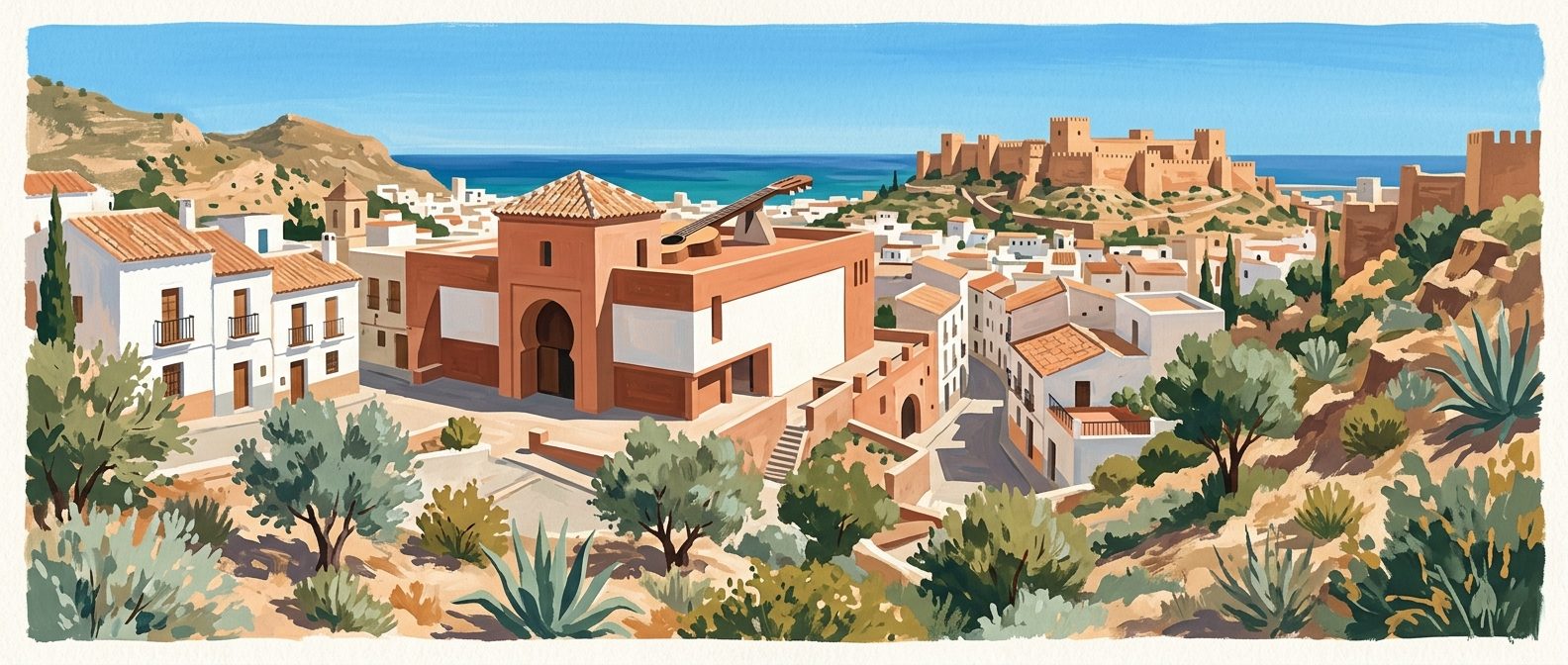
Museo de la Guitarra Almería
Andalucía 365 · Updated 18 July 2026
Our Verdict
“This meticulously curated museum brilliantly balances serious historical scholarship with hands-on interactivity. While the deep organology might feel slightly niche for visitors with no musical interest, the chance to strum instruments in the Sound Room and view priceless 17th-century guitars makes it a standout cultural stop in Almería.”
Last verified: July 2026
Behind the imposing walls of the Almería Cathedral lies a modern space dedicated to a local carpenter who fundamentally changed global music. Antonio de Torres Jurado, born in the nearby village of La Cañada in 1817, did for the classical guitar what Antonio Stradivari did for the violin. Before his interventions in the late 19th century, guitars were relatively quiet, intimate instruments designed for small parlour gatherings. Torres reimagined their architecture, increasing the body size and introducing an internal fan bracing system that gave the instrument the volume and projection required for large concert halls. The Museo de la Guitarra Española 'Antonio de Torres' explores this evolution, combining serious organology with a hands-on experience that honours Almería's most influential son.
The Master Luthier's Workshop
The central exhibition acts as a chronological timeline, focusing heavily on Torres's life and his enduring legacy in the musical world. Visitors are guided through his original design concepts alongside a life-sized recreation of a traditional 19th-century luthier's workshop. Here, the displays delve into the meticulous craft of guitar making, allowing you to examine the specific tonewoods, such as rosewood, spruce, and cedar, and the delicate tools used to shape them.
The exhibition explains the mechanics of his revolutionary fan bracing, a pattern of wooden struts glued to the underside of the soundboard. This innovation allowed the top of the guitar to be made incredibly thin, resonating freely while remaining structurally sound. The permanent collection includes original instruments built by the master himself. Among these are the Torres SE46 from 1883 and one of his earliest surviving models from 1853, which bears its handwritten label. These rare pieces anchor the museum as a pilgrimage site for classical guitarists visiting Almería City.
Centuries of Stringed History
Beyond the specific focus on Torres, the museum charts the broader evolution of stringed instruments. The displays trace the lineage of the guitar from its medieval ancestors, including the lute and the vihuela, through to the ornate, five-course Baroque guitars of the 17th century.
Among the historic instruments featured in the museum's broader collection is the oldest known Spanish guitar with a dated label. Built in Seville in 1684 by the luthier Thomas Durán, this historic piece grounds the stringed timeline in the deep roots of Andalucían craftsmanship, demonstrating that the term 'Spanish guitar' was a defined concept centuries before the modern era. The exhibition spaces also explore the global reach of this traditionally Spanish invention, displaying how industrial and artisanal production methods have spread worldwide.
The Sound Room and Interactive Exhibits
Unlike many musical heritage sites, where instruments are strictly confined behind protective glass, this museum actively encourages participation. The Sound Room is a dedicated, acoustically treated space where visitors can pick up various acoustic and classical guitars and attempt to play them. This tactile element breaks the usual barrier between the artifact and the audience.
Throughout the galleries, interactive touchscreens and high-fidelity audio stations allow listeners to compare subtle tonal shifts between different historical eras, string materials, and body shapes. You can hear the difference between the warm tone of gut strings and the sharp attack of modern nylon, or compare the fast, percussive decay of a flamenco guitar with the sustained resonance of a classical model. The museum also regularly houses temporary exhibitions that have historically explored everything from classical lineage to the 20th-century electric revolution, examining how foundations laid by Torres were adapted to shape modern rock.
Almería's Flamenco Connection
The museum serves as an active cultural hub for the city's thriving flamenco scene. The building frequently hosts evening concerts, taking advantage of the main hall's excellent acoustics, as well as intimate workshops and masterclasses. The legendary flamenco guitarist Tomatito, a native of Almería, regularly uses the museum as the venue for his prestigious summer masterclasses, drawing students from across the globe. This ongoing utility ensures that the museum is not just a repository of the past, but a living institution that continues to foster new musical talent.
A Candid Assessment
This is a highly focused, meticulously curated museum that succeeds by balancing deep historical scholarship with genuine interactive appeal. Professional musicians, luthiers, and flamenco aficionados will deeply appreciate the technical details of the bracing patterns and the chance to view authentic Torres instruments up close. Casual visitors and families will similarly enjoy the opportunity to strum instruments in the Sound Room. However, those with absolutely no interest in music history might find the detailed organology overly niche. The modern building is fully wheelchair accessible, with wide spaces allowing visitors to comfortably navigate the display galleries.
How to Visit
Located on Ronda del Beato Diego Ventaja in the historic centre, the museum is easily reached on foot from the city's primary monuments. The old town streets surrounding the cathedral are narrow and largely pedestrianised, so drivers should park in the larger public car parks near the port or Calle Real. It makes perfect geographical sense to combine a visit here with the adjacent cathedral, or to walk up to the Alcazaba de Almería to make the most of your time in the historic district.
Official schedules shift with the seasons, often favouring evening access during the intense heat of the Andalucían summer. Visitors should consult the official municipal culture website to confirm visiting schedules and gallery changes before travelling. For wider explorations of the region's cinematic legacy, consider reviewing our guide to the best day trips from Almería.
Nearby worth your time
A few well-placed stops for extending the day without turning it into a checklist.
Continue through Almería City
Step back into the wider landscape with local guides, nearby places and the province overview.
Place guide · 8 min
A Local Guide to Playa de Mojácar: Sands, Spirits and Almerían Soul
Experience the diverse 17-kilometre coastline of Mojácar Playa, where volcanic sands meet clear waters and lively chiringuitos offer the perfect Almerían escape.
Place guide · 7 min
Playa de los Genoveses: A Guide to the Wild Heart of Cabo de Gata
Experience the untouched beauty of Playa de los Genoveses, a vast volcanic bay in Almería where golden sands meet shallow turquoise waters in a protected natural park.
Itinerary · 13 min
5 Days in Almería: City, Desert and Cabo de Gata
A realistic five-day driving itinerary through Almería province, balancing the historic capital, the cinematic Tabernas badlands, and the protected volcanic shores of Cabo de Gata.