
attraction · Almería
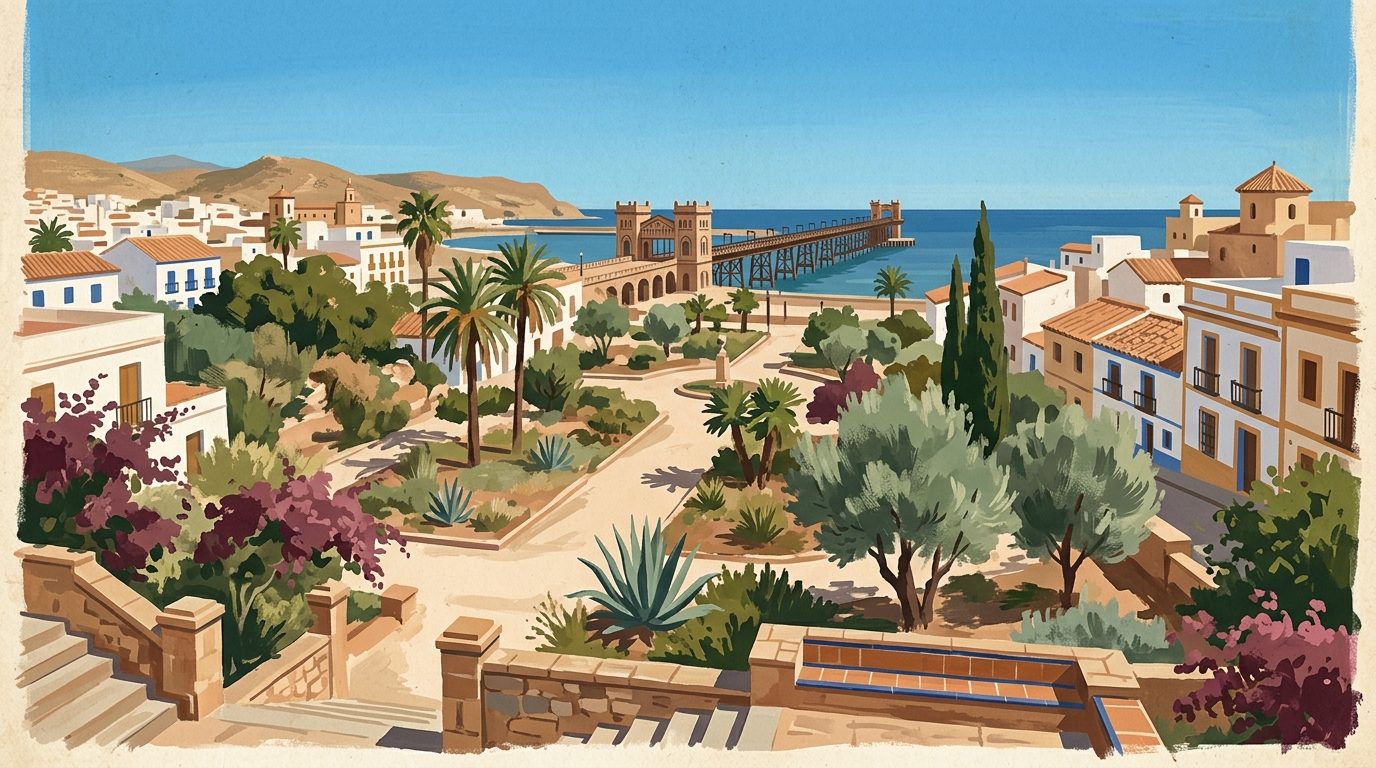
Parque de las Almadrabillas
Andalucía 365 · Updated 18 July 2026
Our Verdict
“Parque de las Almadrabillas offers a striking contrast to Almería's ancient Moorish monuments. While lacking shade and greenery, its industrial centrepiece, the restored Cable Inglés, and the moving Monumento a la Tolerancia make it an essential stop for history enthusiasts and photographers exploring the city's modern waterfront.”
Last verified: July 2026
At the eastern edge of Almería's port, the Mediterranean breeze cuts across a stark expanse of paved walkways and monumental history. Parque de las Almadrabillas occupies the grounds of the city's former fishing operations, though today it is defined by steel, concrete and modern recreation rather than nets and salt. It is here that the city's twentieth-century industrial peak collides with its most sobering wartime memories, creating an urban space that feels less like a traditional green park and more like an open-air museum of Almerian resilience.
Maritime Origins and Tuna Fisheries
The park's name provides a direct link to Almería's maritime past. Before heavy iron structures took over the coastline, this area was dedicated to traditional fishing. The term refers to smaller versions of the almadraba, an intricate system of nets historically used across the Mediterranean coast to trap migrating tuna. While larger nets were designed for massive Atlantic bluefin tuna, the almadrabillas targeted smaller species such as bullet tuna and skipjack. Today, the fishing nets are long gone, replaced by a paved urban plaza that serves as a transition zone between the commercial port and the sandy stretches of the city's beaches.
The Cable Inglés and Iron Architecture
The undisputed centrepiece of the park is the Cable Inglés, a gargantuan iron ore loading pier inaugurated by King Alfonso XIII in 1904. Engineered by the Scottish engineer John Ernest Harrison, who drew heavy inspiration from the architectural principles of Gustave Eiffel's school, this monumental structure of cast iron, wood and concrete stretches prominently into the sea. It was built for the British-owned Alquife Mines and Railway Company to transport iron ore from the inland mines of Granada directly into the holds of waiting cargo ships, drastically reducing loading times. Following extensive restoration work, visitors can now walk along the elevated promenade of this former railway viaduct. Standing beneath its lattice of rust-coloured steel beams at park level is equally impressive, offering a visceral sense of the sheer scale of Andalucía's mining boom.
The Monument to Tolerance
A short distance from the imposing shadow of the Cable Inglés stands a far quieter and highly emotional monument. The Monumento a la Tolerancia, inaugurated in 1999, is a stark grid of concrete pillars designed by the local sculptor María Ángeles Lázaro Guil. The installation consists of exactly 142 columns, with each pillar representing one of the 142 Almerian residents who died in the Mauthausen and Gusen concentration camps during the Second World War. The central space of the memorial is intended to evoke the forced labour endured by the victims in the Austrian stone quarries. It is a profoundly moving tribute that anchors the park in the broader tragedies of twentieth-century European history, providing a contemplative contrast to the surrounding recreational spaces.
Recreational Spaces and the Rambla de Almería
Beyond its historical significance, Parque de las Almadrabillas functions as a highly active civic space for the city's residents. Its broad, paved avenues are popular with local walkers, cyclists and inline skaters. The park features the Ignacio Echeverría skate park, which draws a dedicated younger crowd throughout the afternoon. The park sits precisely at the mouth of the Rambla de Almería, the main pedestrian avenue that dissects the city, making it a natural terminus for those walking down from the commercial centre. From the park's vantage point, you can watch ferries departing for North Africa from the adjacent commercial port or admire the sailboats moored at the nearby Club de Mar. The park also serves as the official starting point for the Paseo Marítimo Carmen de Burgos, a coastal promenade leading directly to the urban sands of Playa de San Miguel.
Accessibility and Practical Details
This is not a leafy retreat intended for a shaded afternoon picnic. Parque de las Almadrabillas is largely paved, wide open and entirely exposed to the coastal elements. In the height of summer, the midday heat here is fierce, and on blustery days, the sea winds whip unhindered off the Alborán Sea. The park is entirely flat, fully paved and completely wheelchair accessible, making it an easy addition to any coastal stroll. It connects seamlessly to the wider Almería City waterfront and is well served by local bus routes, with a large public car park available at the adjacent Muelle de Levante. Visitors planning to walk the upper promenade of the loading pier should consult the official Almería Tourism website to confirm guided tour availability and any advance booking requirements. As the area lacks natural shade, early morning or early evening visits are highly recommended. The visual contrast between the intricate ironwork of the Cable Inglés, the sombre concrete pillars of the Mauthausen memorial and the deep blue of the Mediterranean makes for exceptional photography, particularly during the late afternoon golden hour.
Sensible Nearby Pairings
Parque de las Almadrabillas sits at the junction of the city and the sea, making it a logical endpoint for a day of urban exploration. After walking the length of the Cable Inglés and exploring the memorials, you can easily head inland to explore the historic core. A short walk up the palm-lined avenues will take you to the Almería Cathedral and the Historic City Centre, where you can swap coastal winds for narrow streets and traditional tapas bars. Alternatively, if you are tracing the broader military and defensive history of the region, pair this industrial monument with a morning visit to the Alcazaba de Almería, Spain's largest Moorish coastal citadel. For those driving the Coastal Drive: Cádiz to Almería, the park provides an excellent reintroduction to urban life after miles of rugged volcanic coastline.
Nearby worth your time
A few well-placed stops for extending the day without turning it into a checklist.
Continue through Almería City
Step back into the wider landscape with local guides, nearby places and the province overview.
Place guide · 8 min
A Local Guide to Playa de Mojácar: Sands, Spirits and Almerían Soul
Experience the diverse 17-kilometre coastline of Mojácar Playa, where volcanic sands meet clear waters and lively chiringuitos offer the perfect Almerían escape.
Place guide · 7 min
Playa de los Genoveses: A Guide to the Wild Heart of Cabo de Gata
Experience the untouched beauty of Playa de los Genoveses, a vast volcanic bay in Almería where golden sands meet shallow turquoise waters in a protected natural park.
Itinerary · 13 min
5 Days in Almería: City, Desert and Cabo de Gata
A realistic five-day driving itinerary through Almería province, balancing the historic capital, the cinematic Tabernas badlands, and the protected volcanic shores of Cabo de Gata.