
attraction · Almería
Parque Nicolás Salmerón
Andalucía 365 · Updated 18 July 2026
Our Verdict
“Parque Nicolás Salmerón offers a heavily shaded, flat escape from the intense coastal heat. While constant traffic noise detracts from its serenity, its towering centenary trees and monumental fountains make it a highly practical, visually striking route between Almería's historic centre and the Mediterranean port.”
Last verified: July 2026
A Botanical Boundary Line
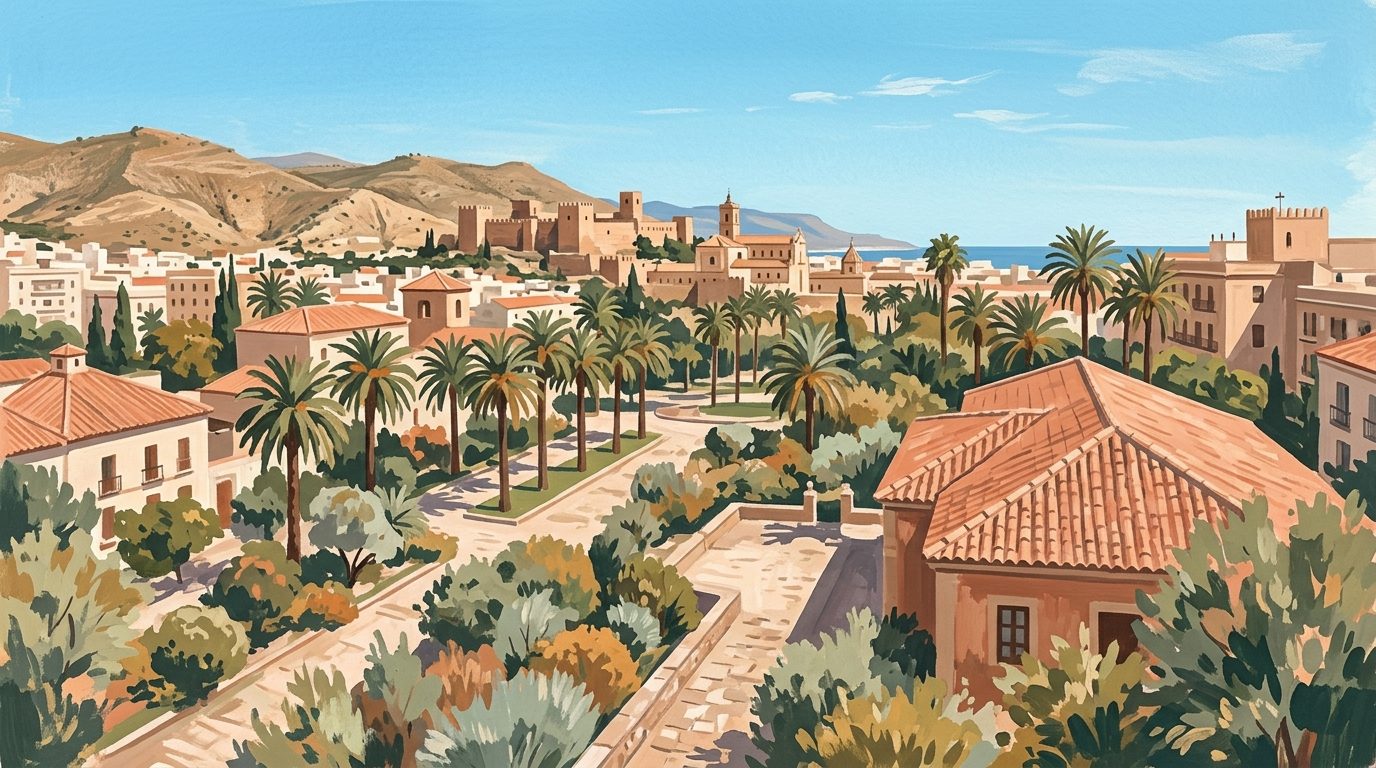
Parque Nicolás Salmerón stretches for nearly a kilometre along the Mediterranean shore, forming a long ribbon of shade between the dense historic centre of Almería and the open expanse of its industrial port. The air here carries a faint mix of sea salt and damp earth. Towering centenary ficus trees cast deep shadows across paved walkways, their sprawling, muscular roots anchoring them firmly into the soil alongside date palms and pines. Established in the mid-nineteenth century and named after the Almería-born president of the First Spanish Republic, this linear park serves as the primary green lung for Almería City. It is an enduring piece of civic engineering that softened the coastal edge of Andalucía following the demolition of the city walls, creating a necessary transitional zone between civic life and maritime industry.
Historical Context and Urban Evolution
For centuries, Almería was cut off from its maritime waterfront by heavy defensive fortifications. When these walls were pulled down in the mid-nineteenth century to make way for a modern harbour and the lucrative export of iron ore and grapes, the city required a buffer space. The construction of the port transformed what was once an open beach into a hub of heavy machinery and commercial trade. Parque Nicolás Salmerón was constructed in phases to bridge the gap between the monumental architecture of the old town and the heavy industry of the docks. Today, it stands as a living historical record of Almerian urban expansion toward the south. The park traces the route of the ancient shoreline, acting as a leafy screen that shields pedestrians from the intense southern sun while preserving the memory of the original waterfront.
Exploring Parque Viejo
The green space is distinctly divided into sections, each reflecting a different era of urban design. The western half, known as Parque Viejo, retains a classical formality. This area has its origins in the Paseo del Malecón, which was created between 1842 and 1845. It is heavily planted with the oldest and most imposing botanical specimens in the city. Visitors walking beneath this canopy experience the quiet grandeur of the park, surrounded by thick trunks and wide, leafy branches that block out the harsh light. The centrepiece separating the old section from the new is the Fuente de los Peces. This classical water feature was designed by local artist Jesús de Perceval, a key figure in the mid-twentieth century Indaliano art movement, serving as both a visual anchor and a historic meeting point.
The Transition to Parque Nuevo
Moving eastward from the fountain, visitors enter Parque Nuevo. Redesigned and expanded in the mid-twentieth century by municipal architect Guillermo Langle Rubio, this section feels decidedly more open and geometric. The wilder tree cover gives way to broad promenades, manicured lawns and symmetrical layouts. This area features contemporary works such as the Fuente de los Delfines, a prominent sculpture crafted by Juan Segura in 1970, depicting five dolphins riding the waves. From these wider pathways, there are clear views across the commercial port, where massive ferries load passengers bound for North Africa. At the far eastern edge, you will find modern sculptural elements, including the bright red Puerta del Coral by Juan José Novella, which marks the transition back into the commercial streets near Avenida Reina Regente.
A Candid Assessment of the Environment
This is not an enclosed, silent retreat. Parque Nicolás Salmerón is a working piece of urban infrastructure. It is bordered on one side by a heavy arterial road serving the port, meaning the hum of traffic and maritime machinery is a constant companion. The fountains are primarily ornamental, and while the mature trees offer magnificent shade, the park is better treated as a pleasant transit route rather than a destination for a prolonged picnic or deep contemplation. However, as a shaded corridor to escape the midday heat, it is highly effective. It offers a cool, flat thoroughfare that is far superior to walking along the sun-baked concrete of the marina itself.
Practical Advice and Accessibility
The park is unfenced and integrated directly into the street layout, allowing visitors to join or leave the path at numerous points. The terrain is entirely flat and paved, making it highly accessible for wheelchair users, pushchairs and visitors with limited mobility. The abundance of stone and iron benches provides frequent opportunities to rest under the canopy. Those driving into the city will find underground parking available near the port or at the nearby Plaza Marín, as street parking along the perimeter is notoriously difficult. Visitors should consult the official Almería City Tourist Board website to confirm current public transport routes and live parking availability. Ensure you bring your own drinking water, as the ornamental fountains are not potable.
Sensible Nearby Pairings
At the western edge of the park, near the intersection with Calle de la Reina, sits the Enclave Arqueológico Puerta de Almería. Here, visitors can see remnants of the tenth-century Caliphal wall and a Roman salting factory once used to produce garum. From there, it is a short uphill walk into the historic quarter to explore the Cathedral of Almería. Alternatively, visitors can trace the park to its westernmost point and begin the ascent to the Alcazaba de Almería, the imposing Moorish fortress that dominates the city skyline. At the opposite, eastern end of the park lies the Cable Inglés, a colossal iron ore loading pier that stands as a striking monument to nineteenth-century industrial architecture and offers a dramatic conclusion to the coastal walk.
Nearby worth your time
A few well-placed stops for extending the day without turning it into a checklist.
Continue through Almería City
Step back into the wider landscape with local guides, nearby places and the province overview.
Place guide · 8 min
A Local Guide to Playa de Mojácar: Sands, Spirits and Almerían Soul
Experience the diverse 17-kilometre coastline of Mojácar Playa, where volcanic sands meet clear waters and lively chiringuitos offer the perfect Almerían escape.
Place guide · 7 min
Playa de los Genoveses: A Guide to the Wild Heart of Cabo de Gata
Experience the untouched beauty of Playa de los Genoveses, a vast volcanic bay in Almería where golden sands meet shallow turquoise waters in a protected natural park.
Itinerary · 13 min
5 Days in Almería: City, Desert and Cabo de Gata
A realistic five-day driving itinerary through Almería province, balancing the historic capital, the cinematic Tabernas badlands, and the protected volcanic shores of Cabo de Gata.