
attraction · Córdoba
Templo Romano
Andalucía 365 · Updated 18 July 2026
Our Verdict
“This soaring colonnade provides a dramatic connection to ancient Roman engineering that cuts straight through the city's medieval reputation. Free guided walks now allow visitors to step onto elevated platforms inside the precinct itself, making it a high-impact and interactive architectural stop.”
Last verified: July 2026
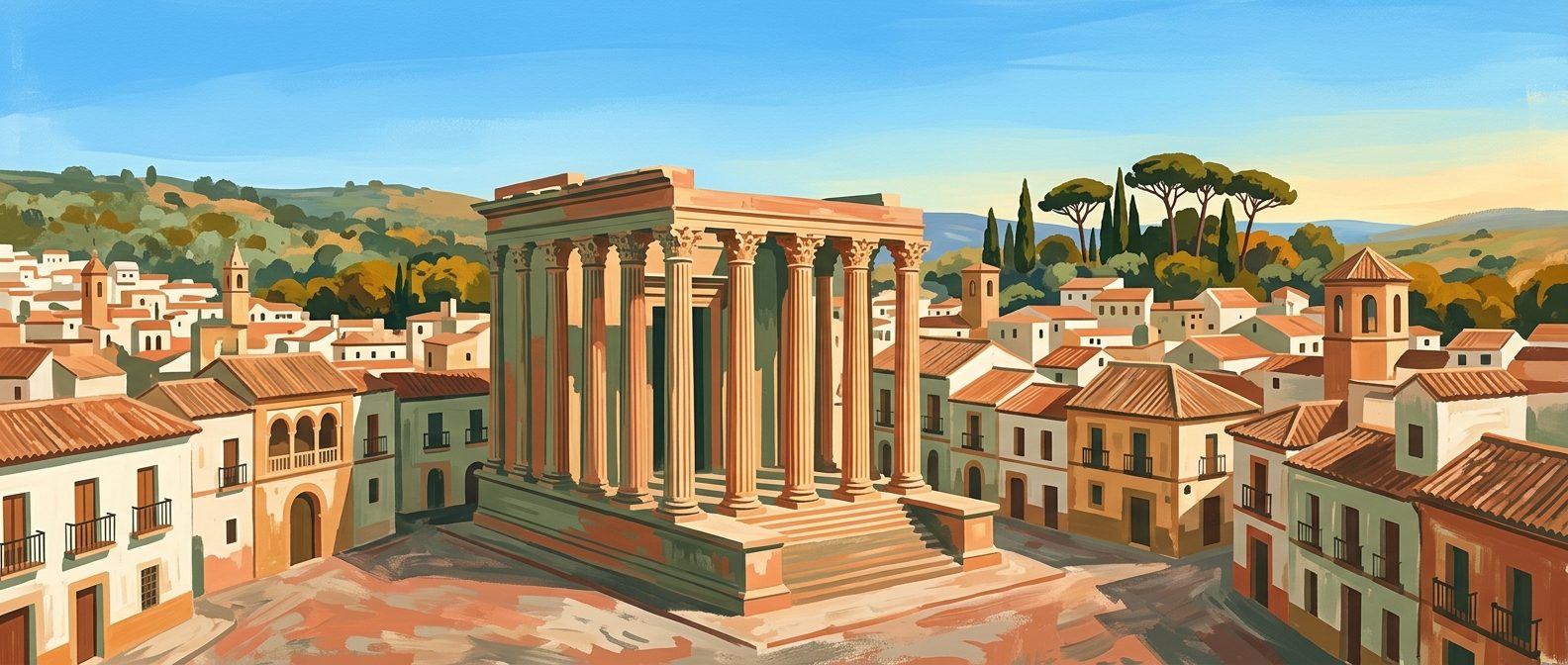
Eleven fluted columns of bright marble soar abruptly above the modern traffic of Calle Claudio Marcelo, creating a colossal architectural interruption in the heart of Córdoba. Standing on a prominent ridge, the Templo Romano is the city’s most significant surviving monument from its era as the prosperous capital of the Roman province of Baetica. While the city is globally renowned for its Moorish legacy, this stark, skeletal colonnade serves as a massive physical reminder that long before the Caliphate, Corduba was one of the wealthiest and most influential urban centres in the Roman Empire.
The Capital of Baetica
Founded in the second century BC by the Roman statesman Marcus Claudius Marcellus, Corduba quickly grew wealthy on the export of olive oil, wheat, and minerals from the wider province of Córdoba. By the first century AD, under the reign of Emperor Claudius and later Domitian, this immense wealth funded a radical monumentalisation of the city.
The Roman Temple was the centrepiece of a new provincial forum. Dedicated to the imperial cult, it was designed not just as a place of worship, but as an intimidating assertion of imperial authority. The structure would have dominated the eastern approach to the city, visible from miles away. Today, visitors can also spot a large marble statue of the city's founder, general Marcus Claudius Marcellus, which was sculpted by Marco Augusto Dueñas and erected near the temple precinct in 2015 to further anchor the site's classical origins. Exploring this history adds crucial context when exploring the wider layers of the former Caliphate capital.
Architectural Ambition and Engineering
The Templo Romano was a hexastyle temple, meaning it featured a portico with six columns across its primary facade, supplemented by further columns along its flanks. What visitors see today is a combination of authentic first century fragments and extensive mid-century reconstruction. The gleaming Corinthian capitals and deeply fluted drums provide a clear sense of the building's original scale, while the precinct floor remains scattered with genuine, unrestored architraves and cornices.
The most fascinating aspect of the ruins lies in its foundations. Because the temple was built on a natural slope, Roman engineers had to construct massive subterranean terraces, known as antérides. These robust foundation walls were arranged in a fan shape to prevent the immense weight of the marble structure from sliding downhill. Looking down from the street level viewing platform, you can clearly trace these subterranean supports, offering a rare view into the pragmatic engineering that underpinned classical architecture.
The Mid-Century Discovery
For over a millennium, the temple was completely lost. As Córdoba evolved through its Visigothic, Moorish, and Christian epochs, the massive Roman stones were either repurposed as building materials or buried beneath dense urban development.
The site was discovered entirely by accident in 1951. During excavations to expand the modern Ayuntamiento, or City Hall, construction workers struck the colossal marble foundations. Under the guidance of architect Félix Hernández and archaeologist Samuel de los Santos Gener, the subsequent dig revealed a structure so large that municipal plans had to be drastically altered. The decision was made to incorporate the ruins into the urban fabric, creating the striking juxtaposition of ancient stone and modern civic administration that defines the corner today.
The Verdict
This soaring colonnade provides a dramatic connection to ancient Roman engineering that cuts straight through the city's medieval reputation. Visitors can now enjoy both street level views and free guided walks along elevated platforms inside the precinct itself. It remains a quick but high-impact architectural stop that beautifully reveals the city's classical roots.
Viewing and Practicalities
The Templo Romano is an open-air archaeological site that sits below street level. It is fully visible 24 hours a day from the public pavements along Calle Claudio Marcelo and Calle Capitulares, completely free of charge. However, visitors are no longer restricted to looking from the street.
Following a municipal rehabilitation project, guided visits began taking visitors onto elevated walkways inside the precinct. These visits reveal the foundations and reconstructed colonnade from a perspective that the pavement cannot provide. Places are limited and the timetable can change, so reserve ahead through the current municipal booking system rather than relying on a walk-up space.
Because the exterior viewing platforms are integrated into the modern streetscape, they are entirely accessible for wheelchair users. The structure is visually striking at any time of day, but the most dramatic perspective comes at dusk. When the sun sets, a modern spotlight system illuminates the white marble against the darkening sky of Andalucía, throwing the deep fluting of the columns into sharp relief. Independent travellers should consult the local tourist board for the current visiting arrangements before setting out.
Nearby Pairings
A visit to the temple takes no more than half an hour, making it a perfect pivot point for a broader city walk. To truly appreciate the site, take a ten minute stroll through the winding streets to the Museo Arqueológico, where many of the delicate original artifacts recovered from the temple excavations are safely housed. From there, you can continue the classical theme by walking down to the Roman Bridge. Alternatively, use the temple as a starting point before eating and drinking in the traditional tapas taverns clustered around the nearby Plaza de la Corredera.
Nearby worth your time
A few well-placed stops for extending the day without turning it into a checklist.
Continue through Córdoba City
Step back into the wider landscape with local guides, nearby places and the province overview.
Things to do · 10 min
Golf in Córdoba Province: Courses, Holidays, and Shops
Discover practical tips, course details, and holiday planning advice for playing golf in Córdoba province, from the mountain fairways of Sierra Morena to the historic greens of Los Pedroches.
Feature · 8 min
The Caliphate of Córdoba
In 929, Abd al-Rahman III declared himself Caliph, breaking religious ties with the Middle East and launching an era of unparalleled architectural and intellectual achievement.
Itinerary · 9 min
A Weekend in Cordoba: Two Days in Andalucía's Caliphate City
Spend 48 hours in Cordoba exploring the mesmerising Mezquita, getting lost in the whitewashed streets of the Judería, and eating excellent salmorejo.