
Practical guide
Language Guide for Andalucía: Communication Tips for Visitors and Expats
Mastering communication in Andalucía means understanding the local Andaluz dialect and knowing how to navigate Spanish bureaucracy. Discover essential phrases, regional quirks, and practical tips for daily life.
By Dan · Updated 14 July 2026 · 7 min read
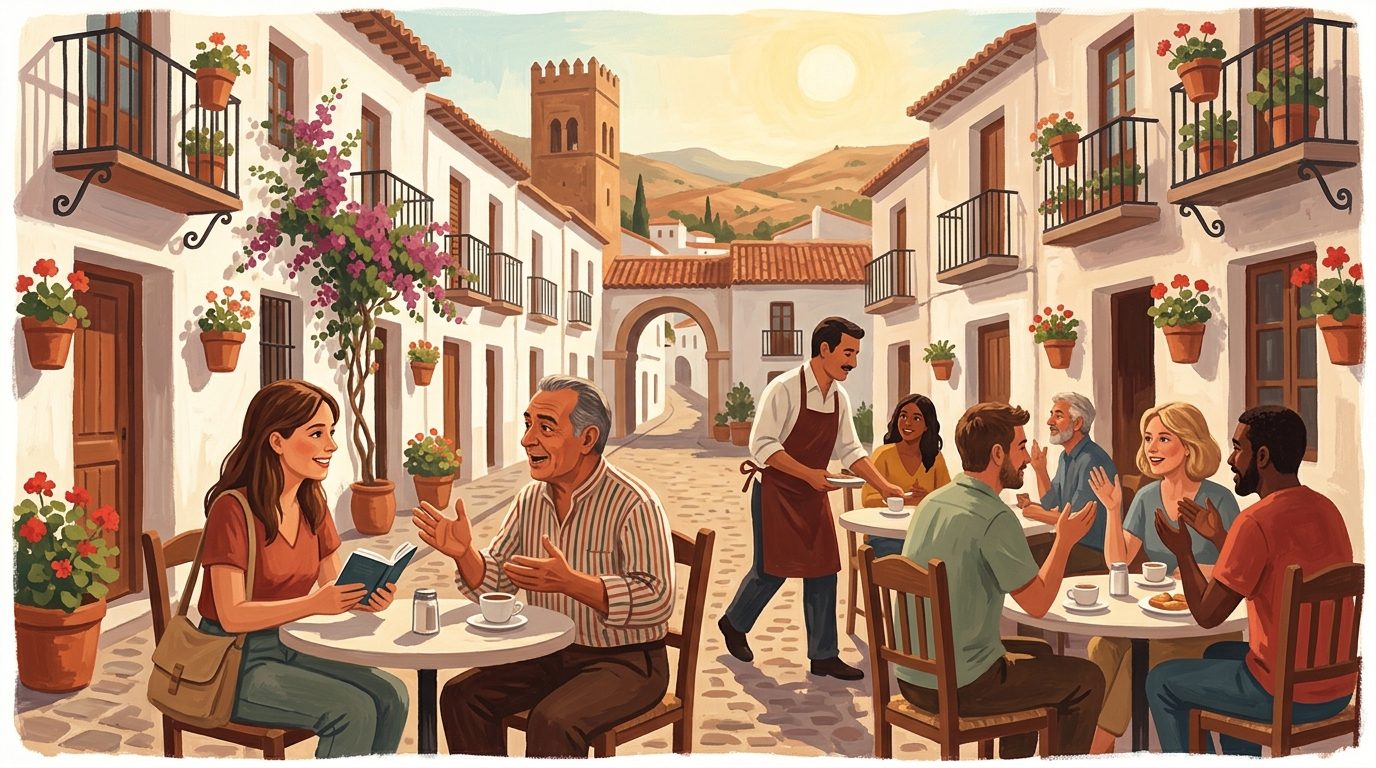
Effective communication in Andalucía requires an understanding of the regional Andaluz dialect and a grasp of basic Spanish. For holidaymakers, getting by with pointing and basic phrases is easy enough. For those relocating or staying long-term, mastering local communication is the difference between a smooth transition and endless bureaucratic frustration.
While Spanish (Castilian) is the official language, Andalucía has a distinct linguistic identity. In major tourist hubs like Marbella or Málaga city, English is widely spoken in service industries. However, once you move inland or into local neighbourhoods, English proficiency drops sharply. Understanding the local accent and mastering everyday etiquette is necessary for navigating daily life, dining, and government paperwork.
The Andaluz Dialect: Understanding the Local Sound
The Andaluz accent is often cited as one of the most challenging for learners to understand. It is not a separate language, but a collection of dialects with specific phonetic characteristics. Most notably, speakers often omit consonants at the ends of words and between vowels.
- Dropping the 'S': The plural 's' at the end of words is often silent. "Dos cervezas" may sound like "Do cerve'a".
- Dropping the 'D': The 'd' between vowels is frequently skipped. "Pescado" (fish) becomes "pesca'o"; "helado" (ice cream) becomes "hela'o".
- Seseo and Ceceo: Depending on the specific province (for example, Sevilla versus Granada), the 's', 'z', and 'c' sounds may be pronounced identically as an 's' or as a soft 'th' sound.
- Aspirating the 'J' and 'G': The harsh, throaty 'j' sound of northern Spain softens into a light, breathy 'h'. "Jamón" sounds closer to "hamón".
- Shortening words: Common words are often truncated in fast speech. "Para" (for or to) often becomes "pa'".
Do not be afraid to ask people to slow down. Locals know their dialect is rapid and are usually happy to repeat themselves if asked politely.
English Proficiency in Andalucía
Your reliance on English depends entirely on your location. The region can be divided into three broad tiers of English accessibility:
- High Accessibility: The Costa del Sol (Torremolinos to Estepona) and Gibraltar. Here, most staff in restaurants, hotels, and shops speak functional to fluent English. You can easily order food, buy groceries, and access private healthcare in English.
- Moderate Accessibility: City centres of Sevilla, Granada, Cádiz, and Málaga. Younger staff and those in the tourism sector will speak English, but administrative staff (police, doctors, post office workers) likely will not.
- Low Accessibility: Rural villages (Pueblos Blancos), agricultural provinces like Jaén, and local residential neighbourhoods in major cities. In these areas, expect to communicate almost exclusively in Spanish.
What Catches People Out: Daily Communication Frictions
Moving beyond basic phrases, several cultural quirks and systemic frictions often catch out new arrivals.
The Cita Previa System
Almost all official administrative business (visiting the police station, town hall, or public health clinic) requires a prior appointment, known as a cita previa. The booking portals for the Junta de Andalucía and national police are entirely in Spanish and are famously complicated to navigate. If you arrive without an appointment, security guards will turn you away at the door. When booking, keep a translation app open on a secondary device to navigate the complex drop-down menus.
WhatsApp is King
Unlike in the UK, businesses in Andalucía rarely use email for daily communication. Tradespeople, landlords, language schools, and even private doctors rely heavily on WhatsApp. If you need a plumber, an electrician, or a haircut, sending a WhatsApp message is far more effective than calling. Voice notes (audios) are extremely common, which can be challenging for beginners trying to parse the Andaluz accent without written text.
Directness Does Not Equal Rudeness
Spanish is a much more direct language than British English. Waiters or shopkeepers might say "Dime" (tell me) or simply "No" without the padding of "I am terribly sorry, but we don't have any left." This is not rudeness; it is simply linguistic efficiency. Do not take offense at the lack of "please" and "thank you" in every single sentence.
Essential Spanish Phrases for Expats and Visitors
Politeness remains highly valued, even with the direct nature of the language. Always start an interaction with a greeting before launching into your request.
Social Basics
- Hola, buenas: A versatile, casual greeting used at any time of day.
- ¿Habla inglés?: Do you speak English?
- No entiendo: I do not understand.
- Más despacio, por favor: Slower, please (crucial for navigating the Andaluz accent).
- Perdone / Disculpe: Excuse me (used to get attention, pass someone in the street, or apologise).
- Gracias / De nada: Thank you / You are welcome.
Practical Living and Bureaucracy
- Tengo una cita: I have an appointment.
- Necesito empadronarme: I need to register on the town hall census (the Padrón).
- ¿Cuánto va a costar más o menos?: Roughly how much will it cost? (Essential when speaking to tradespeople).
- ¿Se puede pagar con tarjeta?: Can I pay by card?
Ordering Food and Drink
Dining out is the most common time you will put your Spanish to the test. In Andalucía, the size of the portion you order is just as important as the dish itself.
Portion Sizes
- Tapa: A small saucer-sized snack. In Granada, Almería, and parts of Jaén, a free tapa is often brought automatically with your drink.
- Media ración: A half-portion, usually perfect for sharing between two people as part of a larger meal.
- Ración: A full plate, intended for sharing among a group. Common mistake: Do not order a ración just for yourself, or you will be overwhelmed with food.
Key Dining Phrases
- Una caña: A small draught beer (usually 200ml to 250ml).
- Un tubo / Una copa: A tall glass of beer or a larger pour.
- Vino tinto / blanco / rosado: Red / white / rosé wine.
- Soy alérgico a...: I am allergic to... (for example, los frutos secos for nuts, or el marisco for shellfish).
- La cuenta, por favor: The bill, please.
During busy events, you will need to speak up to be served. If you are reading up on understanding Spanish festival culture, note that during ferias or busy street parties, you must often order and pay directly at the bar before taking your drinks into the crowd.
As of 2026, expect to pay between €1.50 and €2.50 for a coffee, and €1.50 to €3.00 for a caña in standard local bars (prices scale much higher in luxury resorts or coastal tourist hotspots).
Asking for Help and Emergencies
If you find yourself in serious trouble, dial 112. This is the free, pan-European emergency number. The operator will likely answer in Spanish. Simply state "English please" and do not hang up; they will patch an English-speaking translator into the call. For a comprehensive list of specific services, read our guide to emergency numbers and procedures in Andalucía.
Helpful Emergency Phrases
- ¡Ayuda!: Help!
- ¡Socorro!: Help! (Reserved for dire or life-threatening situations).
- Necesito un médico: I need a doctor.
- He perdido mi bolso/cartera: I have lost my bag/wallet.
- ¿Dónde está la farmacia de guardia?: Where is the 24-hour on-call pharmacy?
Frequently Asked Questions
Do I need to speak Spanish to live in Andalucía?
If you live entirely within an expat enclave on the Costa del Sol, you can survive comfortably with English. However, for any legal residency processes (securing a TIE card, registering on the Padrón), property purchases, or setting up utilities, you will need either an intermediate grasp of Spanish or a paid translator (gestor). True integration into the local community is virtually impossible without learning the language.
Is the Andaluz accent considered "bad" Spanish?
Absolutely not. It is a legitimate, historical regional variation. While it may be harder for students of standard Castilian to understand initially, it is the native tongue of over eight million people and is proudly used in local media, arts, and government.
How do I ask for the bill in a busy bar?
Catch the waiter's eye and make a brief writing motion with your hand in the air, or say loudly "La cuenta, por favor" as they pass. In casual bars, it is completely normal to walk up to the bar to pay before leaving if you haven't been served at a table.
Are menus usually in English?
In tourist areas, menus are almost always bilingual. In authentic local tapas bars inland, menus are often handwritten on chalkboards in Spanish only. Scanning a QR code to view the menu on your phone remains very common practice across the region.
Can I rely on translation apps?
Yes. Translation technology is a lifeline for expats. Apps like Google Lens are highly recommended for translating physical letters, utility bills, and chalkboard menus instantly. For drafting emails to government officials or landlords, DeepL tends to provide more natural, context-aware Spanish translations than Google Translate.
Summary
- English is common on the coast but rare in inland villages and essentially non-existent for administrative tasks.
- The Andaluz dialect drops many consonants and aspirates sounds; always ask speakers to slow down if needed.
- Learn the Cita Previa system and embrace WhatsApp, as these are how local life and appointments are managed.
- Understand portion sizes (Tapa, Media Ración, Ración) to avoid over-ordering and wasting food.
- Always greet with "Hola" or "Buenas" before making a request, despite the directness of the language.
Last reviewed: 21 June 2026 · Editorial policy
Related guides
Postal Services and Sending Parcels in Andalucía
A practical guide to using Correos, sending international parcels, and navigating courier services like SEUR and MRW in Andalucía.
7 min read

A Practical Guide to the TIE Residency Card in Andalucía
A comprehensive, practical guide to getting your TIE residency card in Andalucía, covering the cita previa system, Modelo 790-012 fees, document checks, and real-world friction points.
8 min read

How to Exchange Your Driving Licence for a Spanish One in Andalucía
A comprehensive guide to exchanging your foreign driving licence in Andalucía. Learn about DGT appointments, the medical test, UK licence rules, bilateral agreements, and the common mistakes that catch expats out.
8 min read

The Digital Nomad Visa for Spain: A Practical Guide for Remote Workers
A comprehensive guide to Spain’s digital nomad visa for those moving to Andalucía. Covering step-by-step applications, tax reality checks, social security hurdles, and avoiding common local pitfalls.
7 min read

Long-Term Renting in Andalucía: A Practical Guide
A deep dive into long-term renting in Andalucía. We explain the LAU, the crucial difference between 11-month and habitual contracts, how to handle deposits (AVRA), the 2023 Housing Law on agency fees, and exactly what to watch out for before signing.
9 min read

Tax Obligations for Expats in Spain: A Practical Guide
A practical guide to tax obligations for expats in Andalucía, covering tax residency rules, resident and non-resident filings, the Modelo 720 asset declaration, and essential friction points to discuss with an adviser.
8 min read
More guides
Using a VPN in Andalucía: A Practical Guide for Travellers and Residents
A comprehensive guide to using a VPN in Andalucía for security, accessing UK streaming services, and maintaining privacy on public Wi-Fi.
6 min read
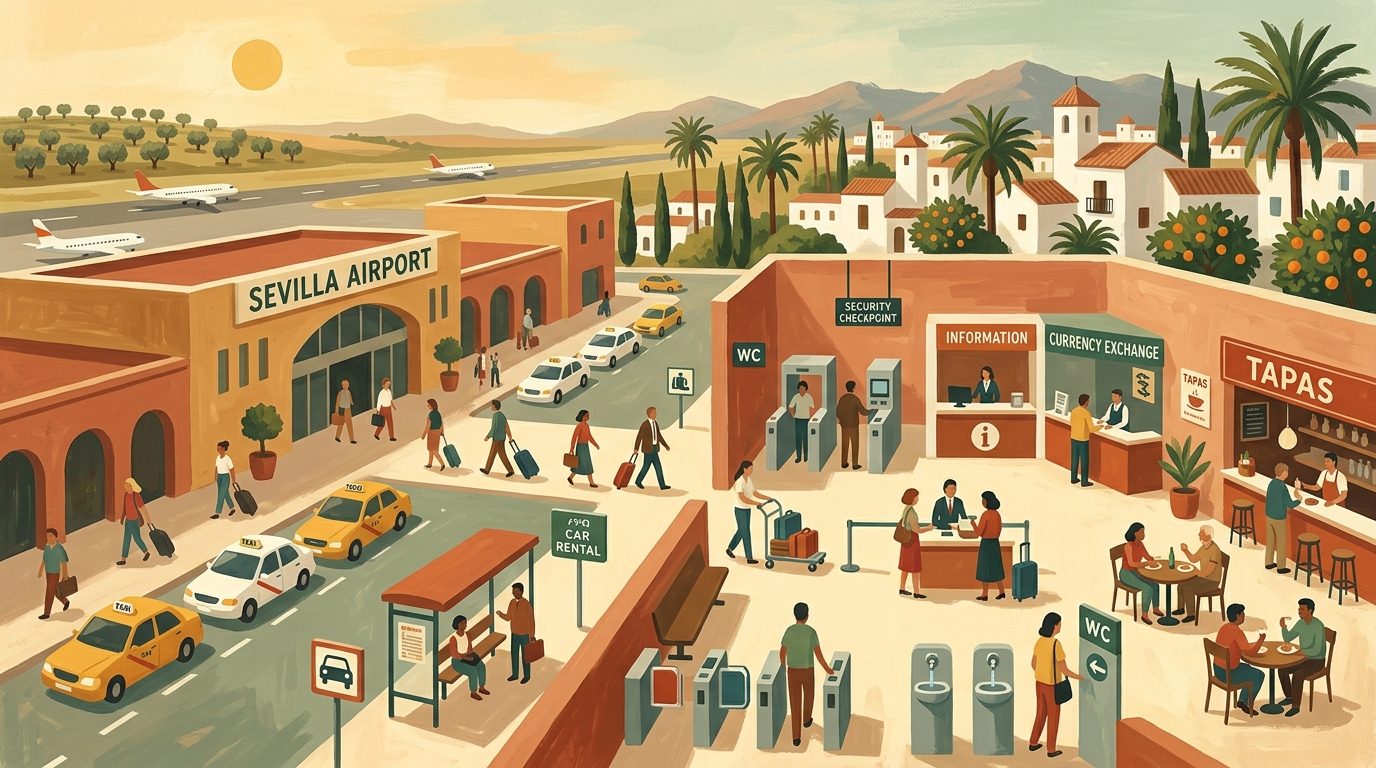
Sevilla Airport (SVQ) Guide: Transport, Facilities and Tips
A practical guide to Sevilla Airport (SVQ) covering the EA bus, taxi flat rates, terminal facilities, car hire, and connecting to wider Andalucía.
9 min read
Practical Guide to Almería Airport (LEI)
A practical logistics guide to arriving at Almería Airport (LEI). Discover how to navigate terminal facilities, use the Surbus Line 30, connect to intercity buses, and avoid common transport mistakes.
7 min read
Practical Guide to Gibraltar International Airport (GIB)
A practical guide to using Gibraltar Airport (GIB) for trips into Andalucía, covering border logistics, avoiding vehicle queues, Spanish transport options, and how to handle wind diversions.
8 min read
Málaga-Costa del Sol Airport (AGP) Travel Guide
A deep practical guide to navigating Málaga-Costa del Sol Airport (AGP). Learn the realities of arrivals, transport connections, parking rules, and common mistakes.
8 min read
Federico García Lorca Granada-Jaén Airport Guide: Transport, Costs and Tips
A complete practical guide to Granada-Jaén Airport (GRX), covering airport buses, taxi fares, car hire friction, terminal facilities, and the step-by-step reality of arriving and departing.
7 min read
Jerez Airport (XRY): The Complete Guide to the Gateway of Cádiz
A deep-dive practical guide to using Jerez Airport (XRY). Learn the realities of onward transport to Cádiz province, car hire friction, train timetables, and how to avoid the most common arrival mistakes.
8 min read

Understanding Spanish Festival Culture in Andalucía
A deep dive into Andalucían festival culture for residents and visitors. Understand Semana Santa, ferias, local holidays, etiquette, administrative friction and how to survive the local party season.
9 min read
Driving in Andalucía: Rules, Tolls, and Parking Guide
A practical guide to driving in Andalucía, covering road rules, ZBE checks, AP-7 toll choices, parking, roundabouts, breakdown equipment and official sources.
9 min read
Newsletter
More stories from Andalucía
Weekly notes, seasonal picks, and the next guides worth bookmarking.