
Practical guide
Electricity, Plugs and Adaptors in Andalucía: A Practical Guide
A practical guide to electricity in Andalucía, covering plug types, adaptors, voltage conversion, contracted power limits for residents, and how to safely upgrade your home's electrical supply.
By Dan · Updated 14 July 2026 · 7 min read
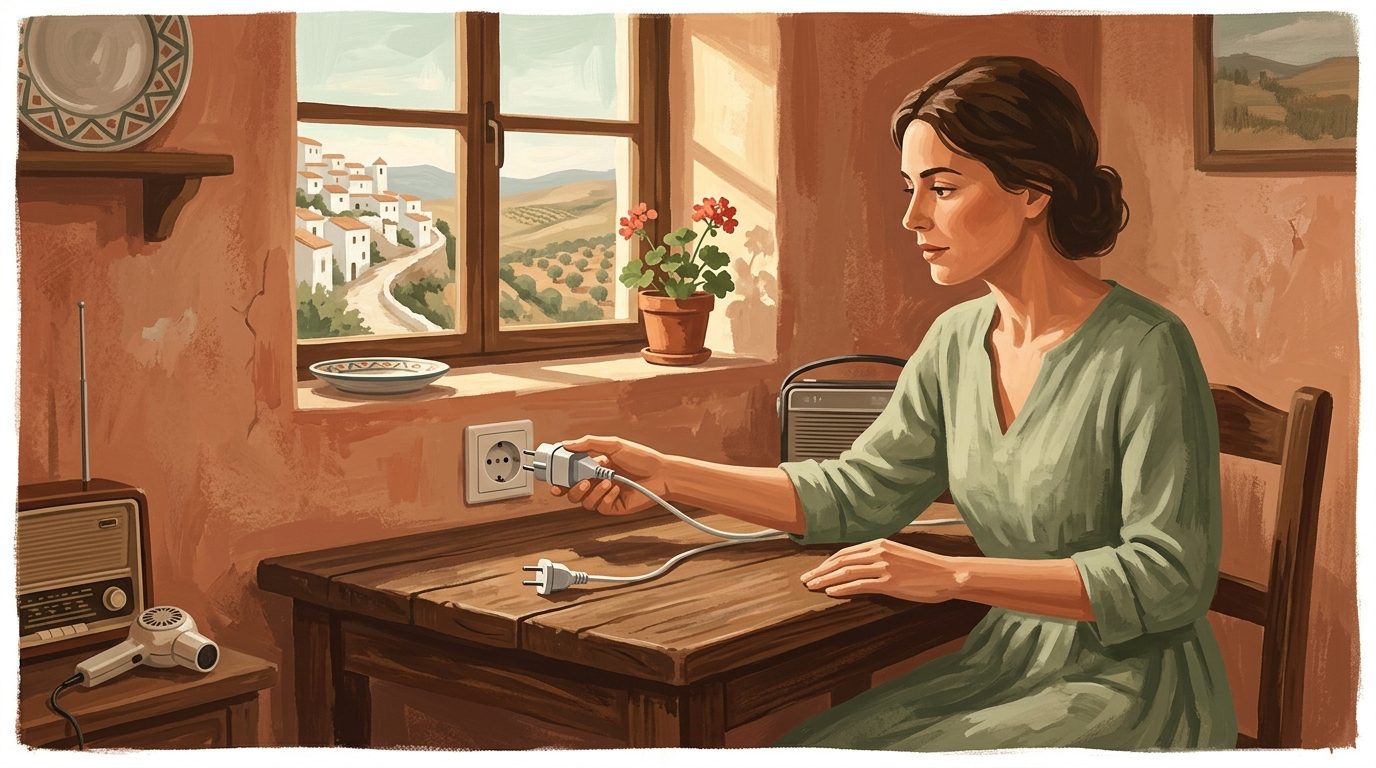
Spain uses mainland European sockets and delivers electricity at 230 volts (V) with a frequency of 50 hertz (Hz). Most holidaymakers travelling with modern electronics only need a quality plug adaptor. However, if you are relocating or planning a long-term stay, the physical shape of the plug is just the beginning. The real challenges for newcomers often involve home electrical limits, dealing with utility companies, and understanding local wiring standards.
Understanding Spanish plugs and sockets
Andalucía uses two primary types of sockets, both of which take two round pins. Before choosing an adaptor, it helps to understand the difference between them.
- Type C (Europlug): This is a flat, ungrounded plug with two round pins. The sockets are often found in older properties or for low-power appliances like lamps and phone chargers.
- Type F (Schuko): This is a larger, round plug with two round pins and two metal earth clips on the top and bottom edges. Almost all modern homes and hotels use Type F sockets because they are grounded and designed for high-wattage appliances like washing machines and kettles.
If you are bringing appliances from the UK, Ireland, or the Americas, you will need an adaptor. If you are preparing your luggage, our Packing Guide for Andalucía: Monthly Clothing and Equipment Essentials has more details on balancing your travel tech with your wardrobe.
Adaptor or voltage converter?
One of the most frequent causes of ruined electronics is confusing a plug adaptor with a voltage converter. They serve entirely different purposes.
- Plug adaptor: This changes the physical shape of the plug to fit a Spanish socket. It does absolutely nothing to the electricity itself.
- Voltage converter or transformer: This actively changes the electrical voltage from Spain's 230V down to the 110V or 120V used in North America and Japan.
How to check your device in three steps
Before plugging anything into a Spanish wall, follow this process to avoid destroying your device or tripping the power.
- Locate the input label: Look for the small print on the power brick, charger, or the back of the appliance. You are looking for the word "Input".
- Check the voltage range: If it says "Input: 100-240V", your device is dual-voltage. It is perfectly safe to use in Andalucía with a standard, cheap plug adaptor. Almost all modern laptops, phone chargers, and tablets fall into this category.
- Check the frequency: Ensure it says "50/60Hz". Some motorised devices, like American hair clippers or record players, rely on a 60Hz frequency to govern their motor speed. Running a 60Hz motor on Spain's 50Hz supply can cause it to run slowly, overheat, or burn out, even if you use a voltage converter.
For residents: Understanding "Potencia Contratada"
If you rent a long-term apartment or buy a property in Andalucía, your biggest electrical hurdle will not be the sockets. It will be the potencia contratada, or contracted power. This is the maximum amount of electricity your property is allowed to draw from the grid at any one instant.
In many countries, you can run multiple heavy appliances simultaneously up to the limit of a large main fuse. In Spain, electricity bills include a fixed daily charge based on your contracted power level. To save money, many landlords and homeowners contract a very low limit, commonly between 3.45 kW and 4.6 kW.
This catches many expats out during the extreme heat of the summer or the damp chill of the winter. As noted in our guide to Weather and Climate in Andalucía: A Practical Guide, temperatures can demand heavy air conditioning or electric heating. If you turn on the oven, the washing machine, and the air conditioning at the same time, the smart meter will detect that you have exceeded your contracted limit and will instantly cut the power.
How to restore power when it trips
If your house suddenly goes dark, do not panic. It rarely means a blown fuse. Follow these steps.
- Turn off the high-wattage appliance you just switched on.
- Locate your home electrical panel (cuadro eléctrico), usually near the front door.
- Find the main switch (often labelled ICP or the largest switch in the box) and flip it down.
- Wait at least three to five seconds.
- Flip the switch back up. The smart meter outside will reset, and your power will return.
How to upgrade your contracted power
If your power trips constantly, you may need to increase your contracted limit. This process involves some bureaucracy.
- Check your Boletín: You need to locate your Certificado de Instalación Eléctrica (CIE), commonly called the Boletín. This document states the maximum safe power limit for your property's wiring.
- Contact the supplier: If your desired new power level is below the limit on the Boletín, you can usually request an upgrade via your electricity provider's app or customer service line.
- Pay the fees: You will be charged regulated fees on your next bill for the upgrade. These include extension rights, access rights, and connection fees, charged per extra kilowatt added.
- Get a new Boletín if required: If your desired power exceeds the current certificate, or if the certificate is more than 20 years old, the utility company will reject the request. You must hire a licensed electrician to inspect your property, potentially upgrade the wiring, and issue a new Boletín before you can proceed.
Hotels, rentals, and older rural homes
Modern hotels and recently renovated apartments, especially those catering to tourists, usually have plenty of sockets. Digital nomads setting up laptops will find that modern infrastructure is very reliable. If you rely heavily on fast internet and multiple devices, you might also want to read about Co-working Spaces and Digital Nomad Life in Andalucía.
However, older rural properties (fincas or village houses) may have antiquated wiring. You might find fewer sockets, and some may be ungrounded Type C outlets. If you are renting an older property and experience flickering lights, sparking sockets, or a burning smell, disconnect your devices immediately and contact the landlord. Do not attempt to alter wiring, replace sockets, or bypass safety devices yourself. In cases of severe electrical fires, refer to the Emergency Numbers and Procedures in Andalucía.
What catches people out: Common mistakes
- The multi-board trap: British residents often bring a UK extension lead, plug it into a single Spanish travel adaptor, and then plug four high-wattage UK appliances into it. This forces too much current through a cheap plastic adaptor, creating a severe fire risk.
- Assuming hairdryers are dual-voltage: High-wattage heating devices like straighteners, curling wands, and travel kettles are rarely dual-voltage. If a North American plugs a 110V hairdryer into a 230V Spanish socket, it will likely spark, smoke, and permanently break within seconds.
- Bathroom socket rules: Spanish building regulations heavily restrict sockets in bathrooms for safety. You will usually only find a special low-voltage socket for electric shavers. You cannot plug a hairdryer or straightener in the bathroom of a typical Spanish home.
- Loose heavy plugs: Standard travel adaptors are often bulky. When combined with a heavy laptop charger, the weight can pull the adaptor slightly out of the wall, exposing live pins or breaking the connection. Always try to support the weight or use an adaptor block with a short cable.
Frequently Asked Questions
Will my UK hairdryer or hair straighteners work in Andalucía?
Yes. The UK uses 230V/50Hz, which is exactly the same as Spain. You simply need a basic, high-quality UK to European plug adaptor. Ensure the adaptor is rated for at least 13 amps to handle the high wattage of heating appliances safely.
Can I use my American CPAP machine or medical equipment?
Most modern CPAP machines have universal power supplies (100-240V), meaning you only need a plug adaptor. However, you must read the manufacturer's label carefully. If it only says 110V, you must buy a high-quality step-down voltage converter rated for at least double the wattage of your machine. For life-saving medical equipment, check with the manufacturer before travelling.
Why does the power go out when it rains heavily?
In older homes and rural areas of Andalucía, heavy rain can sometimes cause the earth leakage circuit breaker (Diferencial) to trip. This happens when moisture gets into outdoor lights, poorly sealed junction boxes, or external water pumps. If it happens repeatedly, an electrician needs to isolate the damp circuit.
Where can I buy adaptors and electrical goods locally?
You can buy safe, CE-marked adaptors at major local supermarkets, large DIY stores like Leroy Merlin, or dedicated electrical shops (ferreterías). Try to avoid buying high-power adaptors from small discount souvenir shops, as the build quality can be poor.
Official checks and consumer rights
If you have issues with utility companies or need official data on the Spanish grid, rely on government and regulatory bodies. Use Red Eléctrica for context on the national electricity system. For regulations and pricing, check the CNMC energy regulation portal or the MITECO energy information site. If you have an unresolved dispute with your electricity provider in the region, consult the Junta de Andalucía's consumer complaint guidance.
Summary checklist for arrivals
- Pack Type C or Type F plug adaptors for your home country's electronics.
- Check every appliance label for "Input: 100-240V" before plugging it in.
- Leave 110V-only appliances at home unless you have a heavy-duty voltage converter.
- If renting or buying, check the potencia contratada on the electricity bill immediately.
- Learn where your fuse box is located so you can easily reset the power if you overload the system.
Last reviewed: 14 July 2026 · Editorial policy
Related guides

Cost of Living in Andalucía by City: A Realistic Guide for Expats
A realistic guide to the cost of living in Andalucía. Learn how to budget for housing, utilities, healthcare, and daily expenses across different Andalucían cities without relying on outdated internet averages.
8 min read

Long-Term Renting in Andalucía: A Practical Guide
A deep dive into long-term renting in Andalucía. We explain the LAU, the crucial difference between 11-month and habitual contracts, how to handle deposits (AVRA), the 2023 Housing Law on agency fees, and exactly what to watch out for before signing.
9 min read

Choosing Your Base: A Comparison of Major Andalucían Cities
A practical comparison of Málaga, Sevilla, Granada and Cádiz for residents. Discover the realities of climate, housing markets, bureaucracy, and transport before you choose where to relocate in Andalucía.
8 min read

How to Register and Run a Holiday Rental in Andalucía
A comprehensive guide to legally registering and running a holiday rental in Andalucía, covering new VFT rules, town hall limits, guest records, and tax obligations.
7 min read

Postal Services and Sending Parcels in Andalucía
A practical guide to using Correos, sending international parcels, and navigating courier services like SEUR and MRW in Andalucía.
7 min read

A Practical Guide to the TIE Residency Card in Andalucía
A comprehensive, practical guide to getting your TIE residency card in Andalucía, covering the cita previa system, Modelo 790-012 fees, document checks, and real-world friction points.
8 min read
More guides
Using a VPN in Andalucía: A Practical Guide for Travellers and Residents
A comprehensive guide to using a VPN in Andalucía for security, accessing UK streaming services, and maintaining privacy on public Wi-Fi.
6 min read

Sevilla Airport (SVQ) Guide: Transport, Facilities and Tips
A practical guide to Sevilla Airport (SVQ) covering the EA bus, taxi flat rates, terminal facilities, car hire, and connecting to wider Andalucía.
9 min read
Practical Guide to Almería Airport (LEI)
A practical logistics guide to arriving at Almería Airport (LEI). Discover how to navigate terminal facilities, use the Surbus Line 30, connect to intercity buses, and avoid common transport mistakes.
7 min read
Practical Guide to Gibraltar International Airport (GIB)
A practical guide to using Gibraltar Airport (GIB) for trips into Andalucía, covering border logistics, avoiding vehicle queues, Spanish transport options, and how to handle wind diversions.
8 min read

Málaga-Costa del Sol Airport (AGP) Travel Guide
A deep practical guide to navigating Málaga-Costa del Sol Airport (AGP). Learn the realities of arrivals, transport connections, parking rules, and common mistakes.
8 min read
Federico García Lorca Granada-Jaén Airport Guide: Transport, Costs and Tips
A complete practical guide to Granada-Jaén Airport (GRX), covering airport buses, taxi fares, car hire friction, terminal facilities, and the step-by-step reality of arriving and departing.
7 min read

Jerez Airport (XRY): The Complete Guide to the Gateway of Cádiz
A deep-dive practical guide to using Jerez Airport (XRY). Learn the realities of onward transport to Cádiz province, car hire friction, train timetables, and how to avoid the most common arrival mistakes.
8 min read

Understanding Spanish Festival Culture in Andalucía
A deep dive into Andalucían festival culture for residents and visitors. Understand Semana Santa, ferias, local holidays, etiquette, administrative friction and how to survive the local party season.
9 min read
Driving in Andalucía: Rules, Tolls, and Parking Guide
A practical guide to driving in Andalucía, covering road rules, ZBE checks, AP-7 toll choices, parking, roundabouts, breakdown equipment and official sources.
9 min read
Newsletter
More stories from Andalucía
Weekly notes, seasonal picks, and the next guides worth bookmarking.