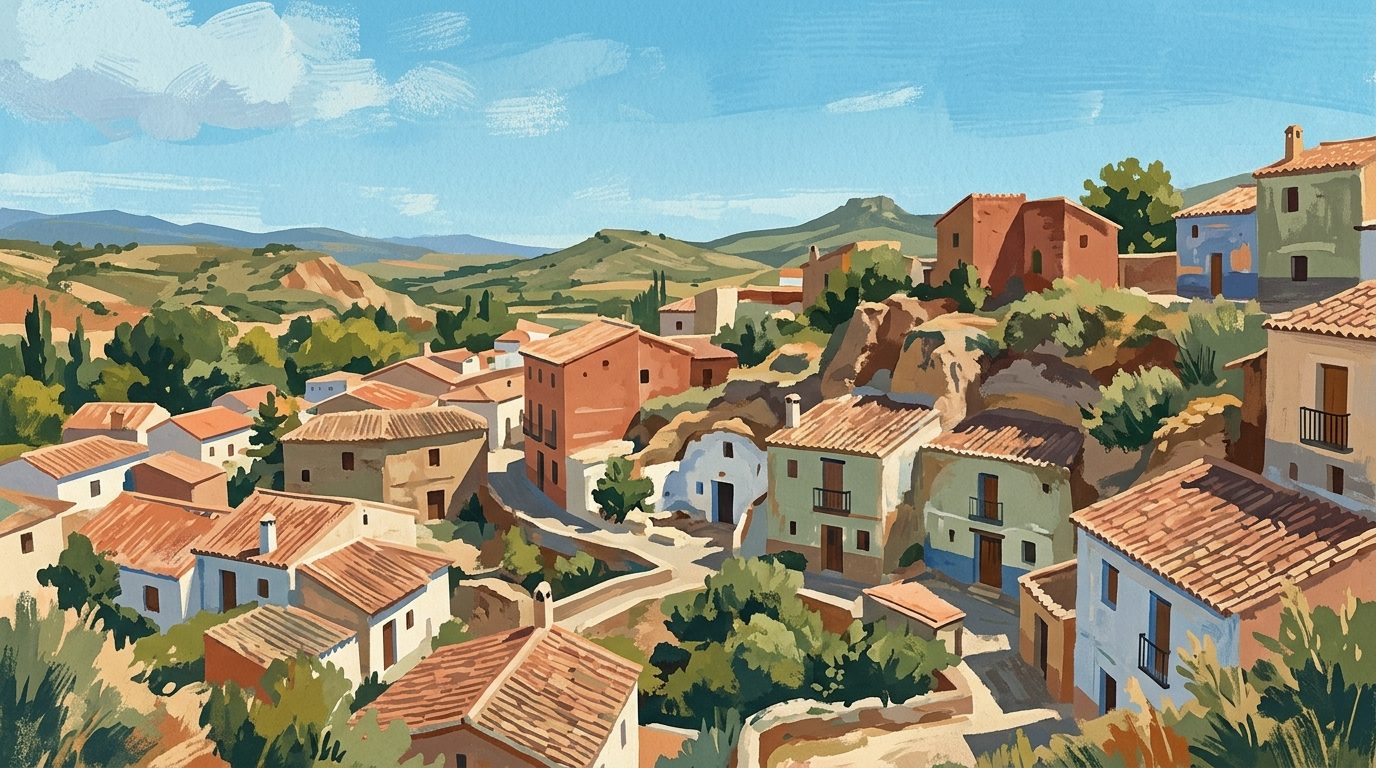
Purullena is a village defined by its relationship with the earth, where families live in dwellings carved directly into the soft clay hillsides. Renowned for its traditional pottery, it offers a distinct glimpse into the subterranean architectural heritage of the Granada province.
Driving along the A-92 motorway towards Almería, the landscape shifts abruptly into a lunar expanse of ochre ridges and deep ravines. This is the Hoya de Guadix, a tectonic basin where erosion has sculpted the soft sedimentary soil into a dramatic display of badlands. In the centre of this geological theatre lies Purullena, a village where the distinction between the natural landscape and human habitation is almost non-existent. To the passing traveller, Purullena is immediately recognisable by the rows of blue and green pottery lining the roadside and the white chimneys that appear to sprout directly from the crumbling clay cliffs.
While often overshadowed by its larger neighbour, Guadix, Purullena provides a more concentrated and raw experience of cave living. Approximately 80% of the population resides underground, benefitting from the natural thermal inertia that keeps these dwellings at a constant 18 to 20 degrees Celsius throughout the year. This subterranean lifestyle is not a relic of the past but a functional, modern way of life that has evolved over centuries. Visitors come here to witness the intersection of ancient geology and traditional craftsmanship, finding a community that remains deeply rooted in the soil it inhabits.
What to See & Do
The Troglodyte Museum: Cueva Inmaculada
To understand the mechanics of living inside a hill, a visit to the Museo Etnográfico Cueva Inmaculada is essential. This museum is a series of interconnected caves that have been preserved to show the evolution of cave dwellings over the last century. Unlike a standard museum, the rooms feel lived-in, featuring traditional kitchen implements, antique furniture, and agricultural tools. The guides explain the process of "picando", the physical act of carving out a new room with a pickaxe, and how the inhabitants manage ventilation and light through carefully positioned shafts. The museum also offers a viewpoint from the top of the cave hill, providing a panoramic perspective of the village’s roofline, which is essentially the ground you stand on.
Pottery Tradition and Workshops
Purullena is widely regarded as the pottery capital of the region. The local clay is exceptionally fine, and for generations, master potters have used it to create the distinctive blue, green, and white ceramics that define the area. As you walk through the village, you will encounter numerous "alfarerías" (pottery shops). Many of these are built into caves themselves, with the rear of the shop serving as the kiln and workshop. It is often possible to watch the potters at work on the wheel. The most traditional designs include the "jarra accitana" (a multi-spouted wedding jar) and hand-painted tiles. Buying directly from the artisans here is not only more affordable than in the city of Granada but also ensures the survival of a craft that is increasingly rare in the modern age.
The Badlands of the Geoparque de Granada
The village serves as a gateway to the Geoparque de Granada, a UNESCO-recognised site of international geological importance. The surrounding badlands were formed by the drainage of an ancient lake system, leaving behind a landscape of gullies, hoodoos, and ridges. For those with a sturdy vehicle or a pair of hiking boots, the tracks leading out of Purullena offer access to some of the most striking viewpoints in southern Spain. The "Mirador del Fin del Mundo" (End of the World Viewpoint) is a short drive away near the border with Beas de Guadix. From this vantage point, you can see the contrast between the green valley floors and the stark, arid peaks of the Sierra Nevada in the distance.
Church of San Martín
In the centre of the village, the 16th-century Parish Church of San Martín provides a rare example of traditional brick and stone architecture amidst the caves. Its Mudéjar-style coffered ceiling is particularly fine, featuring intricate woodwork that survived the centuries. The church sits on a small plaza that serves as the social heart of the community, offering a stark contrast to the subterranean neighbourhoods that radiate outwards from the village core.
Practical Information
Opening Times: The Museo Etnográfico Cueva Inmaculada generally opens from 10:00 to 14:00 and 16:00 to 19:00 (check on the operator's website before travelling, as afternoon hours can vary). Pottery workshops usually follow standard Spanish business hours (10:00 to 14:00 and 17:00 to 20:00), though many roadside shops stay open throughout the day to cater to travellers.
Ticket Prices: Entry to the Cave Museum is typically around €3.00 to €5.00 per person (check on the operator's website before travelling for the latest seasonal pricing), which often includes a guided explanation. Exploring the village streets and viewpoints is free of charge.
How to Get There: Purullena is located 55 kilometres northeast of Granada city. The easiest access is via the A-92 motorway, taking exit 288 for Purullena/Cortes y Graena. The drive takes roughly 45 minutes. There is also a regular bus service operated by ALSA (check alsa.es before travelling for current timetables; note that the site may use a virtual queue during peak summer periods) that connects Granada and Guadix, stopping in Purullena several times a day.
Parking: There is ample free parking along the main road (Antigua Carretera de Murcia) that runs through the village. For the cave museum, follow the signs up the hill where there is a designated parking area for visitors.
Where to Eat Nearby
Dining in Purullena often involves hearty, rural flavours. Restaurante El Maño is a local institution located on the main road. It specialises in grilled meats and traditional stews like "choto al ajillo" (kid goat with garlic). The portions are generous and aimed at local workers and hungry travellers alike. Another excellent option is Mesón La Taberna, where you can sample local cured meats and cheeses. If you are looking for a more formal setting, a five-minute drive into Guadix opens up options like La Bodega, which is famous for its tapas and regional wine selection. Always try the local "pan de pueblo" (village bread), which is traditionally baked in wood-fired ovens.
Where to Stay
To fully appreciate the Purullena experience, staying in a cave house is recommended. Cuevas Hammam Abuelo José offers beautifully converted cave apartments that include access to traditional Arab baths, providing a high level of comfort while maintaining the authentic cool environment of the hillside. Alternatively, Cuevas del Zenete in nearby Valle del Zalabí offers a similar experience with views over the Marquesado plains. These accommodations provide modern amenities such as Wi-Fi and kitchens within the ancient clay walls.