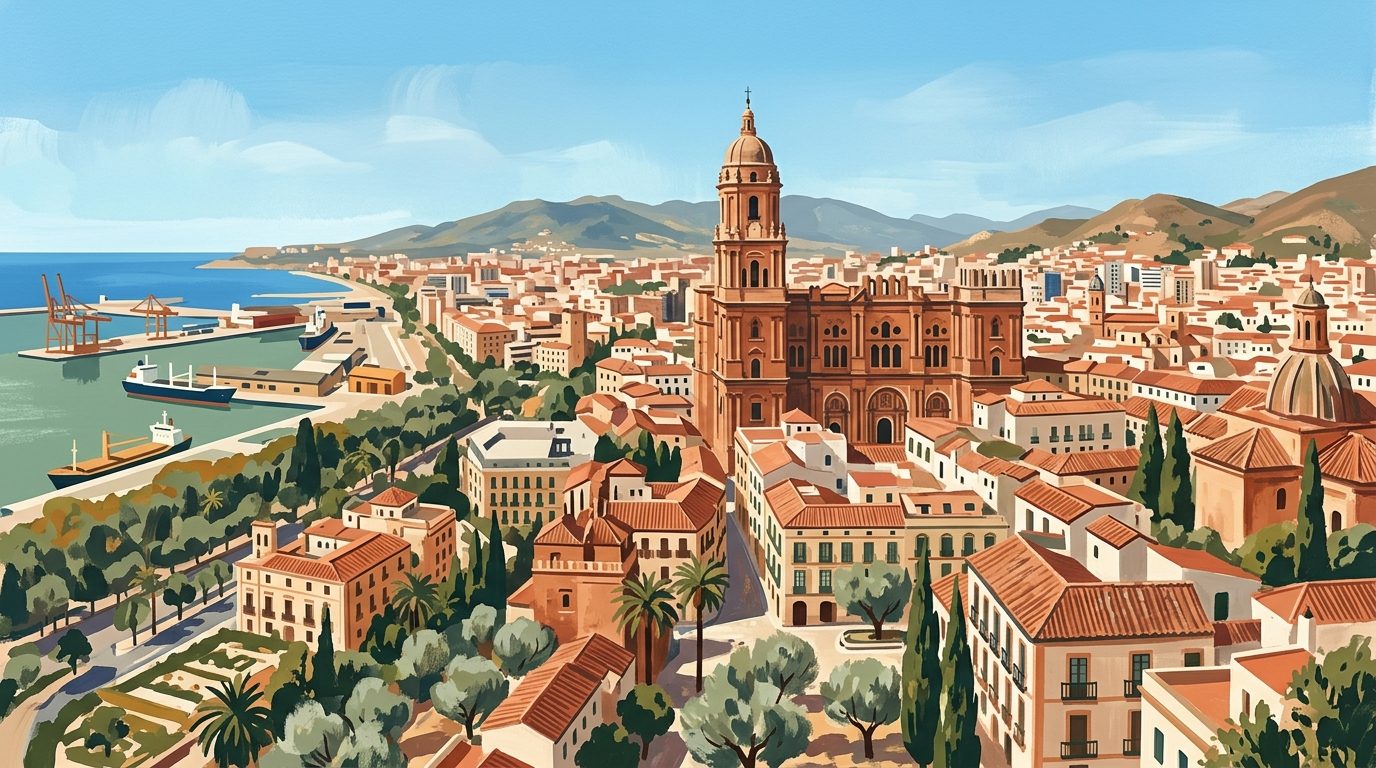
Few cities manage to marry 16th-century stone with 21st-century glass as harmoniously as Málaga. The walk from the shadow of the cathedral’s unfinished tower to the white canopy of the port is the defining experience of the city.
Málaga has undergone a remarkable evolution over the last two decades, shifting from a mere gateway for the Costa del Sol into a sophisticated cultural capital. At the heart of this change is the relationship between its historic centre and the Mediterranean. For centuries, the city turned its back on the water, separated by industrial fences and a weary harbour. Today, that barrier has vanished, replaced by a seamless transition from the limestone majesty of the Santa Iglesia Catedral Basílica de la Encarnación to the sleek, open-air promenade of Muelle Uno.
Walking through this area allows you to trace the city’s timeline. You start among the narrow, orange-scented streets of the old town, dominated by one of the tallest cathedrals in Andalucía, and end at a waterfront that feels more like a modern art gallery than a working port. It is a space designed for slow strolls, long lunches, and observing how the Mediterranean light plays off both Renaissance arches and contemporary steel structures.
What to See & Do
The Cathedral: La Manquita
Málaga Cathedral is a masterclass in architectural perseverance, and its eventual exhaustion. Construction began in 1528 on the site of a former mosque and continued for over 250 years. However, if you look at the main façade, you will notice something striking: the south tower is missing. This earned the building its affectionate nickname, "La Manquita," or The One-Armed Lady.
Local legend suggests the funds intended to finish the second tower were sent to support the American Revolutionary War against the British, though records imply the money was more likely diverted to pay for the road to Antequera. Inside, the scale is immense. The central nave is among the highest in Spain, supported by massive fluted columns. The true masterpiece, however, is the choir. Carved by Pedro de Mena and other Renaissance masters, the 42 wooden stalls feature incredibly detailed figures that seem almost fluid despite being made of cedar and mahogany.
The Rooftop Walkway (Las Cubiertas)
To truly understand the layout of the city, you should climb the 200 steps to the cathedral roof. This isn't just a balcony; it is a walk across the very top of the domes and vaults. From this height, the city opens up. To the north, you see the Alcazaba fortress and Gibralfaro Castle clinging to the hillside; to the south, the blue expanse of the Alboran Sea. It is particularly effective at sunset when the stone of the cathedral turns a deep ochre.
Palmeral de las Sorpresas
Leaving the cathedral and crossing the Plaza de la Marina, you enter the port area via the Palmeral de las Sorpresas (The Palm Grove of Surprises). This is a masterfully designed park featuring a long, undulating white concrete canopy that provides much-needed shade. Thousands of trees, fountains, and children’s play areas line this stretch, which serves as a quiet buffer between the city traffic and the water. It is a favourite spot for locals to take their evening paseo, watching the cruise ships dock in the distance.
Centre Pompidou Málaga
At the corner where the two piers meet, a giant multicoloured glass cube marks the entrance to the Centre Pompidou Málaga. This was the first branch of the famous Parisian gallery to open outside France. While the "Cube" is the visible landmark above ground, the gallery itself is subterranean. It houses a rotating collection of 20th and 21st-century art, featuring works by artists such as Picasso (a Málaga native), Francis Bacon, and Frida Kahlo. The space is bright, airy, and manages to make high-concept modern art feel accessible to casual visitors.
Muelle Uno
Muelle Uno is the commercial heart of the waterfront. This is not a standard shopping centre; it is a broad, open-air quay lined with independent boutiques, high-end brands, and an array of restaurants. It feels like a social hub rather than a mall. At the far end stands La Farola, the city’s lighthouse. Built in 1817, it is one of the few lighthouses in Spain to be given a female name, and it remains a sturdy symbol of the city’s maritime history.
Practical Information
Málaga Cathedral
Opening Times: Typically Monday to Friday 10:00 to 20:00, with reduced hours on weekends. Note that the last entry is 45 minutes before closing, and access may be restricted during religious services. Check the official website for seasonal variations and mass times.
Ticket Prices: General admission is usually around €10.00 (which includes an audio guide), with a combined rooftop ticket for approximately €15.00. Concessions are available for seniors (65+) and students (under 25), whilst residents of Málaga province can enter for free with proof of ID. (Check on the operator's website before travelling for the latest 2026 pricing).
Centre Pompidou Málaga
Opening Times: Open daily from 09:30 to 20:00. The museum is closed on Tuesdays, 1st January, and 25th December. Visit the Centre Pompidou Málaga website for current exhibition schedules.
Ticket Prices: Combined entry for the semi-permanent and temporary exhibitions is typically €9.00, with reduced tickets for seniors and students around €5.50. Entrance is normally free for everyone on Sundays after 16:00. (Check on the operator's website before travelling for up-to-date pricing).
How to Get There & Parking
The cathedral is in the pedestrianised centre, a two-minute walk from Calle Larios. If you are arriving by car, the most convenient option is the Muelle Uno Underground Parking (Paseo de la Farola). It is open 24 hours and offers direct access to the waterfront. Prices are approximately €2.10 to €2.50 per hour (visit the Muelle Uno website for current rates). Alternatively, Parking Plaza de la Marina is situated directly between the cathedral and the port entrance.
Where to Eat Nearby
For a traditional atmosphere, El Pimpi is an institution. Located near the cathedral, its labyrinthine rooms and wine barrels signed by celebrities like Antonio Banderas make it a classic choice for a glass of sweet Málaga Virgen wine and a plate of Iberian ham. For something more contemporary, head to the port and visit José Carlos García. This Michelin-starred restaurant offers a sophisticated take on local flavours with views directly over the yachts. For a reliable seafood lunch, Los Mellizos on Calle Sancha de Lara provides exceptionally fresh fish in a refined setting just steps from the harbour.
Where to Stay
Palacio Solecio is a beautifully restored 18th-century palace in the Jewish Quarter, offering an elegant, quiet retreat just five minutes from the cathedral. For those who prefer a view, the AC Hotel Málaga Palacio is positioned perfectly between the old town and the port. Its rooftop bar is famous for having the best perspective of the cathedral’s exterior and the coastline, making it an ideal base for exploring both the historic and modern sides of the city.