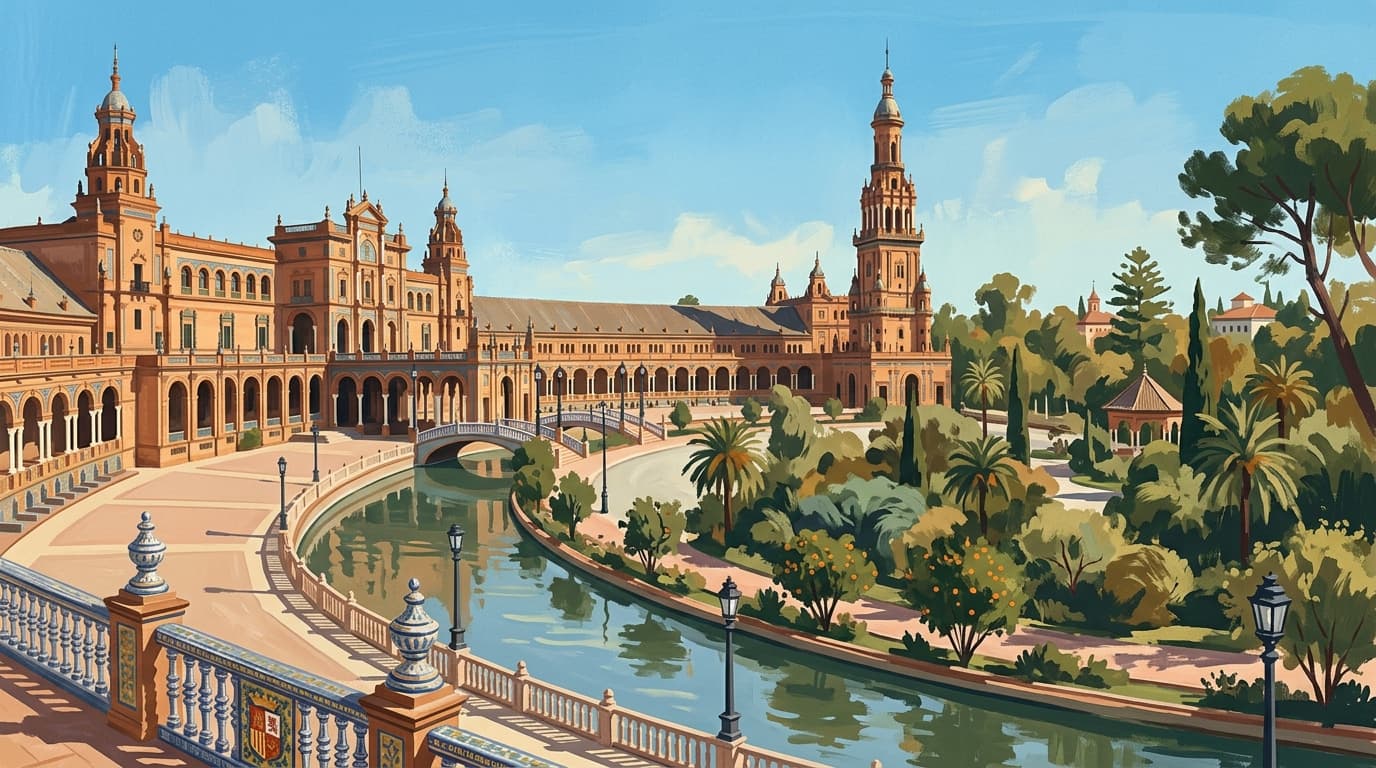
An architectural masterpiece created for the 1929 Ibero-American Exposition, the Plaza de España sits at the heart of Seville’s most extensive green space. This guide explores the tiled alcoves, winding paths, and historic pavilions that define this monumental corner of the city.
Exploring Plaza de España and María Luisa Park in Seville
To walk through the Plaza de España and the surrounding María Luisa Park is to step into a grand vision of Seville’s early 20th-century identity. While the city’s medieval core is a labyrinth of narrow alleys, this southern district offers wide-open boulevards and monumental scale. Designed as the centrepiece of the 1929 Ibero-American Exposition, the plaza was intended to showcase Spain’s industrial and architectural prowess to the world. It succeeded so well that it remains one of the most photographed locations in Europe, serving as a backdrop for everything from royal visits to Hollywood blockbusters like Star Wars: Attack of the Clones.
The park itself was originally part of the private gardens of the Palace of San Telmo. In 1893, Princess María Luisa Fernanda, Duchess of Montpensier, donated half of the palace grounds to the city. Jean-Claude Nicolas Forestier, the French landscape architect who designed the Champ-de-Mars in Paris, transformed the site into a Mediterranean woodland. The result is a landscape that feels deliberate and organic at once, where formal ceramic fountains are framed by wild expanses of Mediterranean fan palms, bitter orange trees, and towering eucalyptus.
What to See & Do
The area is vast, covering roughly 100 acres. While many visitors simply walk across the plaza and leave, the true charm of this space lies in the details found within the wooded groves and the smaller pavilions scattered throughout the parkland.
The Provincial Alcoves
The most striking feature of the Plaza de España is the semi-circular brick building that wraps around the central square. Running along the base of this facade are 48 tiled alcoves, each representing a different province of Spain. Each alcove features a map of the province, its coat of arms, and a ceramic painting depicting a significant historical event from that region. It is a local tradition for Spanish visitors to find their home province and pose for a photograph on the benches. The ceramics are examples of Triana tilework, demonstrating the high level of craftsmanship Seville is known for.
Rowing the Canal
A 500-metre canal follows the curve of the plaza building, crossed by four ornate bridges representing the four ancient kingdoms of Spain: Castile, León, Aragon, and Navarre. You can hire a small rowing boat to navigate the waters. It is a slow, peaceful way to see the architecture from a different perspective, looking up at the two 74-metre towers that anchor the ends of the plaza. The water is shallow, and the rowing is manageable even for beginners, making it a popular activity for families and couples in the late afternoon.
Monte Gurugú and the Cascades
Deep within the Parque de María Luisa, you will find Monte Gurugú, a small artificial hill named after a mountain in Morocco. It features a stone staircase leading to a viewpoint at the top and a waterfall that spills into a small pond. It is one of the coolest spots in the park during the heat of a Seville summer, shaded by dense foliage and cooled by the mist from the water. Nearby, the Isleta de los Patos (Duck Island) is a small pavilion in the middle of a lake where you can see swans, ducks, and peacocks roaming freely.
Plaza de América and the Museums
At the southern end of the park lies the Plaza de América, framed by three distinct architectural styles: Neo-Mudéjar, Gothic, and Renaissance. This area is often called the 'Pigeon Plaza' because of the sheer number of white doves that congregate here, often fed by local children. The Neo-Mudéjar building houses the Museum of Arts and Traditions, which offers a look at traditional Andalusian life, including flamenco costumes and agricultural tools. Opposite is the Archaeological Museum, housed in a Renaissance-style pavilion. Please note that the Archaeological Museum is currently undergoing extensive renovations, though the exterior remains a highlight of the park’s architecture.
Horse and Carriage Rides
Seville’s traditional horse-drawn carriages (coches de caballos) have several official stops around the park and the plaza. A ride usually lasts about 45 minutes and takes you through the main avenues of the park, offering a narrative of the various pavilions built for the 1929 Expo. It is a classic Seville experience that allows you to cover more ground than you would on foot, especially during the warmer months when walking the full perimeter of the park can be tiring.
Practical Information
The Plaza de España and María Luisa Park are free to enter. However, certain activities and nearby museums carry a cost.
- Opening Times: The park and plaza are open daily from 08:00 to 22:00 in winter, and until 00:00 during the summer months (usually May to September).
- Rowing Boat Hire: Approximately €6 for a 35-minute rental. Motorboats are also available for around €12.
- Museum of Arts and Traditions: Admission is free for EU citizens and €1.50 for other visitors. It is closed on Mondays.
- How to Get There: The easiest way to reach the area is via the Seville Metro (Line 1) to the 'Prado de San Sebastián' station. The T1 Tram also stops at San Bernardo or Prado de San Sebastián, both a five-minute walk from the park entrance. Numerous bus lines, including the C1 and C2, stop at the 'Glorieta de los Marineros' near the river.
- Parking: On-street parking near the park is difficult and usually managed by 'gorrillas' (unauthorised attendants asking for change). It is better to use the underground car park at Avenida de Roma or the public parking at San Bernardo.
Where to Eat Nearby
While the park has a few small kiosks for water and ice cream, you will find better dining options just across the main road in the El Porvenir or San Bernardo districts. Espigón on Calle Capitán Vigueras is a formal, high-quality seafood restaurant known for its fresh fried fish and traditional service. For something more contemporary, Marea offers excellent tapas with a focus on seasonal ingredients. If you prefer a quick bite with a view, Bilindo is located right on the edge of the park near the river and serves standard Mediterranean fare in an outdoor setting that is particularly pleasant in the evening.
Where to Stay
The area surrounding the park is home to some of Seville’s most established hotels. Meliá Sevilla is located directly opposite the Plaza de España and offers modern rooms with many overlooking the monument itself. For a more historic stay, the Hotel Alfonso XIII is a short walk away near the Puerta de Jerez; built to house dignitaries for the 1929 Exposition, it remains the city's most prestigious hotel, featuring grand Andalusian patios and intricate tilework.