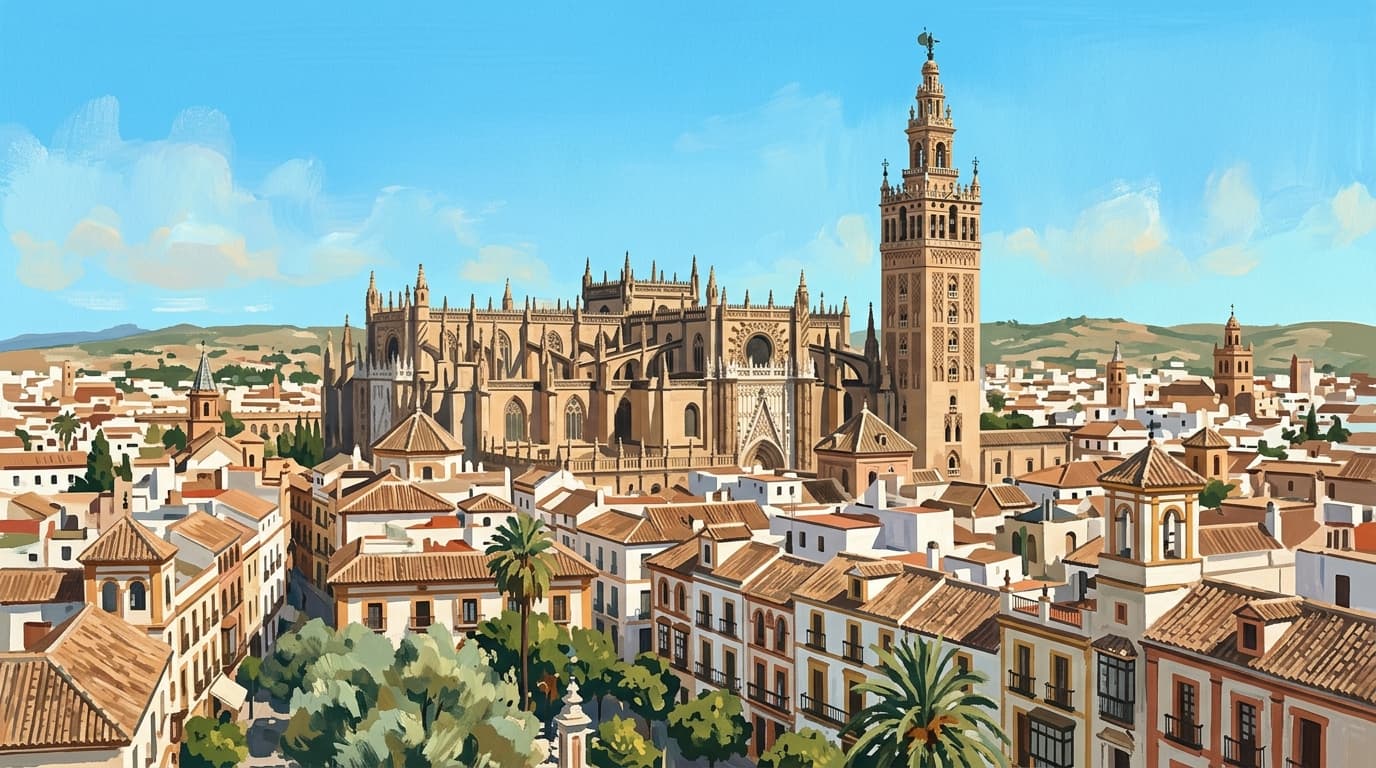
Standing on the site of a 12th-century mosque, Seville Cathedral represents the sheer ambition of the Reconquista through its scale and architectural complexity. Its famous bell tower, the Giralda, remains the city’s most enduring landmark and offers the finest views over the terracotta rooftops of the Santa Cruz quarter.
Exploring Seville Cathedral and the Giralda Tower
When the cathedral chapter decided to build a new church in 1401, they famously declared their intention to create a structure so magnificent that future generations would think them mad for attempting it. This ambition was not merely hyperbole; the resulting Santa María de la Sede Cathedral is the largest Gothic building in the world and the third-largest church overall, surpassed only by St. Peter’s in Rome and St. Paul’s in London. It occupies the footprint of the former Almohad Great Mosque, and this layer of Islamic influence provides a fascinating architectural dialogue throughout the site.
The cathedral was recognised as a UNESCO World Heritage site in 1987, and walking through its massive bronze doors today remains one of the definitive experiences of Southern Spain. It is a place where the weight of the past is felt in the cool, cavernous interior, and where the transition from an Islamic caliphate to a Christian kingdom is written directly into the stone and mortar. Whether you are an art historian or a casual visitor, the sheer scale of the 80 chapels and the 42-metre-high central nave is designed to inspire awe.
What to See & Do
The Great Main Altar (Retablo Mayor)
Positioned at the heart of the cathedral, the Retablo Mayor is an overwhelming display of craftsmanship and devotion. Designed by the Flemish sculptor Pierre Dancart, it took nearly 80 years to complete and is considered the largest and most expensive altarpiece in Christendom. The work features over 1,000 carved figures and 44 distinct relief scenes depicting the life of Christ and the Virgin Mary. Every centimetre is covered in gold leaf brought back from the Americas, glinting in the dim light of the nave. To appreciate the detail, it is worth spending time identifying the individual panels, which transition from Gothic styles at the bottom to more Renaissance influences at the top.
The Giralda Bell Tower
The Giralda is the emblem of Seville. Originally the minaret for the mosque, its lower two-thirds date back to the 12th century, featuring the distinctive brick latticework characteristic of Almohad design. After the reconquest, the Christians added a Renaissance-style belfry to house 24 bells, topped with the Giraldillo—a bronze weather vane representing Faith. Remarkably, there are no stairs to the top. Instead, 35 gently sloping ramps were built so that the Sultan or the muezzin could ascend the tower on horseback. Climbing these ramps today is manageable for most fitness levels and provides a gradual reveal of the city’s skyline.
The Tomb of Christopher Columbus
Located near the Puerta de los Príncipes, the tomb of the explorer Christopher Columbus is a dramatic monument of bronze and stone. Four monumental figures, representing the four kingdoms of Spain—Castile, Aragon, Leon, and Navarre—carry his casket aloft. The remains inside were moved several times, travelling from Valladolid to Seville, then to Santo Domingo, Havana, and finally back to Seville in 1899. For many years, the authenticity of the remains was questioned, but DNA testing in 2006 confirmed that the bones within the cathedral are indeed those of the navigator.
Patio de los Naranjos
This courtyard served as the original ablutions area for the Almohad mosque, where worshippers would wash before prayer. Today, it contains over 60 orange trees, providing a fragrant and shaded space to rest before exiting. The layout remains largely unchanged from the 12th century, including the central fountain. As you leave through the Puerta del Perdón (Gate of Forgiveness), look up to see the fine plasterwork that combines Islamic horseshoe arches with later Christian bronze doors.
The Royal Chapel and Sacristy
The Capilla Real holds the remains of King Fernando III, who captured Seville from the Moors in 1248 and was later canonised. His silver tomb is a masterpiece of the Baroque era. Nearby, the Sacristía Mayor houses the cathedral's treasury, including the keys to the city presented to Fernando. The walls here are lined with significant artworks, including pieces by Goya and Murillo, which would be the centrepiece of any standard museum but are simply part of the daily fabric here.
Practical Information
Seville Cathedral is located in the Plaza de la Virgen de los Reyes, in the city centre. Due to its popularity, booking tickets online in advance is essential to avoid queues that can stretch for hours in the summer heat.
- Opening Times: Monday to Saturday from 10:45 to 18:00 (last entry at 17:00). Sunday from 14:30 to 18:00. Note that the cathedral is a working church, and times may change for special liturgical celebrations.
- Ticket Prices: General admission is €12 when purchased online and €13 at the ticket office. This price includes access to the Cathedral, the Giralda, and the nearby Church of El Salvador. Reduced tickets for students under 25 and seniors over 65 are €7. Free entry is available for residents of Seville and the unemployed (proof required).
- How to Get There: The Metrocentro tram (Line T1) stops at Archivo de Indias, directly across from the cathedral. It is also a short walk from the Puerta de Jerez metro station.
- Parking: Driving in the immediate vicinity is discouraged as most streets are pedestrianised. The nearest public car parks are Parking Avenida Roma or Parking Cano y Cueto, both roughly a ten-minute walk away.
Where to Eat Nearby
For an authentic experience, head to Las Teresas in the nearby Santa Cruz quarter. Established in 1870, this bar is famous for its hand-carved jamón ibérico and traditional cold tapas. It offers a standing-room-only atmosphere that feels worlds away from the tourist crowds. If you prefer a more casual, high-energy environment, Bodega Santa Cruz (Las Columnas) is an institution. It is usually crowded, but the montaditos (small sandwiches) and pringá are excellent and very affordable. For a contemporary take on Andalusian flavours, El Pintón offers a stylish courtyard setting with a menu featuring fresh seafood and modern rice dishes.
Where to Stay
Staying in the Santa Cruz district puts you on the doorstep of the cathedral. Hotel Doña María is a classic choice, featuring a rooftop terrace with arguably the best head-on view of the Giralda. For those seeking absolute luxury, the Hotel Alfonso XIII is a short walk away, offering palatial interiors and exceptional service. Numerous boutique hotels, such as Hotel Casa 1800 Seville, provide a more intimate stay in restored 19th-century mansions, often featuring private patios and traditional tilework.