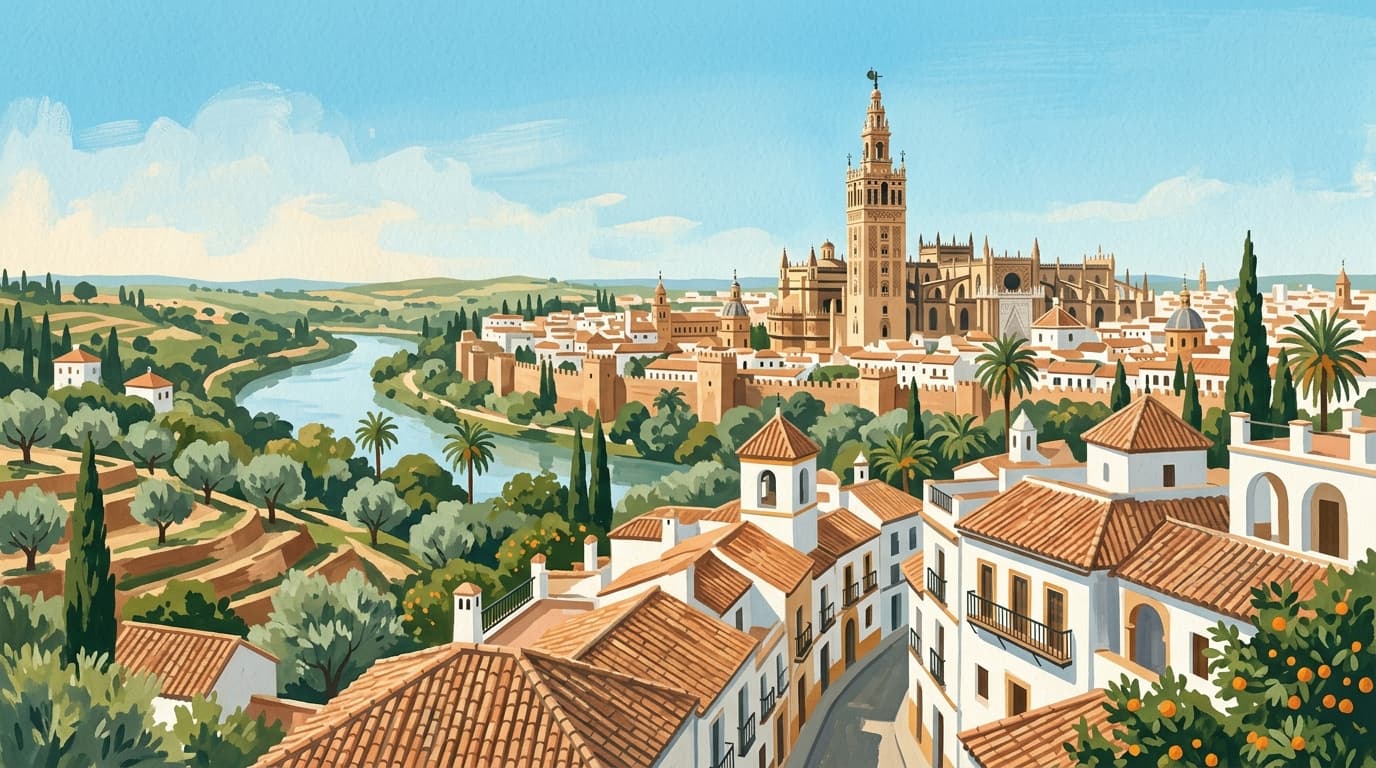
Seville is a city that moves at its own pace, where the scent of bitter orange blossom hangs heavy in the humid air of spring and the sound of a distant Spanish guitar is never far away. It is the definitive Andalucían experience, balancing grand Gothic monuments with the intimate, lived-in charm of its river-facing neighbourhoods.
Seville does not reveal itself to those in a hurry. To understand the Andalucían capital, you must adopt the local rhythm: a slow morning coffee, a long afternoon siesta (nap) when the sun is at its peak, and an evening that only truly begins when the sky turns a deep violet. This is a city of layers, where Roman foundations support Moorish walls, which in turn house Renaissance palaces. It is the home of flamenco, the setting of Carmen, and the place where the Spanish Empire’s colonial riches once flowed through the Guadalquivir river.
While many visitors arrive with a checklist of monuments, the real character of Seville is found in the sobremesa—that uniquely Spanish tradition of lingering at the table long after the meal has finished to talk, argue, and laugh. Whether you are standing at a grease-stained wooden bar in a century-old taberna or watching the light fade over the terracotta rooftops from a terrace, you will find that Seville is less about seeing things and more about feeling them. The city is unashamedly traditional, yet it possesses an energy that keeps it from ever feeling like a museum.
Places to Explore
Seville Cathedral & Giralda
The scale of the Catedral de Santa María de la Sede is difficult to grasp until you are standing beneath its central nave, the highest in Spain. Built on the site of the city’s 12th-century Almohad mosque, the cathedral governors famously declared in 1401 their intention to build a church "so beautiful and so great that those who see it finished will think we are mad." They largely succeeded. The interior is a forest of stone pillars, housing the tomb of Christopher Columbus and the Retablo Mayor, a staggering wall of carved wood and gold leaf that took Pierre Dancart nearly a lifetime to complete.
The Giralda, the cathedral’s bell tower, remains the city’s most enduring icon. Originally the minaret of the mosque, its ascent is unique; instead of stairs, a series of 34 gently sloping ramps lead to the top. This design allowed the Sultan to ride his horse to the summit to enjoy the call to prayer. From the top, the view over the city’s flat roofs and internal patios is peerless. Before leaving, walk through the Patio de los Naranjos (Courtyard of the Orange Trees), where the original Moorish irrigation channels still water the trees, providing a cool, shaded respite from the stone heat.
→ Read the full Seville Cathedral & Giralda guide
Real Alcázar de Sevilla
While the Cathedral represents the city’s Christian triumph, the Real Alcázar is a testament to Mudéjar art—a style where Islamic craftsmen worked under Christian rule. This royal palace is still used by the Spanish royal family today, making it one of the oldest active royal residences in Europe. The heart of the complex is the Palacio de Don Pedro, specifically the Patio de las Doncellas (Courtyard of the Maidens). The intricate plasterwork, known as yesería, and the complex artesonado (coffered) wooden ceilings are so detailed they appear more like lace than stone or wood.
The transition from the ornate interior rooms to the expansive gardens is one of the great joys of a Seville visit. The gardens are a labyrinth of palms, fountains, and peacocks, where the scent of jasmine is often overpowering. Look out for the Galeria de Grutesco, an elevated walkway built into the old Almohad wall that offers a bird's-eye view of the formal hedges and the Baños de María de Padilla (the baths of Maria de Padilla), a vaulted underground tank where the water remains perfectly still, reflecting the golden stone of the arches above.
→ Read the full Real Alcázar de Sevilla guide
Barrio Santa Cruz
The old judería (Jewish quarter) is a tangle of narrow alleys designed to trap cool air and provide shade during the fierce Andalucían summers. It is easy to get lost here, and that is precisely the point. The streets are so narrow in places—such as the Callejón del Agua—that they are known as "kissing lanes," where neighbours can reach across from their balconies. The barrio is defined by its white-washed walls, wrought-iron window grilles (rejas), and glimpses into private courtyards filled with ferns and colourful tiles.
For a quieter moment, find your way to the Plaza de la Alianza or the Plaza de Doña Elvira, which is surrounded by orange trees and tiled benches. While Santa Cruz is undoubtedly the most visited part of the city, it retains an air of mystery after dark. Visit the Hospital de los Venerables, a former home for elderly priests, to see its stunning Baroque chapel and a small but excellent collection of Velázquez paintings. When the crowds thin out in the evening, the sound of water trickling from stone fountains becomes the neighbourhood’s soundtrack, reminding you of its medieval origins.
→ Read the full Barrio Santa Cruz guide
Barrio de Triana
To reach Triana, you must cross the Puente de Isabel II, more commonly known as the Triana Bridge. Historically, this was the sailors' and potters' quarter, a place with a distinct identity that often feels like a separate village from the rest of Seville. Triana is the spiritual home of flamenco and azulejos (ceramic tiles). As you enter the neighbourhood, the Mercado de Triana sits directly on your right, built over the ruins of the Castillo de San Jorge, the former seat of the Inquisition. The market is excellent for local cheeses and bacalao (salted cod).
Walk down Calle Castilla to find the Centro Cerámica Triana, housed in an old factory, which explains the district’s long history of clay-working. For a drink with a view, Calle Betis runs along the riverbank, offering a panorama of the Torre del Oro and the Giralda. However, for a more authentic experience, head deeper into the barrio to find a peña flamenca (a local flamenco club) or a small bar like Casa Cuesta, where the walls are lined with old feria posters and the atmosphere is thick with local conversation rather than tourist scripts.
→ Read the full Barrio de Triana guide
Plaza de España & Parque de María Luisa
Built for the Ibero-American Exposition of 1929, the Plaza de España is a grand semi-circular brick palace that serves as a love letter to Spain’s provinces. Each province is represented by a tiled alcove and a bench where visitors from across the country often take photos of their home town’s heraldry. The floor is covered in albero—the yellow-gold sand found in Seville’s bullrings—and a small canal allows you to rent a rowing boat to pass under the four bridges representing the ancient kingdoms of Spain.
The plaza is situated within the Parque de María Luisa, the city’s primary green space. It is a sprawling park of Mediterranean and exotic plants, dotted with hidden gazebos and tiled fountains. It is far less manicured than a northern European park, which is part of its charm. Seek out the Monte Gurugú, a small man-made hill with a waterfall, or the Isleta de los Patos (Duck Island), where the writer Gustavo Adolfo Béquer is said to have found inspiration. It is the perfect place to escape the city noise, especially in the late afternoon when the light filters through the plane trees and the local 19th-century architecture feels at its most romantic.
→ Read the full Plaza de España & Parque de María Luisa guide
Eating & Drinking in Seville City
Eating in Seville is an informal, social affair centered around the tapeo (tapas crawl). Start at El Rinconcillo on Calle Gerona; established in 1670, it is the city’s oldest bar, where the waiters still chalk your bill directly onto the mahogany counter. Order the espinacas con garbanzos (spinach with chickpeas), a classic Moorish-influenced dish that Seville does better than anywhere else. For something more contemporary, head to La Brunilda in Arenal, which serves an exceptional cod fritter with pear aioli.
In the evenings, follow the locals to Bodega Santa Cruz (locally known as 'Las Columnas') for a pringa montadito—a small toasted sandwich filled with slow-cooked pork, chorizo, and morcilla. If you want a break from meat, Seville’s salmorejo (a thicker, creamier version of gazpacho topped with egg and ham) is a staple. Pair your food with a caña (small draught beer) of Cruzcampo or a chilled glass of manzanilla sherry from nearby Sanlúcar de Barrameda. Finish the night at Casa Morales, where massive 19th-century wine vats (tinajas) form the backdrop for a final glass of vermouth.
Where to Stay
For those who want to be in the heart of the action, Barrio Santa Cruz offers several boutique options housed in converted palacetes. Las Casas de la Judería is perhaps the most atmospheric, consisting of 27 traditional houses linked by a series of underground tunnels and internal courtyards. It feels more like a private village than a hotel. If you prefer something more modern but with a sense of history, the area around the Plaza de la Encarnación (home to the Setas de Sevilla) offers stylish apartments with rooftop views.
For a quieter, more local experience, look across the river to Triana. Hotels here, like the Zenit Sevilla, offer a slightly slower pace and easier access to the riverside walk. If luxury is the priority, the Hotel Alfonso XIII is the city’s grand dame, built to house international dignitaries during the 1929 Expo; even if you don’t stay there, the Moorish-revival courtyard is worth a visit for a coffee.
Getting There & Around
Seville is exceptionally well-connected. The Santa Justa railway station is a hub for the AVE high-speed train, whisking you to Madrid in just two and a half hours or Córdoba in forty minutes. The Seville Airport (SVQ) is a twenty-minute taxi or bus ride from the centre. Once in the city, your best assets are your own feet. The historic centre is largely pedestrianised and flat. For longer distances, the Sevici bike-sharing scheme is excellent, with docking stations throughout the city. The MetroCentro tram also runs a short, useful route from Plaza Nueva to the San Bernardo train station.
Best Time to Visit
Spring is the golden season in Seville. During late March and April, the scent of orange blossom (azahar) is everywhere, and the city prepares for its two biggest events: Semana Santa (Holy Week) and the Feria de Abril. The weather is warm but rarely oppressive. Avoid July and August if possible; temperatures frequently exceed 40°C, earning the city the nickname "the frying pan of Europe." Autumn is a fantastic alternative, with mild temperatures and fewer crowds, while winter is often sunny and crisp, perfect for long walks and outdoor dining under the heaters.