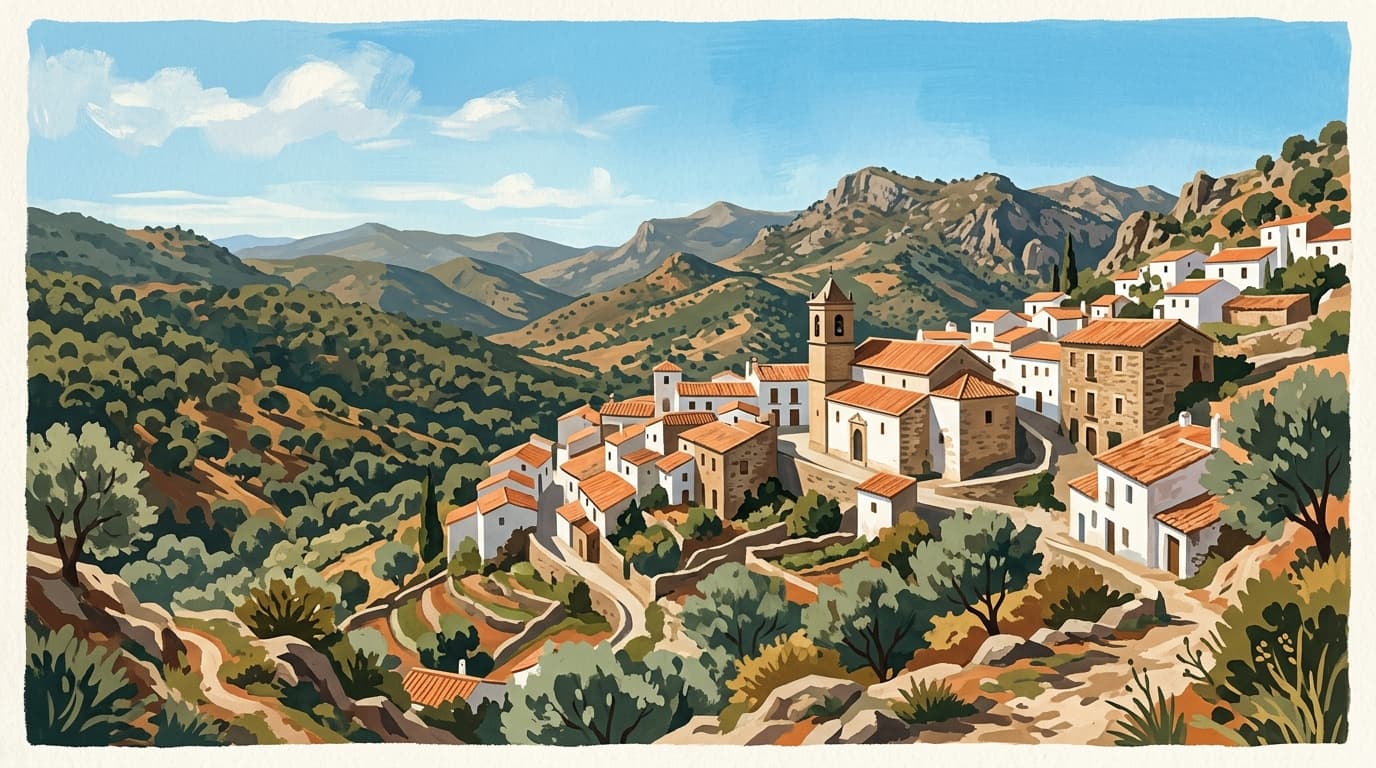
While the city of Seville swelters, the rolling oak forests and jagged karst peaks of the Sierra Norte provide a cooler, wilder sanctuary. This is a landscape of slow-cooked stews, ancient silver mines, and cork trees that have stood for centuries.
The Lungs of Seville: An Introduction to the Sierra Norte
To many visitors, Seville is defined by the Giralda and the scent of orange blossom in the Barrio Santa Cruz. However, those who travel eighty kilometres north find a completely different world. The Sierra Norte de Sevilla, part of the sprawling Sierra Morena range and a designated UNESCO Global Geopark, is a landscape dominated by the dehesa (Mediterranean oak savannah). Here, the air is sharper, the pace of life is dictated by the seasons, and the architecture shifts from the Mudéjar brick of the city to the whitewash and stone of the mountains.
This region is not a place for frantic sightseeing. It is an area for long walks through cork oak forests, exploring abandoned iron mines like the Cerro del Hierro, and sitting in town squares where the only sound is the fountain and the occasional tractor. The geology here is ancient; the karst formations and the Rivera del Huéznar waterfalls create a microclimate that feels more like northern Europe than the dry plains of the Guadalquivir valley. For the Sevillanos, this is their weekend escape, a place to eat jamón ibérico at its source and to enjoy the scent of woodsmoke in the autumn air.
Places to Explore
Constantina
Constantina is perhaps the most architecturally striking town in the park. Spread across a valley and overlooked by the ruins of its Moorish castle, the town is divided into distinct neighbourhoods that reflect its history. The Barrio de la Morería (Moorish Quarter) is a tangle of steep, narrow streets where the whitewash is so bright it almost glows under the Andalucian sun. Walking up to the Castillo (castle) provides a panoramic view of the red-tiled roofs and the surrounding silver-green olive groves. The fortress itself, though largely in ruins, maintains its imposing 15th-century silhouette.
Down in the lower part of town, the atmosphere changes. The Paseo de la Alameda is the social heart of Constantina, lined with plane trees and traditional bars. Constantina has a long-standing reputation for its production of spirits; the local crema de guindas (cherry liqueur) is a local staple. Visit the Destilerías de Constantina to understand how these traditions have survived. For those interested in the industrial past, the nearby Pozos de Nieve (ice houses) are fascinating stone structures where snow was once packed and stored to provide ice for Seville during the summer months. The town’s parish church, Santa María de la Encarnación, features a stunning 50-metre tower that serves as a landmark for miles around.
→ Read the full Constantina guide
Cazalla de la Sierra
Cazalla de la Sierra sits higher and feels slightly more aristocratic than its neighbours. It was once a favourite retreat for King Philip V, and that regal influence remains in the grand facades of the manor houses along Calle La Plazuela. The town is synonymous with aguardiente (anise-flavoured spirit), a tradition so deep-seated that the word 'Cazalla' became a generic term for the drink across much of Spain. You can still visit local producers like Anís Miura to see the copper stills in action.
The standout architectural site is the Cartuja de Cazalla, a former Carthusian monastery located a few kilometres outside the town centre. It has been converted into a unique hotel and arts space, but its ruins remain hauntingly beautiful, surrounded by orchards and silence. Back in the centre, the Nuestra Señora de la Consolación church is a remarkable example of how different eras collided; its unfinished facade and fortress-like walls are a mix of Mudéjar, Renaissance, and Baroque styles. For nature lovers, the town is the starting point for several trails leading to the Rivera del Huéznar. The 'Sendero de las Laderas' is a particularly rewarding walk that follows the river through a dense canopy of gallery forest, providing shade even in the height of summer.
→ Read the full Cazalla de la Sierra guide
Eating & Drinking in Sierra Norte de Sevilla
The gastronomy of the Sierra Norte is unashamedly rustic and seasonal. Because this is dehesa country, the Cerdo Ibérico (Iberian pig) is king. The acorns from the holm oaks provide the diet for the pigs that produce some of the finest hams in the world. In any bar in Constantina or Cazalla, you should start with a plate of jamón or caña de lomo (cured loin). However, the region is also famous for its wild game. Look for caldereta de venado (deer stew) or jabalí (wild boar) on the menu at places like Restaurante Agustina in Cazalla, which offers a contemporary twist on these mountain staples.
Autumn brings a bounty of setas (wild mushrooms), particularly the tana (Amanita caesarea) and the gallipierno. Restaurants like Casa Tocinillo in Constantina specialize in these fungal delights. For something sweet, the local convents are the place to go; the nuns at the Convento de Santa Clara in Constantina sell traditional handmade pastries. To wash it all down, try the local wines. While Seville isn't traditionally known as a wine province, the Sierra Norte is an exception. Wineries like Bodega Fuente Reina are producing excellent reds and whites on the high-altitude slopes, proving that there is more to Andalucian drink than just Sherry and Manzanilla.
Where to Stay
For a truly immersive experience, skip the standard hotels and look for a casa rural (country house). In Cazalla de la Sierra, the Palacio de San Benito is a dreamlike choice; it is an old hospital and palace filled with antiques, religious art, and overgrown gardens. It feels more like staying in a private museum than a hotel. For something closer to nature, El Batán de las Monjas near the Huéznar waterfalls offers simple, comfortable apartments and a fantastic restaurant on-site, perfect for those who want to wake up to the sound of the river.
In Constantina, the Hospedería del Monasterio is located in a refurbished part of a working monastery. It offers a peaceful, austere luxury with thick stone walls that keep the rooms cool in summer and warm in winter. If you prefer to be in the heart of the village, many of the traditional townhouses have been converted into boutique rentals, retaining their original courtyards and tiled floors.
Getting There & Around
The most flexible way to explore the Sierra Norte is by car. From Seville, take the A-431 towards Lora del Río and then the A-455 up into the mountains. The drive takes roughly 90 minutes. Be prepared for winding roads; while the surfaces are generally good, the turns can be sharp as you climb into the park. For those preferring public transport, the Cercanías C-3 train line runs from Seville’s Santa Justa station to 'Cazalla-Constantina' station. Note that the station is located about 5 kilometres from either town, so you will need to coordinate a local bus or taxi to reach your final destination.
Best Time to Visit
Autumn (October to December) is arguably the best time to visit the Sierra Norte. This is when the dehesa comes alive; the pigs are foraging for acorns, the mushrooms are appearing after the first rains, and the leaves of the deciduous trees along the riverbanks turn golden. Spring (March to May) is also spectacular, with wildflowers carpeting the hillsides and the waterfalls at their most powerful. Summers are much cooler than the city of Seville, making it a popular escape for locals, though the landscape can look quite parched by August. Winters are crisp and cold, often with frost on the ground—perfect for sitting by a roaring fire with a glass of local aguardiente.