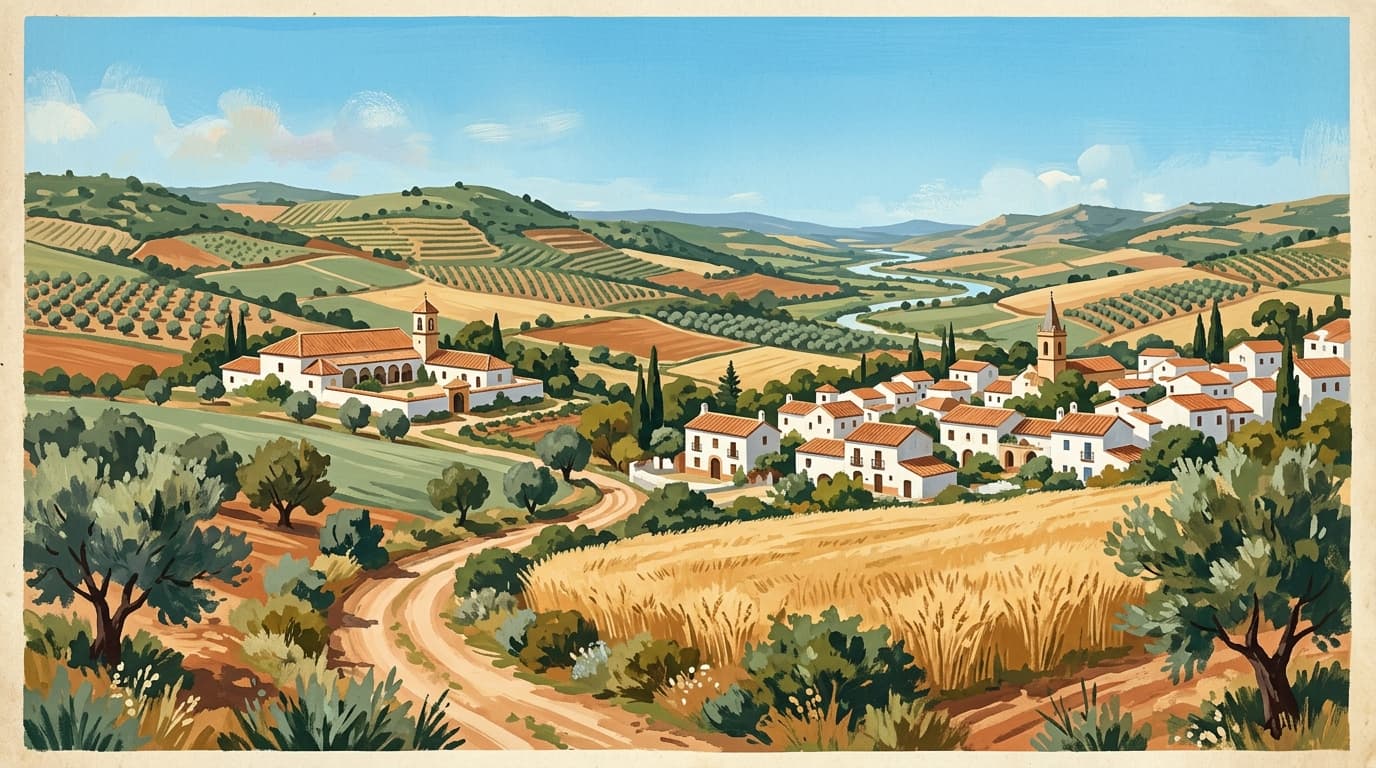
Stretching across the fertile basin of the Guadalquivir, this is a landscape of rolling wheat fields and silver-green olive groves. It is a region where monumental Baroque towers rise above the horizon long before the towns themselves come into view.
To travel through the Campiña Sevillana (Sevillian countryside) and the Lower Guadalquivir is to step into the engine room of Andalucían history. This vast agricultural heartland has been the region’s breadbasket since Roman times, providing the grain, oil, and wine that once fueled empires. While most visitors stay within the city limits of Seville, those who venture east and south find a different pace of life—one dictated by the harvest cycles and the midday heat.
This is a territory of white-washed towns perched on strategic ridges and grand aristocratic manors. In places like Carmona and Osuna, the wealth generated by the surrounding land was poured into stone, resulting in some of the most impressive Baroque and Renaissance architecture in Spain. Further south, towards Lebrija, the landscape flattens as it approaches the Marismas (marshes), where the air carries the salt of the Atlantic and the soil turns heavy and dark. Expect to find sincere hospitality, deep-rooted traditions, and a food culture that celebrates the raw quality of local produce without unnecessary fuss.
Places to Explore
Carmona
Standing on a high ridge overlooking the Vega del Corbones (Corbones plain), Carmona is one of Europe’s oldest continuously inhabited settlements. It is impossible to miss the Puerta de Sevilla, a formidable Roman gateway modified by the Moors that still guards the entrance to the old quarter. Walking through it feels like a genuine transition into the past. Head straight for the Plaza de Arriba, which occupies the site of the ancient Roman forum, before wandering the narrow alleys lined with mudéjar churches.
For the best perspective of the surrounding countryside, walk to the Parador de Carmona. Even if you aren't staying there, the terrace offers a view that spans miles of fertile farmland. For a specific local experience, visit the Roman Necropolis on the edge of town, where over 900 family tombs are carved into the rock. Before you leave, stop at Pastelería Sabina to try the Torta Inglesa (English cake)—a puff pastry filled with cider vinegar jam and cinnamon that is the town’s signature sweet. For a lunch of espinacas con garbanzos (spinach with chickpeas), find a table at Molino de la Romera, a former olive oil mill.
→ Read the full Carmona guide
Osuna
Osuna is arguably the most architecturally consistent town in the province. The Calle San Pedro is often cited by UNESCO as one of the most beautiful streets in Europe, lined with 18th-century stone palaces topped with elaborate family crests. To see the town’s true grandeur, climb the hill to the Colegiata de Santa María de la Asunción. This Plateresque masterpiece houses works by José de Ribera and feels more like a cathedral than a parish church. Nearby, the 16th-century University of Osuna still operates, its courtyard a quiet retreat from the sun.
A short drive from the centre leads to the Coto de las Canteras. Known locally as the 'Petra of Andalusia,' this ancient quarry features colossal relief carvings in the soft yellow stone and served as a film location for Game of Thrones. Back in town, eat at Restaurante Casa Curro, where the ardoria (a thicker, punchier version of salmorejo) is a local staple. The town is quiet during the afternoon, but the atmosphere in the Plaza Mayor picks up after 8:00 pm when the locals emerge for their evening walk.
→ Read the full Osuna guide
Écija
Known as La Sartén de Andalucía (the Frying Pan of Andalusia) due to its staggering summer temperatures, Écija is a town defined by its skyline. Eleven ornate Baroque bell towers rise above the rooftops, each decorated with glazed tiles that catch the sun. The Palacio de Peñaflor is the standout building here; its long, curved balcony and exterior frescoes are unique in the region. Inside the Palacio de Benamejí, you can see the 'Amazon of Écija,' a remarkably well-preserved Roman statue found during excavations in the main square.
Despite the heat, the town is energetic. The local breakfast of choice is a mollete de Écija—a soft, round bread roll typically served with manteca colorá (lard flavoured with paprika and scraps of pork). For dinner, Casa Juan Luis is a local institution specialising in game and traditional stews. If you visit in late spring, the scent of orange blossom in the Plaza de España is almost overwhelming. Be aware that most shops and monuments close strictly between 2:00 pm and 5:00 pm.
→ Read the full Écija guide
Lebrija
Situated at the southern tip of the province, Lebrija feels closer to the coast than the plains. It is a town of pottery, flamenco, and wine. The Parroquia de Nuestra Señora de la Oliva features a bell tower modelled on Seville’s Giralda, while the interior houses a magnificent altarpiece by Alonso Cano. This is also the birthplace of Antonio de Nebrija, who wrote the first grammar of the Spanish language—a point of great local pride.
The character of Lebrija is best experienced through its bodegas. Unlike the grand cathedrals of sherry in nearby Jerez, the wineries here, such as Bodegas González Palacios, are smaller and more intimate. Try the Lebrija Old, a fortified wine that pairs perfectly with the local caracoles (snails) served in spicy broth during the spring. For a substantial meal, Venta Luis Rey serves traditional countryside fare to a loyal local crowd. The town feels authentic and unpolished, making it a refreshing change from the more manicured tourist routes.
→ Read the full Lebrija guide
Eating & Drinking in Lower Guadalquivir & Countryside
The food in this region is unpretentious and deeply linked to the land. This is the home of pringá—a mixture of slow-cooked beef, pork fat, and chorizo that is mashed onto bread and eaten as a tapa. In the Campiña, legumes are king. Look for cocido madrileño-style stews or garbanzos con rabo de toro (chickpeas with bull’s tail) on the daily menus of roadside ventas (country inns).
Olive oil is not just a condiment here; it is the foundation of every meal. The local Manzanilla and Gordal olives are world-renowned; in Carmona, they are often served with a marinade of fennel and orange peel. For dessert, the influence of the convents is still strong. In Osuna, visit the Monasterio de la Encarnación to buy bizcochos marroquíes (light sponge cakes) through a wooden turnstile. In Écija, the yemas de San Pablo (egg yolk sweets) are the local delicacy. To drink, ask for the local mosto—a young, cloudy wine served in the winter months, typically accompanied by a bowl of olives and a slice of sheep’s cheese.
Where to Stay
For a sense of history, the Parador de Carmona is the standout choice. Built on the site of a 14th-century Moorish fortress, it offers a swimming pool with views across the valley and rooms decorated with traditional tiles. In Osuna, Palacio de los Sanjuanes provides a boutique experience inside an aristocratic manor, complete with a central courtyard and original stone carvings. For those who prefer a rural setting, Hacienda de Orán near Utrera is a working farm converted into a luxury guesthouse, offering a glimpse into the grand estate life of the Sevillian elite. In Écija, the Hotel Infanta Leonor offers a more contemporary stay with a rooftop terrace that puts you at eye-level with the city's famous Baroque towers.
Getting There & Around
A car is essential for exploring this region properly. The A-4 motorway (Autovía del Sur) connects Seville directly to Carmona (30 minutes) and Écija (1 hour). Osuna is reached via the A-92, the main road to Málaga, taking about an hour from Seville. Lebrija is south of the city, easily accessed via the AP-4 or the local Cercanías (suburban train) line C1, which is one of the few places in the countryside reachable by rail. Parking in the historic centres of Carmona and Osuna can be difficult; it is usually better to park on the periphery and walk in.
Best Time to Visit
Spring (April to June) is the prime season. The fields are a brilliant green, the wildflowers are out, and the temperatures are comfortable for walking. Autumn (late September to October) is also excellent, especially during the harvest season. Avoid July and August at all costs; Écija and the surrounding plains frequently record the highest temperatures in Spain, often exceeding 40°C, and many smaller shops and monuments close for the summer holidays. If you visit in February, you may catch the local carnival celebrations, which are particularly lively in Carmona.