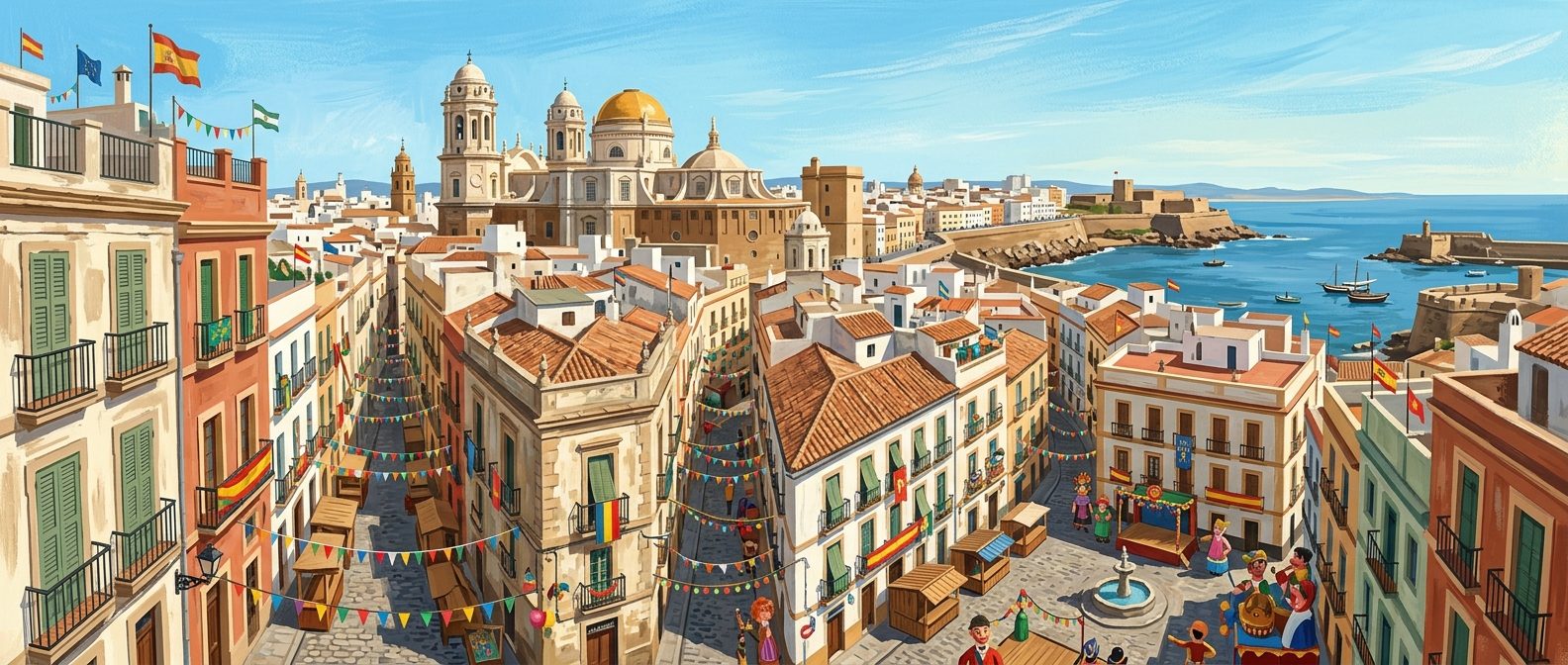
Every February, the narrow alleys of Cádiz transform into an open-air theatre where biting satire and local wit take centre stage. This is a celebration that prioritises the power of the word, making it the most intellectual and hilarious festival in Spain.
To understand the Carnival of Cádiz is to understand the soul of the city itself. Unlike the grand, orchestrated spectacles of Rio or Tenerife, this is a festival defined by the voice. The locals, known as Gaditanos, possess a legendary sense of humour called guasa, a sharp, often self-deprecating wit that spares no politician, celebrity, or social norm. For ten days, the city abandons its usual rhythm to indulge in a collective exercise of musical comedy and social commentary.
This tradition is a deep-rooted expression of freedom. Even during periods of strict censorship, the people of Cádiz used clever metaphors and double meanings to mock authority. Today, the festival is a massive street party that requires no invitation, where the boundary between performer and spectator evaporates. While the elaborate costumes (known as tipos) are impressive, the real currency here is the copla, the song. If you visit, expect to hear the constant hum of guitars and the distinct buzz of the pito de caña (the kazoo-like carnival whistle) echoing through every plaza.
What to See & Do
The Official Competition (COAC)
The heart of the formal celebration is the Concurso Oficial de Agrupaciones Carnavalescas (COAC), held at the magnificent Gran Teatro Falla. For weeks leading up to the main carnival, hundreds of groups compete in four categories: Chirigotas (satirical and funny), Comparsas (poetic and serious), Coros (large choirs), and Cuartetos (rhymed comedy sketches). The Grand Final is a marathon event that starts on a Friday night and lasts until the early hours of Saturday morning. While getting tickets for the final is notoriously difficult, the preliminary rounds offer a fantastic chance to see the groups in their element. The lyrics often address the biggest news stories of the year, from local council disputes to global geopolitical shifts.
The "Illegal" Callejeras
While the theatre competition is prestigious, many purists argue that the true spirit of Cádiz is found in the callejeras. These are the "illegal" or unofficial groups that do not enter the official contest. Instead, they simply take to the streets with their guitars and songbooks. You will find them on the steps of the Central Market, in the narrow corners of the La Viña neighbourhood, or tucked away in the Pópulo district. These groups are often the funniest and most irreverent, performing for whoever gathers around them. There is no set schedule for the callejeras; part of the magic is wandering through the old town and following the sound of laughter to the next performance.
The Carrusel de Coros
On the carnival Sundays and holidays, the Coros take over the city. These large groups, sometimes featuring up to 45 members, perform on bateas (flatbed trailers pulled by tractors). They move through the streets in a "carousel", usually around the Plaza de Abastos (Central Market) and Plaza de las Flores. The music is grander than the street chirigotas, often featuring tangos and elaborate harmonies. Seeing these massive wagons navigate the tight turns of the medieval city while thousands of people sing along is one of the most evocative sights of the festival.
Pre-Carnival Gastronomic Festivals
Cádiz begins its celebrations weeks early with a series of food-focused events that act as rehearsals for the street groups. These events are free and offer a wonderful introduction to the city's culinary and musical habits. The Pestiñada (usually held in Plaza de San Francisco) involves the distribution of thousands of pestiños (honey-glazed pastries). The Ostionada focuses on fresh oysters in Plaza de San Antonio, while the Erizada in the La Viña neighbourhood celebrates the sea urchin. These gatherings are the perfect time to hear the first songs of the season before the crowds of the main carnival week arrive.
Practical Information
Dates: The carnival dates change annually based on the lunar calendar and Lent. For 2027, the official carnival is expected to run from 4 February to 14 February. However, the "Carnaval Chiquito" (the little carnival for locals) usually takes place on the following Sunday.
Tickets: Access to the street performances, parades, and gastronomic events is entirely free. Tickets for the COAC competition at the Gran Teatro Falla are sold online via the Bacantix platform. Prices range from approximately €15 for preliminary sessions to €95 for the Grand Final. Be aware that tickets for the final sell out within minutes of being released.
How to Get There: Cádiz is well-connected by train. During the main carnival Saturdays, Renfe typically runs special "Carnival Trains" from Sevilla and Jerez that operate throughout the night. This is often the best way to visit, as it avoids the struggle of parking. If you are coming from across the bay, the ferry (Catamarán) from El Puerto de Santa María or Rota offers a scenic arrival, though services may be limited during late-night hours.
Parking: Driving into the old town during carnival is not recommended. The streets are largely pedestrianised and the few car parks fill up by midday. The best options are the large underground car park at Muelle Reina Sofía (the port) or Parking Santa Bárbara near the Genovés Park. Alternatively, park in the newer part of the city and take the number 1 bus into the centre.
Where to Eat Nearby
Taberna Casa Manteca: Located in the heart of the La Viña neighbourhood (Calle Corralón de los Carros, 66), this is perhaps the most famous tavern in the city. During carnival, it is packed, but it is worth the squeeze for their chicharrones (thinly sliced cured pork belly) served on greaseproof paper and a glass of local sherry. The walls are covered in bullfighting memorabilia, providing an authentic backdrop to the festivities.
Freiduría Las Flores: Situated in the Plaza de las Flores, this is the go-to spot for a paper cone of pescaíto frito (fried fish). It is fast, efficient, and ideally located for those watching the Coros carousel. Try the bienmesabe (marinated dogfish) or the tortillitas de camarones (shrimp fritters).
El Faro de Cádiz: For a slightly more formal experience, El Faro in Calle San Félix offers exceptional seafood. Their bar area is great for high-quality tapas, including some of the best seafood croquettes in the province. It is a sanctuary of tradition amidst the carnival madness.
Where to Stay
Accommodation in Cádiz during carnival must be booked months in advance. The Parador de Cádiz is the most luxurious choice, offering views over the Atlantic and a quiet retreat from the noise. For something more central, Hotel Francia y París in Plaza de San Francisco puts you right in the middle of the action. If the city is full, many visitors stay in Jerez de la Frontera or San Fernando and commute via the frequent train service.