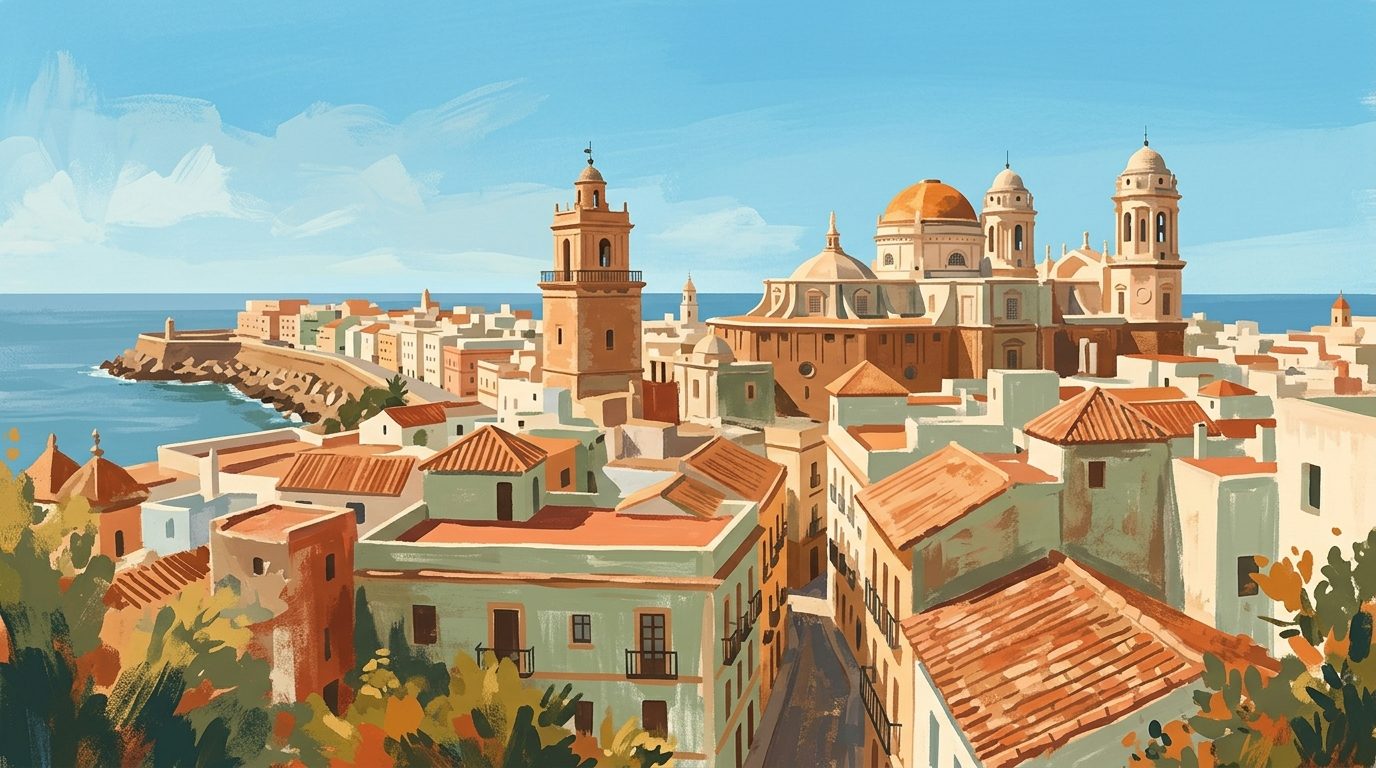
Cádiz Cathedral is a masterclass in Baroque and Neoclassical architecture, taking over a century to complete and dominating the Atlantic skyline. Paired with the panoramic views from Torre Tavira, these landmarks offer the definitive perspective on Europe's oldest continuously inhabited city.
Cádiz is a city defined by the sea, and nowhere is this more evident than in its two most prominent landmarks: the Cathedral and the Torre Tavira. The Cathedral, with its famous golden tiles reflecting the intense Atlantic light, was built during the city’s 18th-century golden age when trade with the Americas moved from Sevilla to Cádiz. It was designed to be seen from the ocean, a symbol of wealth and power for arriving merchant ships. A short walk through the narrow, salt-eroded streets of the El Pópulo and Centro districts leads to Torre Tavira, the highest of the city's remaining 126 watchtowers. Together, these sites provide a narrative of Cádiz's maritime history, from its religious devotion to its strategic importance as a naval hub.
What to See and Do
The Cathedral of the Americas
Construction of the Cathedral of the Holy Cross over the Sea began in 1722 but was not completed until 1838. This long duration explains the mix of architectural styles, transitioning from the ornate Baroque elements at the base to the more austere Neoclassical finishes at the top. As you walk through the interior, notice the difference in the stone; the lower sections use local oyster stone (piedra ostionera), which is porous and dark, while the later sections transition to lighter limestone. The scale of the building is immense, featuring high vaulted ceilings and a stunning choir carved from mahogany and cedar, brought across the ocean from the New World.
The Crypt and Manuel de Falla
Descending below the main altar brings you to the crypt, a space carved entirely from the dark oyster stone. The acoustics here are remarkable, and the atmosphere is noticeably cooler and more humid due to its location below sea level. This is the final resting place of two of the city's most famous sons: the composer Manuel de Falla and the poet José María Pemán. The circular design of the crypt, with its low ceilings and heavy pillars, creates a stark, sombre contrast to the airy, light-filled nave above.
The Torre de Poniente
Included in your cathedral ticket is access to the Torre de Poniente (the West Tower). Unlike the Torre Tavira, which was a merchant watchtower, this was a bell tower. Climbing the ramp (rather than stairs, to allow for donkeys to carry heavy materials) leads you to the top for a view that places you level with the golden dome. From here, you can see the Campo del Sur, the seaside promenade that bears a striking resemblance to Havana's Malecón, and the Atlantic waves crashing against the sea wall.
Torre Tavira: The City's Highest Point
While the Cathedral provides a view of the sea, Torre Tavira provides a view of the city itself. Standing 45 metres above sea level, it was designated as the official watchtower of Cádiz in 1778 because it sat at the city's highest geographical point. It is named after its first watchman, Antonio Tavira. The climb involves 173 steps, but the reward is a 360-degree view of the layout of the old town, showing the unique flat-roofed houses and the sheer density of the watchtowers that merchants used to spot their fleets returning from the West Indies.
The Camera Obscura Experience
The highlight of Torre Tavira is the Camera Obscura, the first of its kind in Spain. Inside a darkened room, a series of lenses and mirrors project a live, moving image of the city onto a white concave screen. A guide manipulates the lenses to show you different parts of Cádiz in real-time. You can see people walking, laundry flapping on rooftops, and ships in the bay, all with a depth of field and clarity that feels almost cinematic. It is a low-tech but deeply impressive way to understand the city's geography. Sessions are guided and usually last about 15 to 20 minutes.
Practical Information
Cádiz Cathedral
Opening Times: Monday to Saturday 10:00 to 20:00; Sunday 13:30 to 20:00 (Always check for morning mass or liturgical changes).
Tickets: General admission includes the Cathedral, the Crypt, the Torre de Poniente, and the Cathedral Museum in nearby Plaza Fray Félix. Reduced rates are available for seniors and students. (Check current prices and book tickets on the official Cathedral website before travelling).
Torre Tavira
Opening Times: October to March 10:00 to 18:00; April to September 10:00 to 20:00 (last entry 30 mins before closing).
Tickets: General admission and reduced rates for seniors, students, and large families are available. (Check current prices and book tickets on the official Torre Tavira website before travelling).
Note: Booking in advance for the Camera Obscura via the official website is highly recommended as group sizes are strictly limited and sessions often sell out by midday.
How to Get There and Parking
Cádiz's old town is best explored on foot. The Cathedral is located in Plaza de la Catedral, a 10-minute walk from the train and bus stations. Torre Tavira is located on Calle Marqués del Real Tesoro, roughly 5 minutes from the Cathedral. If arriving by car, do not attempt to drive into the narrow streets of the old town. Use the large underground car parks at Muelle Reina Sofía (by the port) or Canalejas. Expect to pay upwards of €3.50 per hour depending on the season (check local rates upon arrival).
Where to Eat Nearby
For a traditional experience, head to Taberna Casa Manteca in the nearby Viña district. This former grocery store is decorated with bullfighting posters and serves excellent cured meats and cheeses on squares of wax paper. For something more substantial, El Faro de Cádiz is a local institution famed for its tortillitas de camarones (shrimp fritters) and fresh Atlantic seafood. If you prefer a more casual atmosphere, the Mercado Central de Abastos has a dedicated gastronomic corner where you can sample everything from local tuna to craft beer while sitting at high tables amongst the market stalls.
Where to Stay
Accommodation in the old town is plentiful and varied. Parador de Cádiz is a contemporary glass-and-steel building located at the edge of the peninsula, offering sea views and a large pool area. For a more intimate stay, Boutique Hotel Casa Cánovas features elegantly restored 18th-century architecture near the Plaza de España. Many visitors also opt for small guesthouses in the El Pópulo district to be within steps of the Cathedral and the city's oldest ruins.