
Route · Almería
Tracing Leone and Eastwood: The Ultimate Almería Spaghetti Western Route
Drive the sun-baked stretches of the N-340a and you will quickly realise why 1960s filmmakers chose this arid pocket of Spain over the American West. Tracing the footsteps of Sergio Leone and Clint Eastwood through the Tabernas Desert offers an eerily precise journey into cinematic history.
By Dan · Updated 8 May 2026 · 11 min read
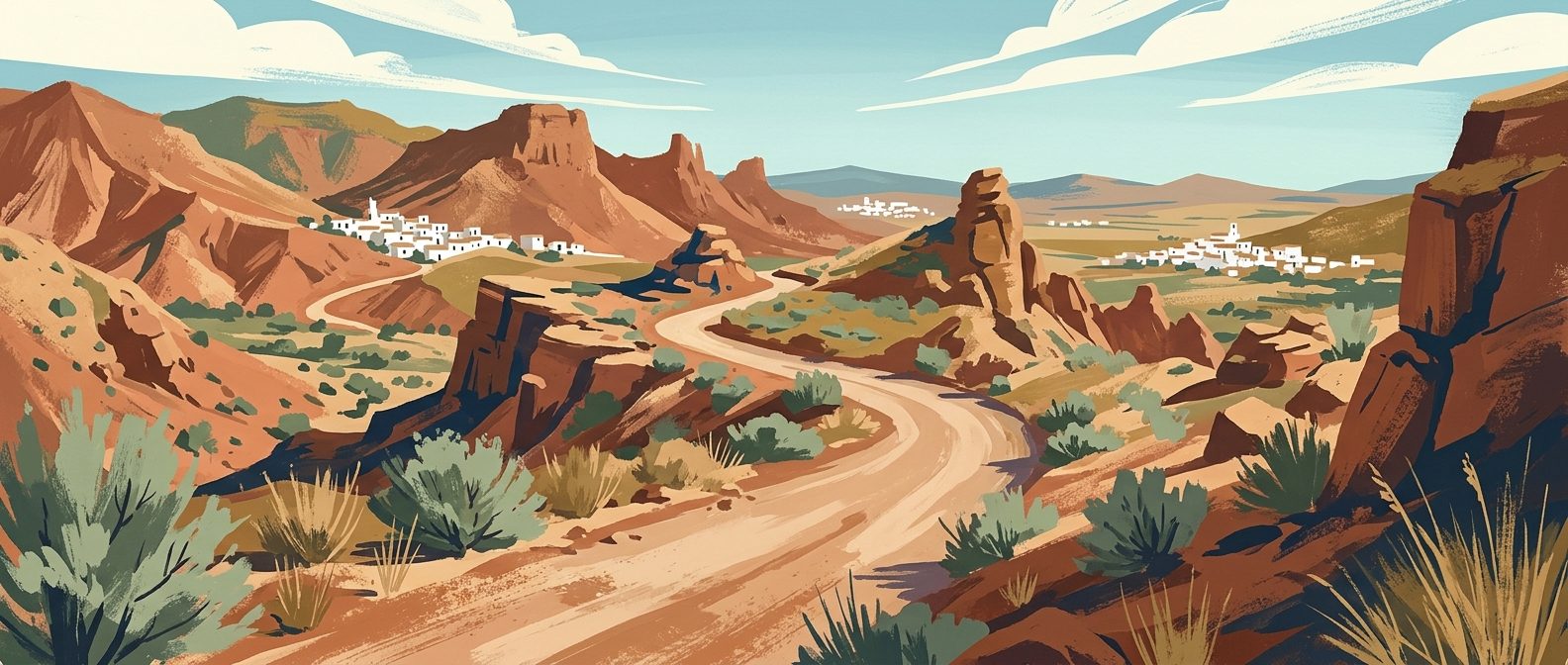
Drive the sun-baked stretches of the N-340a and you will quickly realise why 1960s filmmakers chose this arid pocket of Spain over the American West. Tracing the footsteps of Sergio Leone and Clint Eastwood through the Tabernas Desert offers an eerily precise journey into cinematic history.
In the mid-1960s, a struggling Italian director named Sergio Leone needed a cheap stand-in for the American-Mexican border. He found it in Almería. The Tabernas Desert, a stretch of cracked earth, dry ravines, and skeletal mountains in Spain's deep southeast, offered a blinding light and a desolate aesthetic that perfectly matched his cynical, violent vision of the West. When A Fistful of Dollars released in 1964, it altered the trajectory of cinema forever, making a global superstar out of a squinting Clint Eastwood and transforming this arid Andalucían province into the 'Hollywood of Europe'.
Today, the cinematic illusion remains entirely intact. Driving the scarred badlands around Tabernas feels surreal. You expect to hear the twang of an Ennio Morricone score drifting over the next ridge. This route is not a standard sightseeing trail; it is an immersion into pop culture archaeology. You will drive along unmarked gravel tracks where Lee Van Cleef rode, walk into wooden saloons where outlaws bled out, and stand in the exact dusty plazas where legendary cinematic stand-offs were filmed. While nature reclaims some of the old sets, three main studios continue to operate, offering a mix of authentic preservation and theatrical tourism. Here is exactly how to navigate the roads, ravines, and replica towns of Almería's spaghetti western territory.
The Cinematic Context: Why Almería?
To appreciate this route, you must understand what drew filmmakers here in the first place. Prior to the 1960s, Hollywood shot its westerns in places like Monument Valley or the Californian desert. But as production costs spiralled, European directors began shooting westerns closer to home. They needed a landscape that looked like Texas, Arizona, or New Mexico, but came with cheap, plentiful European labour.
Almería offered 3,000 hours of sunshine a year, a remarkably diverse topography, and an economy still recovering from post-war stagnation, which meant extras and construction crews were incredibly affordable. Franco’s government was also keen to attract foreign investment, readily offering up the Spanish army to serve as background actors. For The Good, the Bad and the Ugly, hundreds of Spanish soldiers were deployed to build sets and play the roles of both Union and Confederate troops.
Over 300 films were shot in Almería between the 1960s and 1980s. While big-budget epics like Lawrence of Arabia, Cleopatra, and later Indiana Jones and the Last Crusade paved the way, it was the low-budget Italian-Spanish co-productions, the so-called Spaghetti Westerns, that etched Almería onto the cultural map. Leone’s 'Dollars Trilogy' defined the genre, establishing a gritty, morally ambiguous tone that completely stripped away the clean-cut heroism of traditional John Wayne films.
The Road to Tabernas: Approaching the Badlands
The journey begins in Almería city. To get the best visual impact, leave the city early in the morning via the A-92 motorway, heading north. As you climb out of the coastal plain, the vegetation quickly thins. At junction 376, exit onto the N-340a. This single-carriageway road is the vital artery of the film route, slicing directly through the Desierto de Tabernas.
The Tabernas is Europe’s only true semi-desert. It is a harsh, deeply eroded landscape of marl and sandstone, entirely devoid of the olive groves and whitewashed villages you expect from Andalucía. The earth here is bruised and folded, cast in shades of ochre, ash-grey, and pale yellow. Roll the windows down. The air is exceptionally dry, carrying the scent of wild thyme and dust. As you drive along the N-340a, keep a close watch on the dramatic peaks of the Sierra Alhamilla to your right. This mountain range formed the permanent, unchangeable backdrop to almost every film shot here, serving as a geographical anchor that film historians still use today to pinpoint exact camera locations.
Stage 1: The Tabernas Desert Natural Reserve (The Raw Landscape)
Before paying an entry fee to any of the constructed sets, you need to explore the raw canvas that Leone worked with. The natural ramblas (dry riverbeds) that weave through the badlands were used extensively for trail riding sequences, ambushes, and cavalry marches.
Pull off the N-340a at kilometre 470, near the town of Tabernas, taking extreme care on the gravel shoulder. From here, you can walk down into the Rambla de Tabernas. This specific dry wash was heavily utilised in The Good, the Bad and the Ugly for the gruelling desert marches. The landscape is brittle, defined by heavily eroded marl, sharp gullies, and sudden drops. Look carefully for the distinctive rock formation known locally as La Tortuga (The Turtle); its bulbous shape features prominently in several wide tracking shots as Clint Eastwood’s 'Man with No Name' rides through the territory. It is worth noting for purists that while the famous Sad Hill Cemetery and the bridge explosion from The Good, the Bad and the Ugly were filmed much further north in the province of Burgos, the vast majority of the searing desert tracking shots, dusty town arrivals, and train sequences were firmly rooted right here in Almería.
For absolute geographical precision, you should book a guided 4x4 excursion. These operators hold the necessary permits to drive deep into the protected Paraje Natural. The guides are obsessive film historians. They will drive you out to the Llano del Búho (Owl Plain) and physically line up printed, laminated screenshots from A Fistful of Dollars precisely with the jagged horizon in front of you.
Warning: Do not attempt to drive a standard rental car down the ramblas. The loose, deep gravel and sudden, steep ravines will reliably strand you, and mobile telephone reception in the gullies drops to absolutely zero.
Stage 2: Oasys MiniHollywood (The Original 'Dollars' Set)
Situated prominently on the N-340a at kilometre 464, Oasys MiniHollywood is the most famous, the most polished, and the most heavily marketed stop on the route. This was the original town of 'El Paso', designed by the brilliant art director Carlo Simi for For a Few Dollars More (1965).
The central town square here is sacred ground for cinema purists. This is the exact dust-choked plaza where Eastwood’s bounty hunter Manco and Van Cleef’s Colonel Mortimer shot the hats off each other to prove their marksmanship. The distinctive yellow bank building, complete with its arched windows, remains instantly recognisable. The studio owners have invested heavily in structural upkeep. The saloon features a long, polished timber bar, a working piano, and a heavy ceiling fan cutting through the midday heat.
However, there is a significant caveat to this location. Oasys was purchased by a large hotel group in the late 1990s and transformed into a broader theme park, complete with a large zoological reserve and a swimming pool complex. If you are a dedicated film purist, walking past a giraffe enclosure to reach a spaghetti western set can severely disrupt the atmospheric illusion. Expect large crowds, families, and high summer entry prices. To mitigate this entirely, visit on a weekday in November or February when the pool is closed, the crowds are non-existent, and the wind whipping through the wooden gallows feels appropriately cinematic.
Stage 3: Fort Bravo (Texas Hollywood)
If you want raw scale and a rougher, more authentic edge, Fort Bravo is overwhelmingly the most impressive of the surviving sets. Reached via a deeply rutted, unpaved two-kilometre dirt track branching off the N-340a (take it very slowly in first gear), this complex is still actively used by commercial production companies today.
Constructed in the 1970s, it lacks the explicit Eastwood connection of MiniHollywood, but it encapsulates the European western genre perfectly. Fort Bravo features two distinct and expansive areas: a sprawling American frontier town and a Mexican pueblo. The wooden boardwalks creak reassuringly under your boots, the sheriff's office feels authentically claustrophobic, and the Mexican square features the classic whitewashed adobe aesthetic, complete with a domed church, seen in dozens of lesser-known Italian westerns. Further out back, accessed via a sandy track, there is a full-scale wooden cavalry fort. The acoustic environment here is extraordinary; the steep walls of the surrounding ravine catch the wind, creating a low, constant howl that sounds exactly like a cinematic sound effect.
Photographers should arrive exactly when the gates open at 09:00 AM. In the low, sharp morning light, you can capture the empty streets and long shadows before the tourist coaches arrive. The daily stunt shows in the main square are energetic and loud, but the real joy here is wandering away from the main saloon and getting lost among the facade-only backstreets. You can rent a horse for a one-hour hack out into the surrounding desert. Riding a Spanish horse through the scrubland, looking back at the timber town, genuinely elevates the experience from mere observation to active participation.
Stage 4: Western Leone (Sweetwater Ranch)
Located just off the A-92 motorway at exit 378, Western Leone is the smallest, the quietest, and the least commercialised of the three remaining film sets. It was originally constructed for Leone's masterpiece, the 1968 operatic epic Once Upon a Time in the West.
The undeniable centrepiece here is the large, red-brick McBain house, famously known as Sweetwater Ranch. Walking up the heavy wooden steps to the front porch, you are standing exactly where Claudia Cardinale’s character Jill arrived, only to find her new husband and stepchildren massacred. The set sits against a striking, unobstructed backdrop of the Sierra Alhamilla. Because it draws significantly fewer crowds than its larger neighbours, you will often find you have the dusty main street entirely to yourself.
The entrance fee is modest, reflecting the smaller scale of the site. They stage a brief, slightly rough-around-the-edges stunt show involving horseback chases and blank-firing revolvers, but the primary appeal here is the quiet, lingering atmosphere of the original timber structures. Grab a strong café solo at the saloon bar, study the faded, curling production photographs pinned haphazardly to the walls, and appreciate the raw, isolated scale of the surrounding valley.
Stage 5: Los Albaricoques and the Cabo de Gata
To complete the trail, you must leave the high desert and drive roughly one hour southeast into the volcanic landscapes of the Cabo de Gata-Níjar Natural Park. Here, the tiny, flat-roofed village of Los Albaricoques served as the outlaw stronghold town of Agua Caliente in For a Few Dollars More.
Unlike the constructed sets in Tabernas, Los Albaricoques is a real, functioning village that has fully embraced its cinematic pedigree. The local council has renamed the main streets after the actors who walked them: you can stroll down Calle Clint Eastwood and Calle Lee Van Cleef. The exact filming locations throughout the whitewashed streets are marked with small, helpful informational plaques.
Walk out to the circular stone threshing floor (era) on the eastern edge of the village. This is the precise spot of the final, tense musical-watch shootout between Mortimer and the villainous El Indio. Standing in the centre of the stone circle, looking back at the low-slung white houses, the geography of the scene matches the film frame for frame. You can almost picture Klaus Kinski’s menacing character lurking in the doorways.
Just a few kilometres away, accessed via a bumpy agricultural track, sits the Cortijo del Fraile. This crumbling, isolated farmhouse is historically significant as the site of the real-life 1928 murder that inspired Federico García Lorca’s famous play Blood Wedding. However, film fans will instantly recognise the dilapidated chapel and the inner courtyard from the mission sequences in The Good, the Bad and the Ugly. The road to the cortijo requires careful driving, and the building itself is fenced off due to structural instability, but the exterior views remain spectacular.
Practical Information for the Film Trail
Basecamp Strategy
You can easily tackle this route as a series of day trips from Almería city, which is a 30-minute drive down the A-92. However, staying in the desert itself offers a vastly superior atmosphere. We recommend booking a night at a rural guesthouse near Tabernas. It provides a quiet, rural escape entirely in keeping with the stark landscape, complete with exceptional dark skies for stargazing. Alternatively, the coastal town of San José in the Cabo de Gata makes an excellent, comfortable base for the second half of the route near Los Albaricoques.
When to Go
The Tabernas is a harsh environment. In July and August, midday temperatures routinely exceed 40°C (104°F). The heat radiating off the baked earth is punishing, and walking around unshaded film sets or dry ravines becomes genuinely dangerous. The optimal window for this route is between October and April. Winter days in Almería are typically bright, sharp, and hover around a very comfortable 16°C to 20°C (60°F to 68°F), perfect for scrambling around dry riverbeds and standing in dusty plazas.
Navigation and Transport
A reliable rental car is completely non-negotiable for this itinerary. Public transport to the film sets is virtually non-existent, and taxi fares from Almería city will quickly eclipse the cost of a daily rental. Pick up a vehicle directly upon arrival at the airport. Bring a physical road map or ensure you have downloaded offline Google Maps data; 4G coverage frequently drops to zero the moment you drive into the deeper ravines or approach the Cortijo del Fraile.
What to Pack
Treat this route like a serious hiking trip, even if you are primarily just visiting the commercial sets. Sturdy walking boots are absolutely essential for the uneven, rocky ground and the rutted streets of Fort Bravo. Pack a wide-brimmed hat, SPF 50 sunscreen regardless of the month, and keep at least five litres of drinking water in the boot of your car at all times.
Finally, download the soundtracks of Ennio Morricone to your phone before you arrive. Playing The Ecstasy of Gold or Farewell to Cheyenne through the car stereo as you approach the Tabernas badlands on the N-340a is a strictly non-negotiable part of the experience.
Last reviewed: 21 June 2026 · Editorial policy
Related guides
Game of Thrones Filming Locations: The Ultimate Andalucían Road Trip
For years, fantasy tourists flocked to the freezing coastlines of Northern Ireland and the medieval streets of Croatia. But it was the sun-baked architecture and cracked deserts of southern Spain that brought the most exotic kingdoms of Westeros to life.
10 min read
The Classic Two-Week Andalucían Road Trip
Fourteen days provides just enough time to experience southern Spain's Moorish capitals, dramatic mountain passes, and Atlantic coastline without spending your entire holiday behind the wheel.
9 min read
One Week in Andalucía Itinerary: The Classic Triangle & Ronda
Seven days in southern Spain is just enough time to trace the defining Moorish capitals and mountain roads of Andalucía. This itinerary strips away the coastal sprawl to focus entirely on the essential cities of Málaga, Granada, Córdoba, and Sevilla, returning via the dramatic mountain gorge of Ronda.
9 min read
Roman Andalucía Heritage Trail
Before the Moorish emirs reshaped southern Spain, this territory was the fiercely wealthy Roman province of Baetica, a crucial supplier of olive oil and emperors to the empire. This seven-day route traces the classical footprint across Andalucía, leading you from coastal fish-salting ruins and lonely mountain amphitheatres to the architectural remnants that bridged the fall of Rome and the rise of Al-Andalus.
9 min read
Beyond the Orange Trees: The Best Day Trips from Sevilla
Broaden your Andalucían horizons with these essential day trips, ranging from the Roman ruins of Itálica to the dramatic clifftop views of Ronda.
7 min read
Day Trips from Cádiz: Coastal Castles and Sherry Cities
Discover the best day trips from Cádiz, featuring world-class sherry bodegas in Jerez, the hilltop beauty of Vejer, and the ancient Roman ruins of Bolonia.
7 min read
More from Almería
Newsletter
More stories from Andalucía
Weekly notes, seasonal picks, and the next guides worth bookmarking.