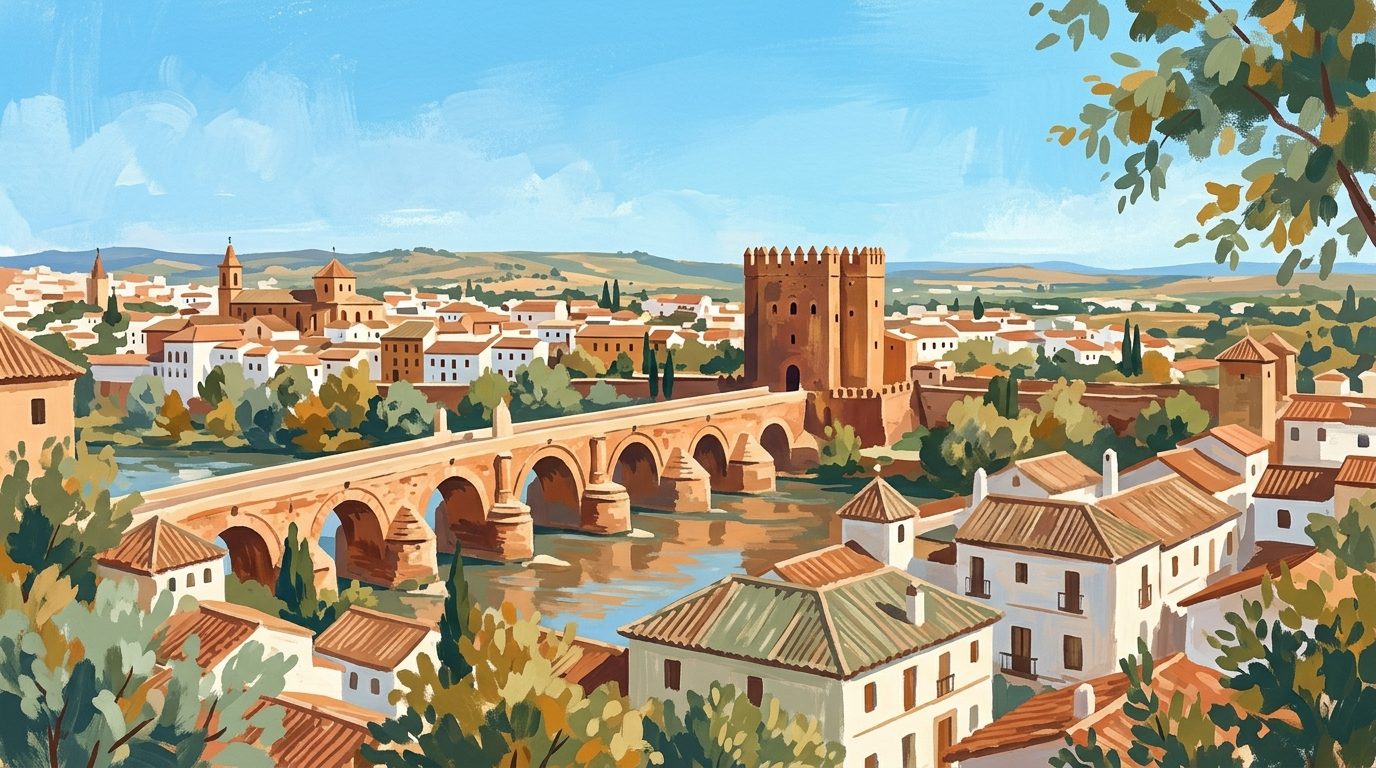
The Roman Bridge serves as the definitive gateway to Córdoba, offering the most recognisable view of the Mezquita-Catedral across the water. Pairing a walk over these ancient arches with a visit to the Calahorra Tower provides a deep look into the city's role as a meeting point for cultures.
Approaching Córdoba from the south bank of the Guadalquivir river feels like stepping into a historical landscape that has remained largely unchanged for centuries. The Roman Bridge (Puente Romano) and the Calahorra Tower (Torre de la Calahorra) form a monumental ensemble that once guarded the primary entrance to the city. For nearly two thousand years, this bridge was the only way to cross the river into Córdoba, making it one of the most strategically significant structures in Andalucía.
Today, the bridge is entirely pedestrianised, allowing visitors to stroll at a leisurely pace while taking in the silhouette of the old quarter. This site is an essential part of any Córdoba itinerary. The walk across the bridge is especially atmospheric at sunset, when the sandstone of the city walls and the Great Mosque-Cathedral begins to glow in a deep ochre hue.
What to See and Do
The experience of visiting these monuments is best enjoyed as a slow progression from the south bank toward the city centre. Start at the Calahorra Tower to understand the historical context before crossing the bridge into the heart of the Jewish Quarter.
The Calahorra Tower and the Living Museum of Al-Andalus
Standing at the southern end of the bridge, the Calahorra Tower is a fortified gate that has evolved through various eras. Originally built by the Almohad Caliphate to defend the bridge, it was later reinforced and expanded by King Enrique II of Castile in 1369. Its current form, with three distinct towers joined into one solid block, reflects its defensive purpose during the conflict between Enrique and his brother, Pedro I the Cruel.
Inside, you will find the Museo Vivo de Al-Andalus (Living Museum of Al-Andalus). This is not a traditional museum filled with dusty artefacts; instead, it uses immersive 3D models and audio-visual presentations to explain the period of 'Convivencia' (coexistence). The exhibits focus on the 10th-century height of the Caliphate, detailing the scientific, philosophical, and artistic advancements that occurred when Jewish, Christian, and Muslim scholars worked side by side. One of the highlights is a meticulously detailed scale model of the Mezquita as it appeared before the Christian cathedral was inserted into its centre.
The Rooftop Viewpoint
Before leaving the Calahorra Tower, climb to the top of the ramparts. The rooftop offers perhaps the best vantage point in the city. From here, you can see the full 331-metre length of the bridge and the way it aligns perfectly with the Gate of the Bridge (Puerta del Puente) and the Mezquita-Catedral. It is the ideal spot to photograph the river landscape and the Sotos de la Albolafia, a protected natural area in the riverbed where rare birds often nest among the reeds and abandoned watermills.
Strolling the Roman Bridge
The bridge itself is a masterclass in engineering and historical layering. Built in the 1st century BC as part of the Via Augusta, the road connecting Rome to Cádiz, it has 16 arches. While the foundations remain Roman, most of the current structure is a result of Islamic reconstructions and 17th-century repairs. Note the varied shapes of the arches and the sturdy triangular starlings (cutwaters) designed to withstand the force of the Guadalquivir’s floods.
In the middle of the bridge stands a statue of San Rafael, the patron saint of Córdoba, dating back to 1651. You will often see locals stopping here to light a candle or leave flowers at the feet of the archangel. It is a quiet, local tradition that adds a touch of living heritage to the stone crossing.
Game of Thrones: The Long Bridge of Volantis
Fans of the HBO series Game of Thrones will find the bridge remarkably familiar. In Season 5, the Roman Bridge was used as the setting for the Long Bridge of Volantis. While the production used CGI to add buildings and markets on top of the bridge, the underlying structure and the aerial shots are unmistakably the Puente Romano of Córdoba. It is one of several locations in the province, including Almodóvar del Río Castle, that helped bring the Seven Kingdoms to life.
Practical Information
The Roman Bridge is a public thoroughfare and is open 24 hours a day with no admission fee. The Calahorra Tower, however, has specific visiting requirements.
- Calahorra Tower Opening Times:
- Winter (October to March): Daily 10:00 to 18:00.
- Spring/Autumn (April to May and September): Daily 10:00 to 19:00.
- Summer (June to August): Daily 10:00 to 14:00 and 16:30 to 20:30.
- Ticket Prices: General admission is €4.50. A reduced rate of €3.00 is available for students, seniors, and groups. Children under 8 enter free. (Prices correct as of May 2026; check the official website for updates.)
- How to Get There: If you are already in the city centre, the bridge is a short walk from the Mezquita. If you are arriving from outside, it is often easier to approach from the south side of the river (Avenida de Fray Albino).
- Parking: Avoid driving into the old town as access is strictly controlled. There is a large outdoor parking area on the south side of the river near the Hesperia Hotel, or you can use the multi-storey car park at Paseo de la Victoria, which is about a 10-minute walk away.
Where to Eat Nearby
For a meal with a view, Regadera on the riverfront (Calle de la Ribera) offers a modern approach to Andalucían ingredients. Their menu focuses on seasonal produce with creative presentations. If you prefer something traditional, Casa Pepe de la Judería is a short walk across the bridge into the old town. It is famous for its rooftop terrace and classic dishes like mazamorra (a cold almond soup) and rabo de toro (oxtail stew). For a more casual experience, Taberna del Río provides excellent tapas and a terrace that looks directly toward the bridge and the river, making it a perfect spot for an evening drink.
Where to Stay
Staying on the south bank at the Hesperia Córdoba offers the distinct advantage of seeing the bridge and Mezquita illuminated at night from your window. For those who prefer to be within the labyrinth of the Jewish Quarter, Balcón de Córdoba is a small, high-end hotel with a private roof terrace that looks out over the rooftops toward the river. Alternatively, the Las Casas de la Judería hotel provides a series of interconnected historic houses with traditional patios, located just minutes from the northern end of the bridge.