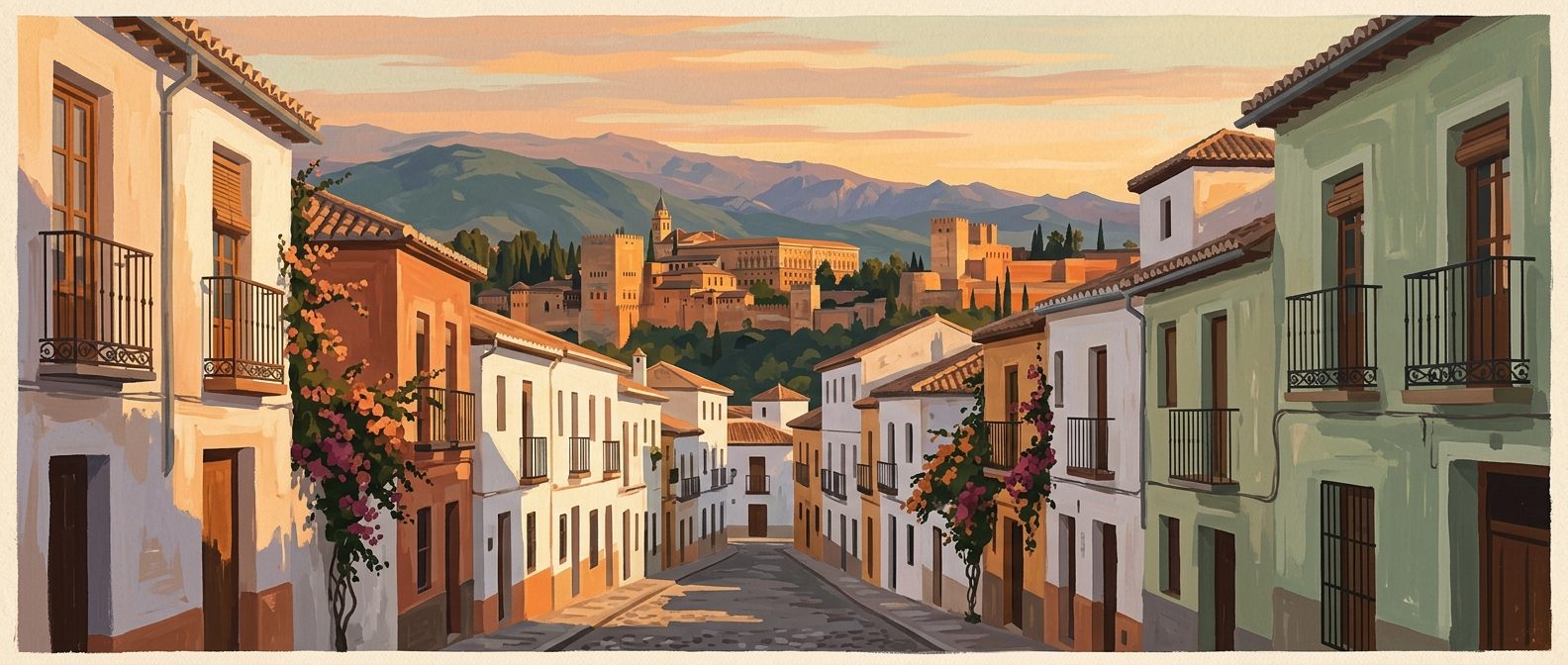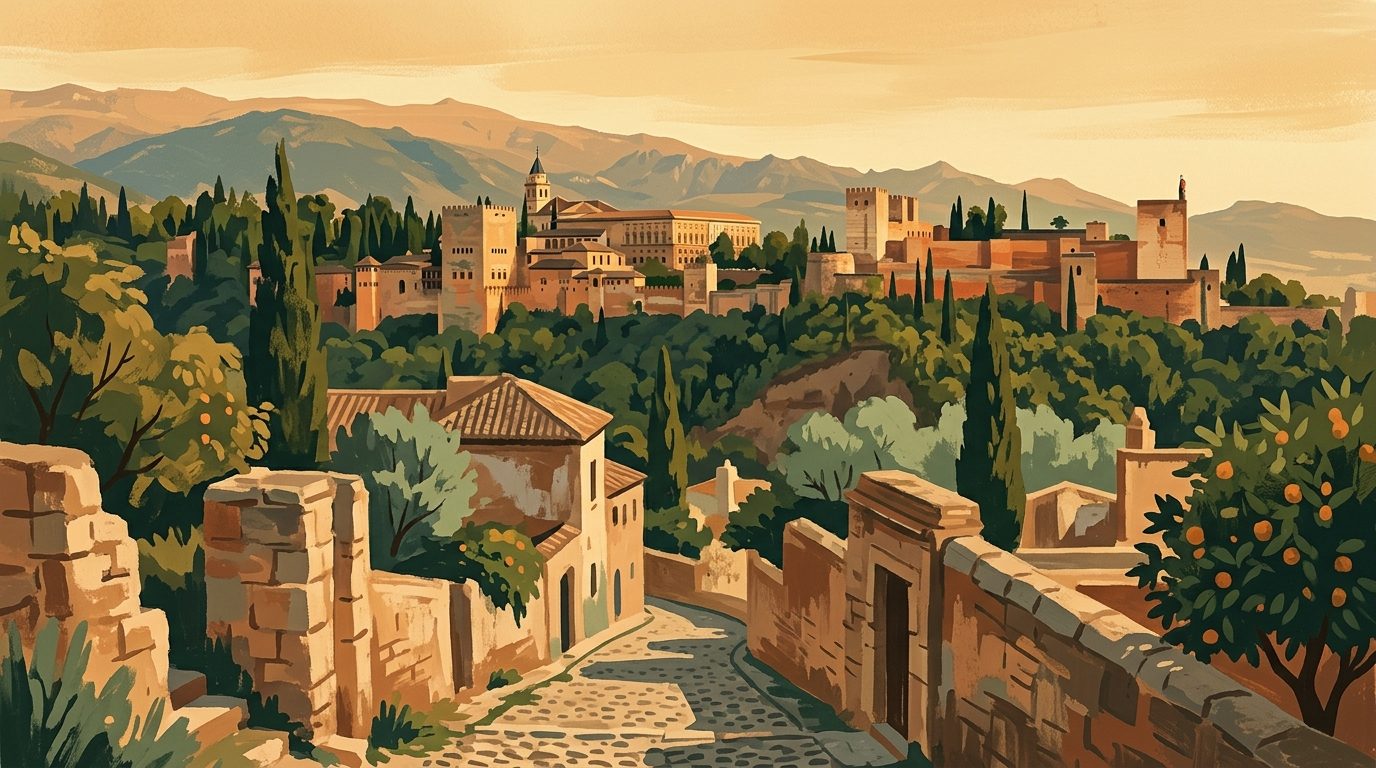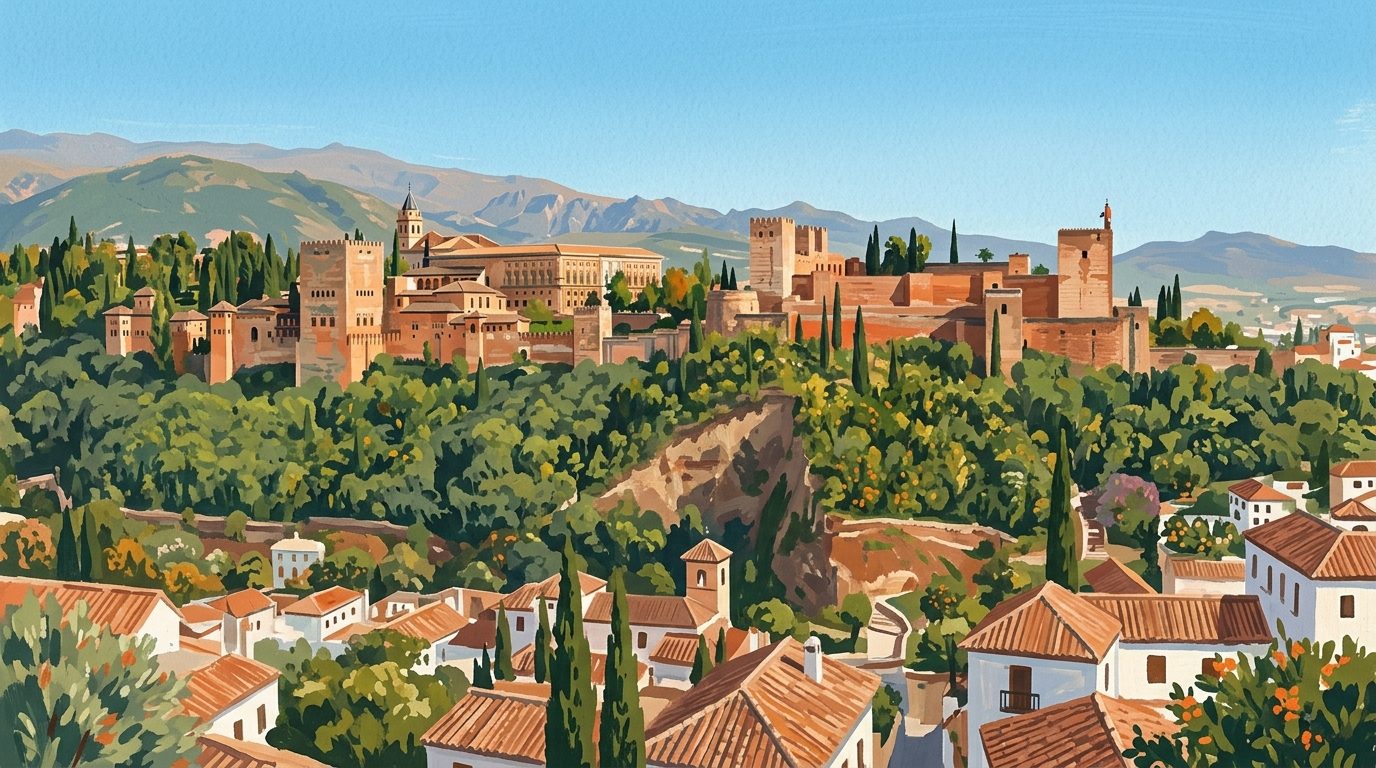
Standing atop the Sabika hill, the Alhambra remains the most complete medieval Islamic palace complex in the world. It serves as a monumental record of the Nasrid dynasty, where intricate stucco and reflective pools define the height of Hispano-Moresque art.
The Alhambra is not merely a palace but a fortified city that captures the final centuries of Islamic rule in the Iberian Peninsula. Constructed primarily during the 13th and 14th centuries by the Nasrid kings, the site evolved from a small 9th-century fortress into a sprawling royal city. Its red-tinted walls, which give the monument its name, al-Qal’a al-Hamra (the Red Castle), overlook the city of Granada and the snow-capped peaks of the Sierra Nevada.
Today, this UNESCO World Heritage site is a reminder of the sophisticated engineering and artistic vision of Al-Andalus. Visitors wander through a sequence of courtyards and administrative halls where every surface is treated with geometric patterns, Arabic calligraphy, and stalactite-like muqarnas. The transition from the defensive grit of the Alcazaba to the sensory indulgence of the Generalife gardens provides a comprehensive look at a civilisation that prioritised harmony between architecture and nature. Understanding the layout and the strict entry requirements is the first step to a successful visit.
What to See & Do
The Nasrid Palaces
The Nasrid Palaces represent the artistic peak of the Alhambra. This section is the only part of the complex with a strictly timed entry, and it consists of three distinct areas: the Mexuar, the Comares Palace, and the Palace of the Lions. The Mexuar served as the council chamber and a place for the administration of justice, featuring heavy wooden ceilings and intricate tilework.
Moving deeper into the complex, the Comares Palace surrounds the Court of the Myrtles. Here, a massive rectangular pool creates a mirror effect, reflecting the massive Comares Tower into the water. This was the official residence of the Sultan, designed to impress visiting ambassadors with its scale and the complexity of the wooden ceiling in the Hall of Ambassadors, which represents the seven heavens of the Islamic universe.
The Palace of the Lions is perhaps the most famous part of the Alhambra. Centred around a fountain supported by twelve marble lions, the courtyard is surrounded by a forest of 124 slender columns. The surrounding rooms, such as the Hall of the Abencerrajes and the Hall of the Two Sisters, feature extraordinary dome ceilings composed of thousands of tiny cells. The play of light and shadow here was designed to evoke a sense of the divine.
The Alcazaba
The Alcazaba is the oldest part of the site, serving as the military heart of the Alhambra. While the palaces focus on delicate beauty, the Alcazaba is all about strength and strategy. You can walk through the ruins of the barrio castrense (military quarter), where the foundations of the soldiers' houses are still visible.
The highlight here is climbing the Torre de la Vela (Watchtower). From the top, you have an unobstructed view across the Albaicín district, the Cathedral, and the expansive Vega of Granada. Historically, the ringing of the bell atop this tower regulated the irrigation of the valley below.
The Generalife
The Generalife served as the summer estate and leisure retreat for the Nasrid kings, located just outside the main fortress walls on the slopes of the Hill of the Sun. The name likely derives from Jannat al-Arif, meaning the Architect’s Garden. It is a space defined by the sound of running water and the scent of seasonal blooms.
The Patio de la Acequia (Court of the Long Pond) is the most iconic space, featuring a long water channel framed by cross-shaped flowerbeds and rows of water jets. The Upper Gardens offer a cooler atmosphere, with the Water Staircase, a stone stairway where water flows down the handrails, showcasing the ingenious hydraulic engineering of the era.
The Palace of Charles V
A striking contrast to the Moorish architecture is the Renaissance Palace of Charles V. Started in 1527 but never fully finished, the building is a massive square with a unique circular two-tiered courtyard inside. It currently houses the Alhambra Museum, which contains an excellent collection of Nasrid artefacts, and the Fine Arts Museum of Granada. The acoustics in the circular courtyard are remarkable, making it a frequent venue for international music festivals.
Practical Information
Tickets and Booking: Tickets sell out weeks or even months in advance. It is vital to book through the official website (Patronato de la Alhambra y Generalife). The "Alhambra General" ticket is the most comprehensive, covering the Nasrid Palaces, Alcazaba, and Generalife.
Ticket Price: The general admission is approximately €19.09 (including booking fees). Children under 12 are free but still require a physical ticket issued at the time of booking. You must provide your passport or national ID number when buying, and you must carry that same ID to enter the monument.
Entry Times: Your ticket will show a specific 30-minute window for the Nasrid Palaces. If you miss this slot, you will be denied entry to the palaces, though you can still visit the gardens and the Alcazaba. It is recommended to arrive at the main entrance at least 60 minutes before your palace time.
Opening Times:
- Summer (1 April to 14 October): 08:30 to 20:00. Night visits are available Tuesday to Saturday.
- Winter (15 October to 31 March): 08:30 to 18:00. Night visits are available Friday and Saturday.
How to Get There: The Alhambra is located on a steep hill above the city centre.
- Bus: Take the C30 or C32 minibuses from Plaza Isabel la Católica. The fare is roughly €1.50.
- Walking: From Plaza Nueva, walk up the Cuesta de Gomérez. It is a steep but beautiful 20-minute walk through the Alhambra woods.
- Taxi: A taxi from the centre costs around €6 to €8.
Parking: There is a large public car park at the entrance (P1 to P4). Fees are approximately €2.80 per hour, with a daily maximum of around €20. Access is via the Ronda Sur (A-44 motorway).
Where to Eat Nearby
For an upscale experience within the grounds, the Parador de Granada (located in a former convent) offers a terrace with views of the Generalife gardens. Their menu features traditional Andalucían dishes like habas con jamón (broad beans with ham). For a more relaxed meal, Restaurante Jardines Alberto sits just outside the main ticket pavilion. It provides a shaded terrace and serves reliable local specialities such as rabo de toro (oxtail) and Granada-style salads. These spots are convenient for those who wish to stay near the complex between morning and afternoon sessions.
Where to Stay
Staying within the Alhambra precinct allows you to experience the site after the day-trippers have departed. The Parador de Granada is the most prestigious option, occupying a 15th-century Franciscan monastery built over a Nasrid palace. For a more intimate stay, Hotel América is a family-run establishment located on the Calle Real de la Alhambra. It offers simple, traditional rooms and a charming patio, providing an atmospheric base just steps from the Nasrid Palaces and the Church of Santa María.