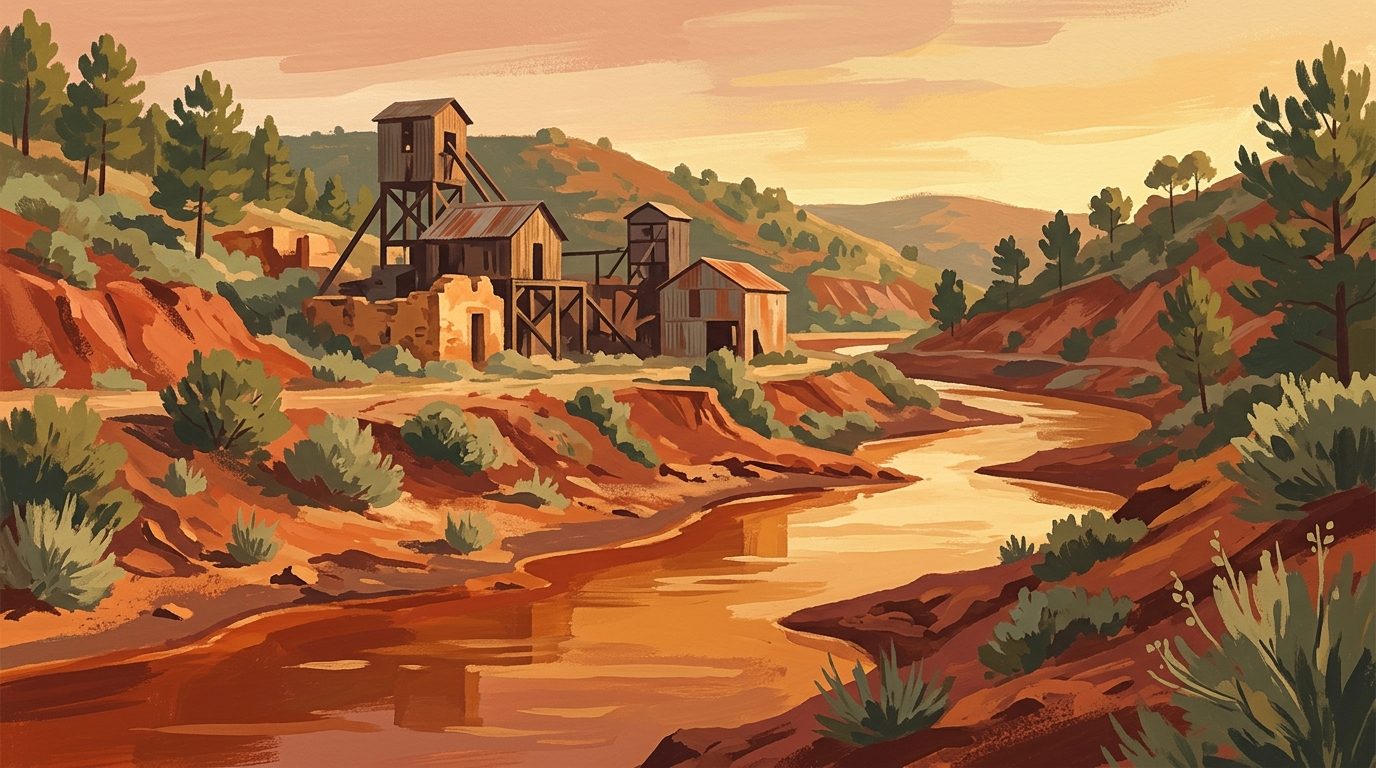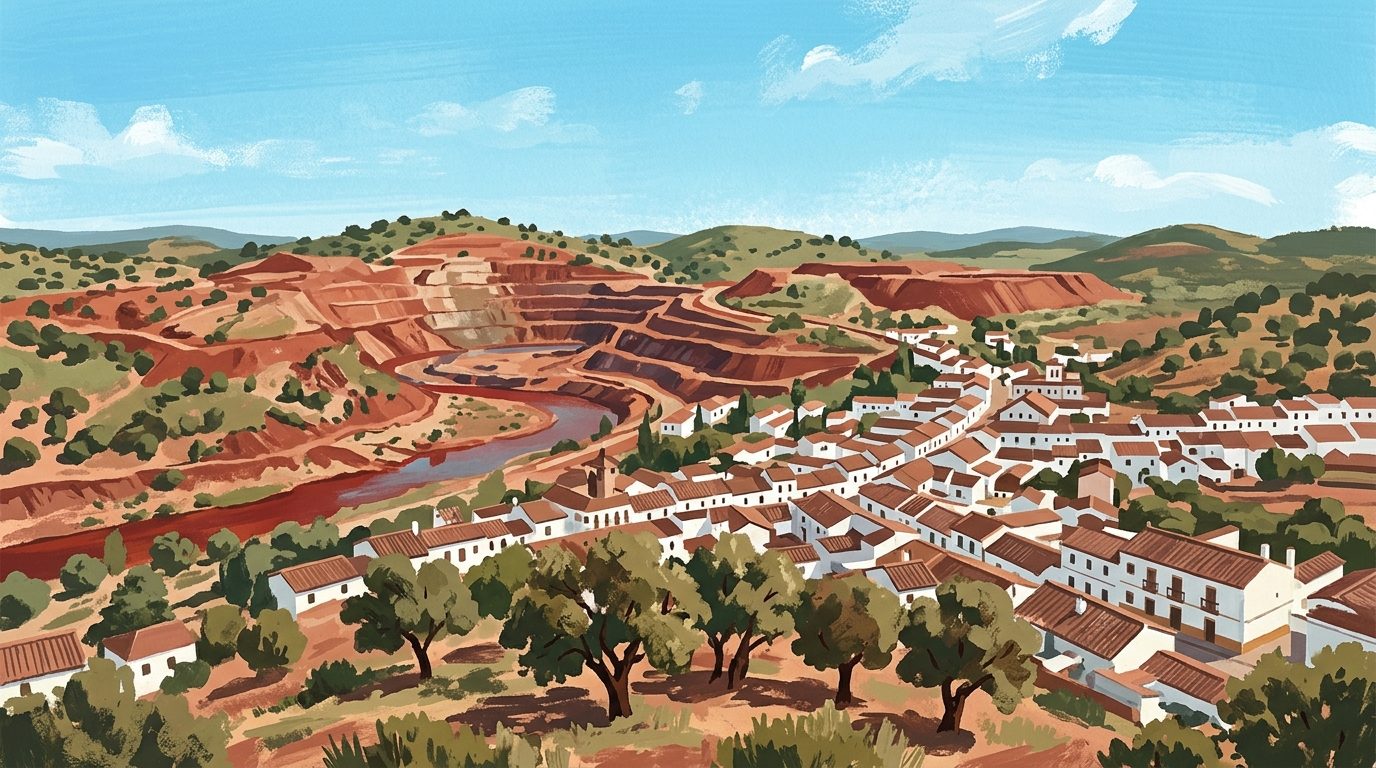
Venture into a landscape where the river runs deep crimson and the earth is carved into immense, multi-coloured amphitheatres. This industrial corner of Huelva offers a journey through 5,000 years of mining history, from Roman galleries to a Victorian British colony.
In the foothills of the Sierra de Aracena lies a landscape that feels entirely detached from the rest of Andalucía. While the region is famous for its white villages and olive groves, the area around Minas de Riotinto and Nerva is defined by oxidised earth, colossal open-cast pits, and a river the colour of red wine. This is one of the oldest mining districts in the world, worked by Tartessians, Romans, and later, the British, who transformed the local culture and architecture in the 19th century.
Today, the area is a site of significant scientific and historical interest. The acidic, mineral-heavy waters of the Rio Tinto are so unique that NASA and the European Space Agency use the river as a Mars analogue to study how life might survive in extreme conditions. For the visitor, it offers a rare opportunity to explore industrial archaeology on a scale seldom seen elsewhere in Europe.
What to See & Do
The Rio Tinto Mining Museum
Located in the building that once served as the hospital for the Rio Tinto Company Limited, the Museo Minero is the best place to begin. It provides a comprehensive overview of the region's 5,000-year relationship with copper, iron, and silver. The exhibits display everything from Roman water wheels used to drain deep shafts to the "Maharajah’s Carriage," an incredibly opulent narrow-gauge railway carriage built for Queen Victoria and later used during a Spanish royal visit.
A highlight of the museum is the walk-through reconstruction of a Roman mine. This 200-metre tunnel gives a visceral sense of the conditions faced by miners 2,000 years ago, highlighting the sheer scale of the Roman operation which extracted millions of tonnes of ore using basic hand tools.
The Mining Train (Ferrocarril Minero)
The most popular way to see the landscape is via the restored 19th-century mining railway. The train follows a 12-kilometre route along the banks of the Rio Tinto, passing through abandoned industrial zones, rusted locomotive graveyards, and tunnels. The journey provides the best vantage points for photographing the river's deep ochre and blood-red waters.
During the trip, the train stops at a siding where passengers can walk down to the riverbank. It is here that you can truly appreciate the river’s chemistry; the water is highly acidic (pH 2.2) and saturated with heavy metals, creating a sterile but beautiful environment that looks more like a laboratory than a waterway.
Corta Atalaya and Peña de Hierro
The scale of human intervention here is most apparent at Corta Atalaya. Once the largest open-cast mine in Europe, it is a circular amphitheatre over 1,200 metres wide and 350 metres deep. The concentric rings of the excavation create a dizzying perspective of the sheer volume of earth moved over the decades.
Nearby in Nerva, the Peña de Hierro mine offers a more intimate experience. Visitors can put on hard hats and walk through a 200-metre gallery into the heart of the mine. This site is particularly significant because it marks the primary source of the Rio Tinto. From the viewing platform, you can see the deep red aquifer where the river begins its journey to the Atlantic.
Barrio de Bella Vista: A Piece of Victorian England
When the British-owned Rio Tinto Company Limited arrived in 1873, they didn't just bring machinery; they brought their lifestyle. The Barrio de Bella Vista was a gated community built for the British managers and engineers. Walking through its streets feels like stepping into a Surrey suburb. You will find red-brick houses with chimneys, a Presbyterian church, a tennis club (one of the first in Spain), and a cricket pitch.
One of the houses, Casa 21, is preserved as a museum. It is furnished exactly as it would have been in the late 1800s, complete with Victorian tea sets, heavy oak furniture, and servants' quarters, illustrating the stark social divide between the British administrators and the local miners.
Practical Information
The sites are managed by the Parque Minero de Riotinto. It is highly recommended to book tickets online in advance via their official website, as the train and mine tours have limited capacity and often sell out, especially at weekends.
- Opening Times: The Museum is generally open daily from 10:30 to 15:00 and 16:00 to 19:00 (closing at 18:00 in winter months). Train departures and mine tours vary by season and demand (check on the operator's website before travelling).
- Ticket Prices: A "Full Pack" (including the Museum, Casa 21, the Train, and Peña de Hierro) costs approximately €22 for adults and €18 for children (under 12) and seniors. Individual tickets for the Museum and Casa 21 cost roughly €7 (check on the operator's website before travelling).
- How to Get There: From Huelva city, take the N-435 north (approx. 1 hour). From Sevilla, take the A-66 then the A-476 (approx. 1 hour 15 minutes). There is no direct train service; the Damas bus company runs limited services from Huelva and Sevilla (check on the operator's website before travelling).
- Parking: Large, free car parks are located directly outside the Mining Museum in Minas de Riotinto and at the Peña de Hierro site in Nerva.
Where to Eat Nearby
In Nerva, Casa Idolina is a standout choice. Housed in the old train station building, it offers a refined take on traditional Huelva cuisine. Try the presa ibérica (Iberian pork) or their creative cod dishes. The setting is atmospheric, with high ceilings and views across the old tracks.
For a more casual experience in Minas de Riotinto, Restaurante Galán serves hearty local fare. It is a popular spot for miners and locals, specialising in grilled meats and traditional stews. If you want a quick bite near the Victorian quarter, Restaurante Época offers a terrace with views of the British-style architecture and serves reliable tapas at fair prices.
Where to Stay
To fully immerse yourself in the history, stay at the Old England House in the Bella Vista quarter. This boutique guest house occupies a restored Victorian villa and features thematic rooms that reflect the British colonial era. Alternatively, the Hotel Victoria in the town centre provides comfortable, modern rooms and a convenient base for exploring the mining park. For those seeking a rural setting, the white village of Aracena is only a 30-minute drive away, offering numerous traditional guesthouses.