
Practical guide · Cádiz
Practical Guide to Gibraltar International Airport (GIB)
A practical guide to using Gibraltar Airport (GIB) for trips into Andalucía, covering border logistics, avoiding vehicle queues, Spanish transport options, and how to handle wind diversions.
By Dan · Updated 14 July 2026 · 8 min read
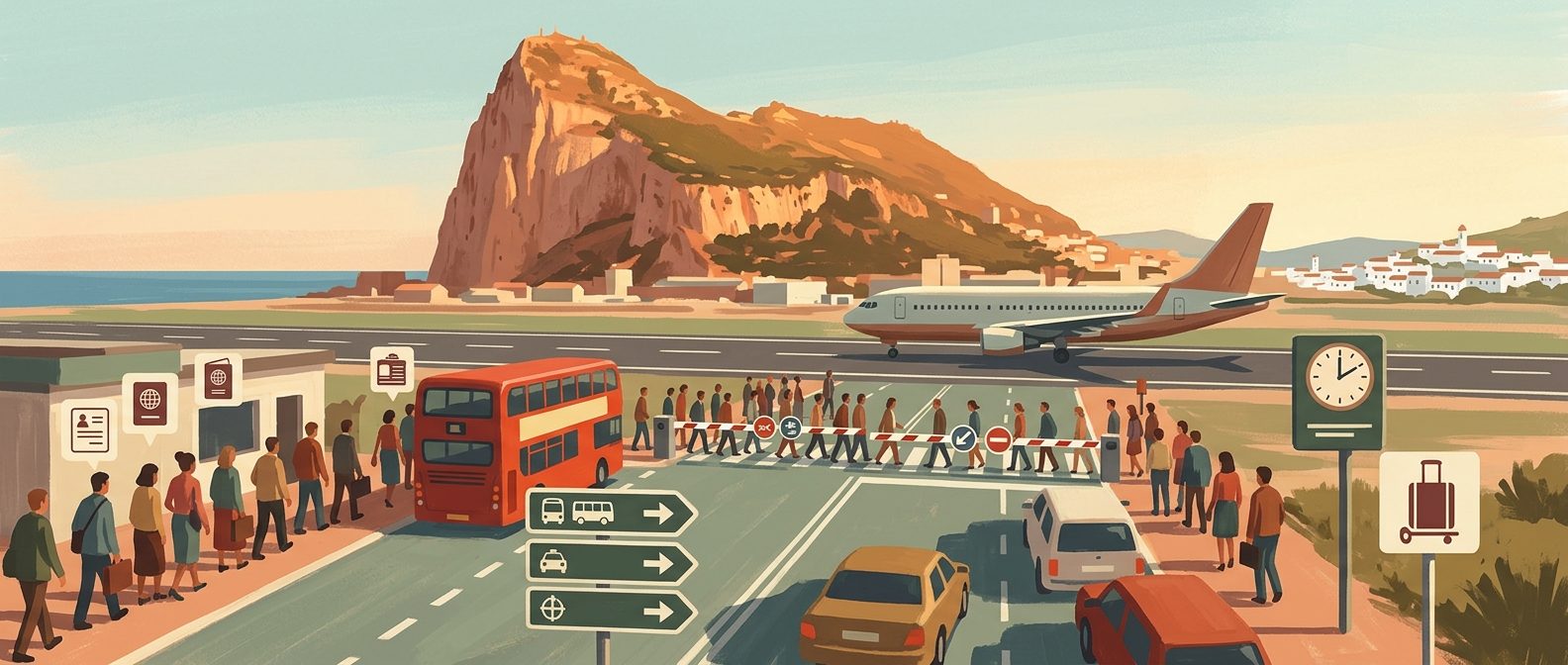
Gibraltar Airport is highly useful for the western Costa del Sol and the Campo de Gibraltar, but it is not a normal Spanish airport. You are dealing with a British Overseas Territory, a physical land border, separate entry rules, unpredictable frontier queues, and a choice between Gibraltar-side and Spain-side transport.
Gibraltar International Airport (GIB) sits right beside the frontier with La Línea de la Concepción. That makes it incredibly convenient for destinations like Sotogrande, Algeciras, Tarifa, and parts of Cádiz province. However, it also means you must plan your passports, border timing, car hire, and onward transport much more carefully than you would for a standard arrival. For live flight boards and terminal basics, always start with the official Gibraltar Airport website.
Quick answer: who should use Gibraltar Airport?
Choosing to fly into Gibraltar instead of a larger Spanish hub depends entirely on your final destination and your tolerance for border logistics.
- Best fit: People staying in Gibraltar, La Línea, Sotogrande, Algeciras, Tarifa, and the western edge of the Costa del Sol (like Manilva or Casares).
- Less convenient: Anyone heading to Granada, Córdoba, Sevilla, or eastern Málaga province. If your destination is further east than Estepona, flying into Málaga-Costa del Sol Airport is almost always a faster, simpler choice with far superior public transport links.
- The main extra step: If your destination is Spain, you will cross an international border immediately after walking out of the terminal.
- Transport decision: Walking across the border on foot and using Spanish-side buses, taxis, or car hire is almost always simpler and faster than taking a vehicle through the frontier.
Step-by-step: Arrival and crossing the border
The terminal is modern, compact, and located mere minutes from the frontier. The physical runway famously crosses the main road into Gibraltar, though vehicle traffic now largely uses a newer tunnel under the runway. If you are heading into Andalucía, here is what the arrival process actually looks like.
1. Gibraltar customs and exiting the terminal
After disembarking (often walking across the tarmac) and clearing Gibraltar passport control and baggage reclaim, you exit into the arrivals hall. From here, simply look for the signs pointing to "Spain" or "The Frontier". It is a flat, easy walk of about three to five minutes to reach the border crossing.
2. The Spanish border checkpoint
You leave Gibraltar through their checkpoint and immediately enter the Spanish passport control building. Border rules are the most critical planning point for this airport. Because Gibraltar is not in the Schengen Area, Spain enforces full external border checks here.
3. Passport stamping and residency cards
If you are a UK citizen visiting Spain, your passport will be stamped to track your 90-day allowance within the Schengen zone. If you are a resident of Spain, you must present your valid TIE (Tarjeta de Identidad de Extranjero) alongside your passport. Do not pack your TIE in your checked luggage. Presenting your TIE ensures your passport is not stamped in error, which can cause severe bureaucratic headaches later. Always double-check official Spain entry requirements and Gibraltar entry requirements before you travel.
Getting to Andalucía by public transport
Once you clear Spanish customs, you step out into La Línea de la Concepción. Do not rely on Gibraltar buses or taxis if your destination is Spain. Gibraltar taxis are not licensed to take passengers across the border into Andalucía.
For most Spanish destinations, you should walk straight ahead to the La Línea bus station, which is roughly a ten-minute walk from the border exit. From there, you have several options.
- Algeciras: The M-120 bus run by the Campo de Gibraltar transport consortium departs frequently. Algeciras is the main hub for onward ferries to Morocco, rail links, and buses heading deeper into Cádiz province.
- Tarifa: You will usually need to take a bus to Algeciras first and change for Tarifa, or book a private transfer. If you are travelling with large kitesurfing equipment, check the luggage rules with the bus operator in advance, as space is limited.
- Estepona and Marbella: Look for Avanza routes departing from La Línea. These are comfortable, air-conditioned coaches, but services drop off significantly in the late evening.
- Spanish Taxis: There is a rank immediately outside the Spanish side of the border. They run on a standard meter for local trips, but you should agree on a fixed price before getting in if you are travelling to Sotogrande or Estepona.
Car hire: Gibraltar side or Spanish side?
Hiring a car requires far more attention here than at a standard airport. You essentially have two choices: hire from a desk inside the Gibraltar terminal, or walk across the border and hire from a Spanish company in La Línea.
If your trip is entirely in Spain, hiring on the Spanish side is highly recommended. Renting in Gibraltar and driving into Spain means you must sit in the vehicle border queue. While the pedestrian crossing takes minutes, the vehicle queue (known locally as "la verja") can take well over an hour during peak commuter times or when Spanish border guards apply stricter checks.
If you do hire in Gibraltar, you must explicitly confirm with the rental company that you are permitted to take the car into Spain, and check if cross-border insurance incurs a daily surcharge. If you hire in Spain, your confirmation email will normally direct you to an office near the Santa Bárbara car park or the Focona centre in La Línea, a short walk from the border. For broader advice on deposits, insurance and vehicle sizes, read our guide to hiring a car in Andalucía and familiarise yourself with local rules in our driving in Andalucía guide.
Parking and departures
Departing from Gibraltar requires a generous time buffer. You must factor in the time it takes to get to La Línea, park, cross the border, and walk to the terminal.
The most stress-free departure method is to drive to La Línea, park in a long-stay underground car park on the Spanish side (such as the Santa Bárbara car park, which is literally adjacent to the frontier), and walk across. Attempting to drive your own Spanish-registered car into Gibraltar just to park at the airport introduces the risk of getting caught in a sudden border queue, which could result in a missed flight.
Keep your passport, boarding pass, and any residency documents accessible until you are entirely through the Spanish exit checks and the Gibraltar entry checks.
Disruption and the Levante wind
Gibraltar Airport is uniquely exposed to the "Levante", a strong easterly wind that frequently funnels through the Strait of Gibraltar. When the Levante blows too hard, it becomes unsafe for aircraft to land on the exposed runway.
When this happens, flights are routinely diverted to Málaga Airport. The airline will typically lay on coaches to transport passengers back down the coast to Gibraltar, but this adds at least two to three hours to your journey. If your onward plans are highly time-sensitive, keep this weather risk in mind. Reliable cover is essential here; review our travel insurance guide to ensure you are protected against weather-related delays.
Money, phones and practical details
Gibraltar is British territory, meaning the local currency is the Gibraltar pound, while Spain uses the euro. Gibraltar pounds are utterly useless once you cross the border into Andalucía, and British pounds sterling are not accepted in local shops. Avoid withdrawing large amounts of cash at the terminal if you are heading straight to Spain. Spanish taxis and buses require euros.
Mobile roaming is another common trap. Because Gibraltar is outside the EU, some Spanish mobile networks charge steep roaming fees if your phone connects to a Gibraltar mast. Conversely, some UK networks include Gibraltar in their free roaming but charge for Spain. Check your provider's specific rules, and read our mobile data and Wi-Fi guide for solutions to cross-border connectivity.
What catches people out
- Assuming Gibraltar taxis will take them to Marbella: They will not. You must cross the border on foot and hire a Spanish taxi.
- Forgetting their TIE card: Spanish residents who forget their physical TIE card will have their passports stamped, eating into their 90-day Schengen allowance.
- Ignoring the vehicle queue: People miss flights every year because they try to drive into Gibraltar at 8:00 AM on a weekday, hitting the massive commuter rush at the border.
- Not checking rental agreements: Taking a Gibraltar hire car into Spain without the correct cross-border paperwork will invalidate your insurance.
Frequently Asked Questions
Can I walk directly from the airport terminal into Spain?
Yes. The walk from the arrivals terminal to the border checkpoint takes under five minutes on flat ground. It is completely normal to wheel your suitcase across the frontier.
Do I need my passport to cross if I live in Spain?
Yes. You are crossing an international external border. You must always carry a valid passport, even if you hold a Spanish residency card (TIE), as the TIE is not a valid travel document on its own.
Where is the best place to park when flying out of Gibraltar?
The Parking Santa Bárbara in La Línea is heavily used by travellers. It is a large underground facility right on the Spanish side of the border. You park there, take the lift to street level, and walk across the frontier.
What happens if my flight is diverted?
If wind prevents a landing at Gibraltar, airlines usually divert to Málaga. The airline will organise a fleet of coaches to drive passengers from Málaga down to the Gibraltar border. You do not need to organise your own transport unless you choose to abandon the airline's bus service.
Summary
- Use Gibraltar Airport for Gibraltar, La Línea, Sotogrande, Algeciras, Tarifa, and western Costa del Sol trips.
- Walk across the border and use Spanish transport (buses, taxis, car hire) to avoid vehicle frontier queues.
- Always carry both your passport and your TIE (if you are a resident) to avoid incorrect stamping.
- Park on the Spanish side in La Línea when departing to remove the stress of border traffic.
- Be prepared for potential wind diversions to Málaga during strong Levante conditions.
Last reviewed: 14 July 2026 · Editorial policy
Related guides

Jerez Airport (XRY): The Complete Guide to the Gateway of Cádiz
A deep-dive practical guide to using Jerez Airport (XRY). Learn the realities of onward transport to Cádiz province, car hire friction, train timetables, and how to avoid the most common arrival mistakes.
8 min read

Accessibility Guide to Andalucía: Travel and Logistics
A practical accessibility guide to Andalucía, with city terrain notes, rail and airport assistance checks, hotel-room questions, adapted beaches and official source links.
6 min read

A Practical Guide to Bus Travel in Andalucía with Alsa
A comprehensive guide to using Alsa buses in Andalucía, covering booking tips, major routes, luggage rules, and station facilities.
7 min read

Guide to Train Travel in Andalucía: Renfe, AVE, and Regional Routes
A practical guide to train travel in Andalucía, covering AVE, Avant, Media Distancia, Cercanías, airport rail, booking checks, accessibility and operator links.
8 min read

Hiring a Car in Andalucía: A Practical Guide
A practical guide to hiring a car in Andalucía, covering rental contracts, deposits, insurance exclusions, parking, tolls, cross-border rules and official driving checks.
7 min read

Money and Costs in Andalucía: A Practical Guide
A practical guide to money, daily costs, and banking in Andalucía. Discover typical prices for meals and transport, plus expert tips on avoiding ATM fees and navigating local banks.
9 min read
Newsletter
More stories from Andalucía
Weekly notes, seasonal picks, and the next guides worth bookmarking.