
Practical guide
Mobile Data, SIM Cards and WiFi in Andalucía: A Practical Guide
A comprehensive practical guide to securing mobile data, SIM cards and WiFi in Andalucía. Learn about mandatory ID laws, navigating the transition from tourist eSIMs to resident contracts, and avoiding the most common connectivity traps in southern Spain.
By Dan · Updated 16 July 2026 · 8 min read
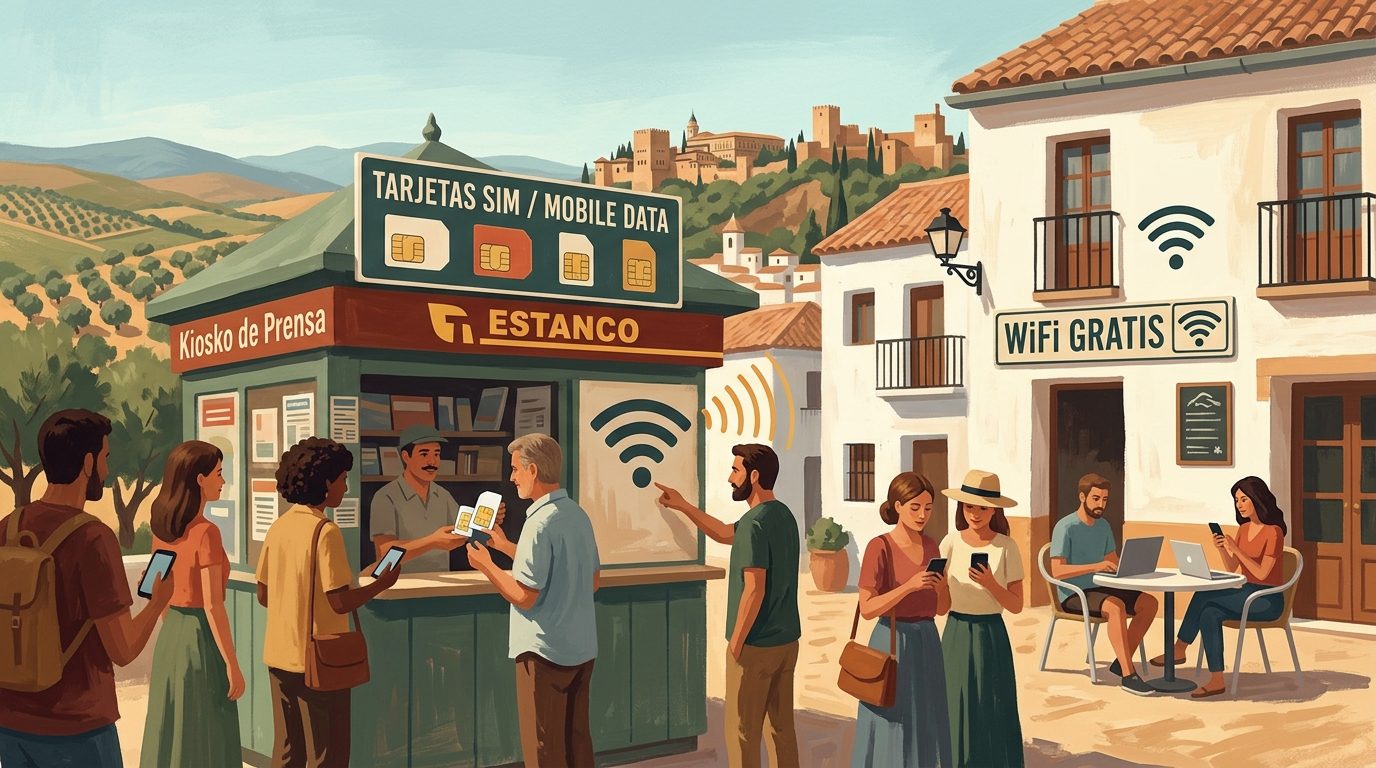
For most visitors and new residents arriving in Andalucía, the safest connectivity plan is simple: check your roaming terms before departure, use a local prepaid SIM or eSIM if your home plan is expensive, and verify coverage for rural or mountain travel. However, making the leap from a short-term tourist to a long-term resident brings an entirely new set of rules, from mandatory identity checks to the absolute necessity of a Spanish phone number.
Mobile data is generally fast and reliable in cities and coastal resorts across southern Spain. 5G is widely available in hubs like Málaga, Sevilla and Granada. Yet, the moment you drive into the valleys of the Alpujarras or the rugged hills of the Alcornocales, the landscape dictates the signal. The best option depends entirely on your phone, your length of stay, your nationality, and whether you’re here for a quick visit or a permanent relocation.
Understanding your baseline: Roaming in Spain
Before buying a Spanish SIM, you must understand exactly how your home provider treats data in Spain. Prices and data bundles change constantly, but the regulatory rules are strict.
EU and EEA residents
Under the European Union "Roam Like at Home" legislation, you can use your home allowance in Spain at no extra cost. However, there is a real-world catch for those relocating: the fair usage policy. Providers monitor your location over a four-month rolling window. If you spend more time in Spain than in your home country, and use more data in Spain, your provider will send a warning text. If you do not return home within 14 days, they will begin applying roaming surcharges. You cannot indefinitely use a French, German or Irish SIM while living permanently in Andalucía.
UK residents
Following Brexit, the guarantee of free EU roaming ended for British numbers. Many major networks have reintroduced daily roaming charges, which typically range from two to three pounds per day. Over a two-week holiday, this is an annoyance. For those spending a month or more in southern Spain, it becomes a significant drain on finances. Always check your specific provider app for their current daily cap and data limits before boarding your flight.
Non-EU residents
For visitors from North America, Australia or Asia, roaming with your home provider is almost always prohibitively expensive. Unless your carrier offers a specific global travel pass, turn off your mobile data before your plane lands to avoid astronomical background refresh charges.
Step-by-step: Buying a Spanish prepaid SIM card
If you are staying for more than a few days, or if you are beginning the relocation process, getting a local prepaid (prepago) SIM is the most cost-effective route. Unlike some countries where you can buy an anonymous SIM card from a supermarket vending machine, Spain has strict anti-terrorism laws (Ley 25/2007) requiring all mobile numbers to be registered to a verified identity. Here is how the process works.
- Unlock your phone: Before leaving your home country, contact your provider to ensure your device is unlocked and accepts foreign SIM cards. A Spanish SIM will not work in a locked phone.
- Bring the correct identity documents: You cannot use a foreign driving licence to buy a SIM card in Spain. You must present a valid physical Passport, a Spanish DNI, or a TIE (Foreigner Identity Card). The shop assistant will take a scan or photograph of your document to register the line.
- Choose a store or locutorio: You can buy SIM cards at official network stores (Vodafone, Orange, Movistar) or independent call shops (locutorios). While you can purchase a SIM upon arrival, as detailed in our Málaga-Costa del Sol Airport (AGP) Travel Guide, airport kiosks often sell marked-up tourist packages. You will usually find better deals by waiting until you reach the city centre.
- Test the line before leaving: Ask the assistant to insert the SIM and configure the APN (Access Point Name) settings. Do not leave the shop until you can successfully load a webpage.
- Save the plastic card: Spanish SIM cards are protected by a PIN code by default. Every time your phone restarts or runs out of battery, you will need to enter this four-digit PIN. Keep the plastic credit-card-sized holder in your wallet, as it contains both the PIN and the PUK code needed to unlock the device if you enter the wrong PIN three times.
Navigating the networks: Who has the best coverage?
Spain is served by four major network operators, alongside dozens of smaller MVNOs (Mobile Virtual Network Operators) that piggyback on the main infrastructure. Coverage can vary drastically by valley, beach, apartment block or village street.
- Movistar: The historic state operator. They generally offer the most robust coverage in remote rural areas, mountain ranges and smaller Andalucían villages.
- Vodafone and Orange (MasOrange): Both offer exceptional urban and coastal coverage, competing heavily on 5G speeds in cities like Málaga, Córdoba and Sevilla.
- Yoigo: The smallest of the primary networks, but they have roaming agreements with the larger providers to fill in coverage gaps.
- Low-cost brands (Digi, Lobster, Lebara): Digi operates on the Movistar network and is incredibly popular among residents for its budget-friendly data packages. Lobster is marketed specifically towards British expats, offering a fully English-speaking customer service experience and easy top-ups.
eSIMs: The quick fix for travellers
If your phone supports eSIM technology, you can purchase a data plan online before you travel. You simply scan a QR code and activate the data the moment you touch down. This bypasses the need to visit a shop or hand over your passport.
However, eSIMs come with significant friction for anyone staying long term. Most travel eSIMs are data-only. They do not provide you with a Spanish (+34) telephone number. If you are ordering local deliveries, the driver will not call a foreign number. More importantly, if you are registering with a local medical centre, dealing with immigration, or trying to secure a "cita previa" (a mandatory prior appointment for any government office), the automated systems frequently reject non-Spanish phone numbers.
WiFi, fibre and rural connectivity
Public WiFi is available in airports, major train stations, and many cafes. If you are travelling across the region, you can check our Guide to Train Travel in Andalucía: Renfe, AVE, and Regional Routes for details on the "PlayRenfe" WiFi service available on high-speed routes. However, public networks are often unsecured, making it highly advisable to read about Using a VPN in Andalucía: A Practical Guide for Travellers and Residents to protect your banking data.
For those moving to Andalucía to work remotely, home internet requires careful research. Do not assume that because a town has fibre optic internet, your specific rental property will have it. In many historic centres, local heritage laws prevent cables from being strung across traditional facades. In the countryside (el campo), fibre rarely reaches isolated fincas. Rural residents often rely on WIMAX (radio internet) or unlimited 4G/5G routers. Always ask a landlord for proof of the exact connection speed at the specific property before signing a lease. You can find more targeted advice in our guide to Co-working Spaces and Digital Nomad Life in Andalucía.
What catches people out: Common mistakes
- Forgetting the SIM PIN: As mentioned above, restarting your phone in Spain will prompt a SIM PIN request. Millions of tourists lock themselves out of their phones because they threw the packaging in the bin outside the phone shop.
- Trying to get a contract without a bank account: You cannot easily walk into a shop and sign a monthly mobile contract (contrato) without a Spanish bank account (IBAN) and a valid NIE (Foreigner Identity Number). If you are fresh off the plane, you must start with a prepaid line.
- Relying on cloud maps in the mountains: Signal blackspots are common in the Sierra de Grazalema, the Alpujarras, and the Cazorla national park. Always download your driving routes and trail maps for offline use while you are still connected to your hotel WiFi.
Frequently Asked Questions
Can I keep my Spanish prepaid SIM active if I leave the country?
Yes, but prepaid SIMs will expire if not topped up regularly. Most Spanish networks require you to add a minimum of 5 euros every six months to keep the line active. If you miss this window, the number is recycled and you lose it permanently.
Can I use my Spanish data in Gibraltar?
Gibraltar is not part of Spain or the EU. While some Spanish networks implicitly include Gibraltar in their roaming agreements, others treat it as an out-of-zone territory. Check your specific provider terms before crossing the border, or simply switch off data roaming to prevent sudden charges.
Is tethering allowed on Spanish SIM cards?
Most standard prepaid SIMs allow tethering (using your phone as a mobile hotspot for your laptop). However, plans advertised as "unlimited data" often contain hidden fair usage clauses that drastically reduce your speeds or block tethering entirely once you hit a certain threshold, typically around 50GB to 100GB.
Official and provider checks
To verify the latest consumer rights and roaming rules, use the CNMC telecom regulation portal and the European Commission roaming guidance. You can also check passenger facility details on the AENA passenger information site. Check current tariffs directly with the providers themselves before buying: Movistar, Vodafone, Orange, Yoigo, Digi and Lobster.
Summary
- Check your home roaming terms before flying, especially the EU four-month fair usage policy and UK daily charges.
- Expect to show a physical Passport, DNI or TIE when buying a Spanish SIM card. Foreign driving licences are not accepted.
- Do not throw away your new SIM card packaging. You will need the PIN code printed on it every time your phone restarts.
- Use travel eSIMs for instant data convenience, but be aware they rarely provide the Spanish +34 number required for local deliveries and official appointments.
- If moving into a rural property, verify the exact physical internet connection available before signing a contract, as fibre optic coverage varies street by street.
Last reviewed: 14 July 2026 · Editorial policy
Related guides

A Practical Guide to Bus Travel in Andalucía with Alsa
A comprehensive guide to using Alsa buses in Andalucía, covering booking tips, major routes, luggage rules, and station facilities.
7 min read

Guide to Train Travel in Andalucía: Renfe, AVE, and Regional Routes
A practical guide to train travel in Andalucía, covering AVE, Avant, Media Distancia, Cercanías, airport rail, booking checks, accessibility and operator links.
8 min read

Hiring a Car in Andalucía: A Practical Guide
A practical guide to hiring a car in Andalucía, covering rental contracts, deposits, insurance exclusions, parking, tolls, cross-border rules and official driving checks.
7 min read

Money and Costs in Andalucía: A Practical Guide
A practical guide to money, daily costs, and banking in Andalucía. Discover typical prices for meals and transport, plus expert tips on avoiding ATM fees and navigating local banks.
9 min read

Airports in Andalucía: A Practical Guide for Travellers
A practical guide to Andalucía's five international airports, covering transport links, airlines, and transfer costs for Málaga, Sevilla, Jerez, Granada, and Almería.
7 min read

A Practical Guide to Solo Travel in Andalucía
Andalucía is a safe, accessible destination for solo travellers, offering excellent public transport and a social dining culture perfectly suited to those exploring alone.
7 min read
More guides

Using a VPN in Andalucía: A Practical Guide for Travellers and Residents
A comprehensive guide to using a VPN in Andalucía for security, accessing UK streaming services, and maintaining privacy on public Wi-Fi.
6 min read

Sevilla Airport (SVQ) Guide: Transport, Facilities and Tips
A practical guide to Sevilla Airport (SVQ) covering the EA bus, taxi flat rates, terminal facilities, car hire, and connecting to wider Andalucía.
9 min read

Practical Guide to Almería Airport (LEI)
A practical logistics guide to arriving at Almería Airport (LEI). Discover how to navigate terminal facilities, use the Surbus Line 30, connect to intercity buses, and avoid common transport mistakes.
7 min read

Practical Guide to Gibraltar International Airport (GIB)
A practical guide to using Gibraltar Airport (GIB) for trips into Andalucía, covering border logistics, avoiding vehicle queues, Spanish transport options, and how to handle wind diversions.
8 min read

Málaga-Costa del Sol Airport (AGP) Travel Guide
A deep practical guide to navigating Málaga-Costa del Sol Airport (AGP). Learn the realities of arrivals, transport connections, parking rules, and common mistakes.
8 min read
Federico García Lorca Granada-Jaén Airport Guide: Transport, Costs and Tips
A complete practical guide to Granada-Jaén Airport (GRX), covering airport buses, taxi fares, car hire friction, terminal facilities, and the step-by-step reality of arriving and departing.
7 min read

Jerez Airport (XRY): The Complete Guide to the Gateway of Cádiz
A deep-dive practical guide to using Jerez Airport (XRY). Learn the realities of onward transport to Cádiz province, car hire friction, train timetables, and how to avoid the most common arrival mistakes.
8 min read

Understanding Spanish Festival Culture in Andalucía
A deep dive into Andalucían festival culture for residents and visitors. Understand Semana Santa, ferias, local holidays, etiquette, administrative friction and how to survive the local party season.
9 min read

Driving in Andalucía: Rules, Tolls, and Parking Guide
A practical guide to driving in Andalucía, covering road rules, ZBE checks, AP-7 toll choices, parking, roundabouts, breakdown equipment and official sources.
9 min read
Newsletter
More stories from Andalucía
Weekly notes, seasonal picks, and the next guides worth bookmarking.