
attraction · Sevilla
Monasterio de San Isidoro del Campo
Andalucía 365 · Updated 18 July 2026
Our Verdict
“A striking Gothic-Mudéjar fortress-monastery that hides world-class Baroque sculpture and the dramatic secret history of the Spanish Protestant Reformation.”
Last verified: July 2026
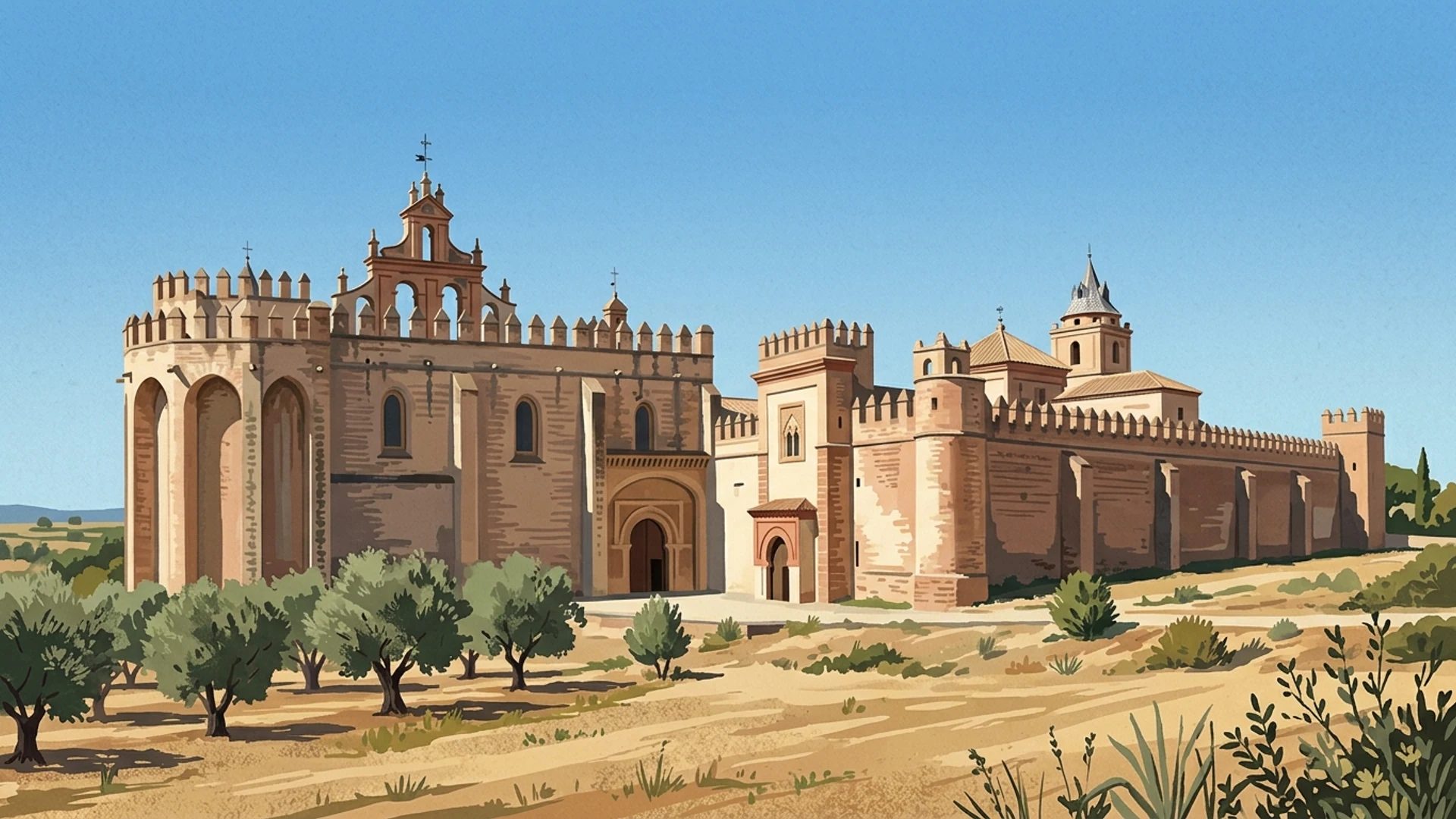
Standing like a brick fortress on the edge of Santiponce, the Monasterio de San Isidoro del Campo is one of Sevilla province’s most layered historical complexes. Founded in 1301 by the nobleman Alonso Pérez de Guzmán, known as Guzmán el Bueno, and his wife María Alonso Coronel, this Gothic-Mudéjar monastery was built over the reputed original burial site of Saint Isidore of Seville. Beyond its striking dual churches and frescoed cloisters, the complex holds a remarkable secret history: in the 16th century, its Hieronymite monks embraced the Protestant Reformation, leading to the first complete translation of the Bible into Spanish. Today, it provides a compelling mediaeval and Renaissance counterpart to the nearby Roman ruins of Itálica, appealing to history enthusiasts, art lovers and those exploring the wider legacy of the Guadalquivir basin.
A Fortress of Faith
The monastery exterior presents a formidable, defensive appearance, a reflection of the turbulent era of its foundation shortly after the Christian conquest of the region. Its robust brick walls and crenellated profiles speak to a time when the Guadalquivir valley was still a contested frontier. Inside, the architecture reveals a rare configuration of twin churches (iglesias gemelas). The original nave was commissioned by the founders, while their son later added a parallel church to accommodate the growing monastic community. The resulting spaces are a masterclass in Andalusian Gothic-Mudéjar design, seamlessly blending the ribbed vaults of European Gothic with the intricate brickwork and geometric precision of Islamic architectural traditions.
Originally entrusted to Cistercian monks, the complex was later handed over to the Hieronymite order in 1432. The Hieronymites expanded the monastery significantly, adding cloisters and commissioning extensive fresco cycles to aid in contemplation. The Patio de los Muertos (Cloister of the Dead) retains substantial fragments of these 15th-century mural paintings, offering a vivid glimpse into the visual culture of mediaeval monastic life. These frescoes depict scenes of the Passion and the lives of saints, providing a stark contrast to the austere architectural lines of the cloister itself.
The Secret Reformation
San Isidoro del Campo holds a unique and dramatic place in Spanish religious history. In the mid-16th century, a clandestine Protestant community took root within its walls, an extraordinary anomaly in the heart of deeply Catholic Andalucía. Influenced by reformist texts smuggled into Sevilla via the busy river port, several monks began practising Lutheran and Calvinist doctrines in secret, questioning papal authority and the established dogmas of the era.
When the Inquisition inevitably uncovered the cell in 1557, the consequences were severe. Many monks were imprisoned, and some were executed in the autos-da-fé of Sevilla. However, a small group managed to flee to Geneva and London. Among them was Casiodoro de Reina, who spent the next decade translating the Old and New Testaments from their original Hebrew and Greek into Castilian. Published in Switzerland in 1569, his monumental work became known as the Biblia del Oso (Bear Bible) due to the printer's emblem of a bear reaching for a honeycomb on its title page. It remains the foundation of the Reina-Valera Bible, the most widely used translation in the Spanish-speaking Protestant world today.
Masterpieces of the Spanish Baroque
While the bones of the monastery are decidedly mediaeval, its artistic zenith arrived during the Baroque period. In the early 17th century, the celebrated sculptor Juan Martínez Montañés, often referred to as the 'God of Wood' for his unparalleled skill, was commissioned to create the main altarpiece. The resulting work is widely considered a milestone in Spanish Renaissance and Baroque sculpture, drawing art historians and enthusiasts from across Europe.
The altarpiece is dominated by the central figure of Saint Jerome Penitent. Carved with astonishing anatomical precision and psychological intensity, the saint is depicted kneeling in the desert, gazing at a crucifix with an expression of profound spiritual yearning. Flanking the altar are the praying effigies of the founders, Guzmán el Bueno and María Alonso Coronel. These figures, kneeling on cushions, are among the very few non-religious sculptures executed by Montañés. They capture the solemn piety of the nobility with remarkable realism, from the heavy folds of their garments to the quiet dignity of their expressions.
Our verdict
San Isidoro del Campo is a profound historical site that rewards those who venture beyond the standard tourist trail of the regional capital. Its combination of Mudéjar architecture, world-class Baroque sculpture and gripping Reformation history makes it an essential stop for anyone visiting the area. It serves as a brilliant chronological bridge for those who have just spent the morning exploring the ancient Roman streets, moving the narrative forward from classical antiquity into the mediaeval and early modern eras.
However, visitors should manage their expectations regarding access and interpretation. The complex is managed by the regional government, and its opening hours are notoriously rigid and subject to sudden changes. Furthermore, because of ongoing conservation efforts and limited staffing, certain cloisters or upper levels may be cordoned off during your visit. There is no permanent interpretive centre or comprehensive audio guide available on site, so reading up on the history beforehand, particularly the dramatic story of the Biblia del Oso, is highly recommended to fully appreciate the empty spaces and silent corridors.
Practicalities
The monastery is located on the Avenida de San Isidoro del Campo, a short walk from the town centre and the main archaeological sites.
- Arrival: From the regional capital, the most straightforward route is the M-170A or M-170B regional bus, which departs from the Plaza de Armas bus station. The journey takes roughly 30 minutes, dropping passengers near the monastery entrance. For those driving, there is usually ample free parking in the immediate vicinity.
- Time-planning: A typical visit takes around 45 minutes to an hour. Capacity is strictly limited to 30 people at a time for conservation reasons, which rarely poses a problem except during major school holidays or special heritage days.
- Access: The site operates on a seasonal schedule. Always verify the current timetable on the official visitor website before travelling, as unannounced closures can occur.
- Mobility: As a historic structure, accessibility is mixed. While the main churches and ground-floor cloisters can be navigated by wheelchair users, the flooring is uneven in places, featuring original cobblestones and worn brickwork. Some secondary spaces and chapels have steps without ramps, limiting full access for those with mobility impairments.
Nearby worth your time
A few well-placed stops for extending the day without turning it into a checklist.
Continue through Itálica & Roman Sevilla
Step back into the wider landscape with local guides, nearby places and the province overview.
Things to do · 9 min
The Definitive Guide to Feria de Abril in Sevilla
Discover the cultural nuances, strict dress codes, and insider advice for navigating Sevilla's exclusive spring fair like a seasoned local.
Things to do · 10 min
Golf in Sevilla Province: Courses, Holidays and Local Pro Shops
Swap the crowded coastal fairways for the refined courses of Sevilla province. Discover top layouts designed by golfing legends, local shops, and expert tips for your next trip.
Itinerary · 13 min
One Week in Sevilla: A Complete Seven Days Itinerary
Spending a full week in Sevilla allows you to slow down and adopt the local rhythm. You can explore the monumental centre, wander through neighbourhood markets, and take the train to nearby Andalucían cities without feeling rushed.