
Practical guide
Driving in Andalucía: Rules, Tolls, and Parking Guide
A practical guide to driving in Andalucía, covering road rules, ZBE checks, AP-7 toll choices, parking, roundabouts, breakdown equipment and official sources.
By Dan · Updated 16 July 2026 · 9 min read
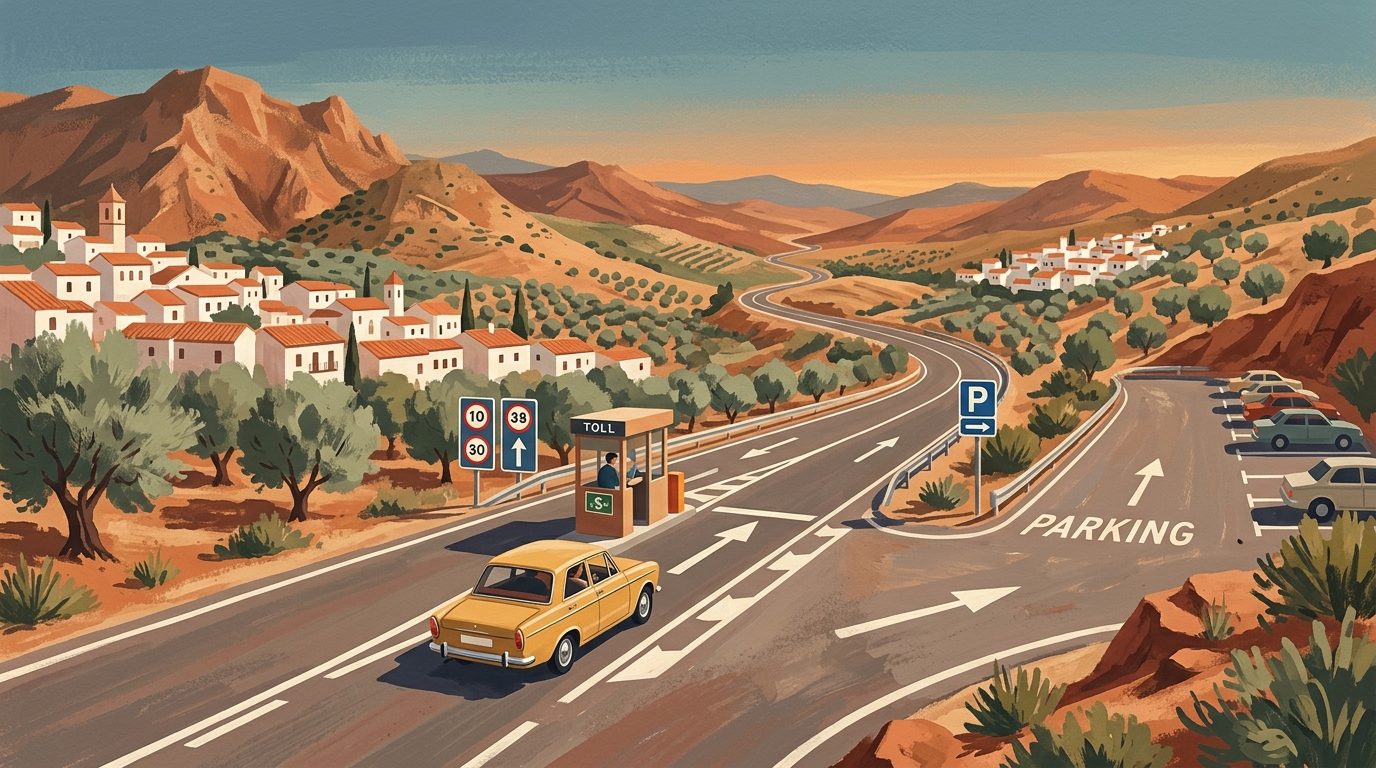
A practical guide to road rules, speed limits, parking regulations, and low-emission zones for drivers in southern Spain.
Driving in Andalucía is the most efficient way to see the region, particularly if you plan to visit the white villages (pueblos blancos) or national parks. While the road network is excellent, Spanish traffic laws are strictly enforced with heavy fines for minor infractions. You must drive on the right-hand side of the road and always carry your driving licence, passport, and vehicle documentation.
Before you drive
- Check the vehicle: insurance, rental agreement, fuel type, tyre condition, breakdown kit and whether required emergency equipment is present.
- Check city access: ZBE rules are city-specific and can affect foreign plates, rental cars and hotel access.
- Plan parking first: in Sevilla, Granada, Córdoba, Cádiz and Málaga, choosing a garage before arrival is often safer than circling the old town.
- Use official sources: DGT, town halls, toll operators and rental contracts override old travel notes.
Quick Answer: Essential Facts
- Drive on the right: Overtake on the left.
- Speed Limits: 120km/h on motorways, 90km/h on secondary roads, and 20-30km/h in urban areas.
- Tolls: Most motorways (Autovías) are free. The AP-7 coastal route has sections with tolls.
- ZBE Zones: Low-emission zones are city-specific; check the exact ZBE rules before entering.
- Roundabouts: Stay in the outer lane unless overtaking; you must exit from the outer lane.
- Documentation: Carry your driving licence (or the digital version on the MiDGT app), passport, and rental agreement at all times.
Speed Limits and Enforcement
Spain uses a mix of fixed cameras, mobile units, and "tramo" (average speed) cameras. Speed enforcement uses fixed, mobile and average-speed controls, so do not rely on informal tolerance margins.
- Motorways (Autopistas/Autovías): 120km/h.
- Standard open roads: 90km/h.
- Urban areas (single lane): 30km/h.
- Urban areas (pavement and road at same level): 20km/h.
- Urban areas (two or more lanes per direction): 50km/h.
Note: It is no longer legal to exceed the speed limit by 20km/h to overtake on secondary roads.
Understanding Roundabouts
Roundabouts in Andalucía can be confusing for international drivers. The legal requirement is to use the outer lane for exiting. If you are in the inner lane, you do not have priority to cut across the outer lane to exit. If you cannot safely move to the outer lane, you must go around the roundabout again. Indicators are mandatory when changing lanes and when exiting.
Motorway Tolls (Peajes)
Most roads in Andalucía are "Autovías" (prefixed with A) and are free to use. "Autopistas" (prefixed with AP) are often toll roads.
- AP-7 (Costa del Sol): This is the primary toll road in the region, running between Fuengirola and Guadiaro. Tolls vary by section, vehicle category, season and operator updates. Check Autopista del Sol before deciding between AP-7 and the slower free A-7.
- Payment: Toll booths accept cash, credit/debit cards, and contactless payments. You can also use a "Via-T" electronic device for automatic billing.
- Alternatives: The A-7 runs parallel to the AP-7 and is free, though it is significantly slower and has more traffic.
Low Emission Zones (ZBE)
Spanish law requires many larger municipalities to create low-emission zones, but timing, boundaries, exemptions and enforcement differ by city. In Andalucía this matters most for drivers entering central areas of cities such as Sevilla, Málaga, Córdoba, Granada, Jerez, Almería and Huelva.
- Stickers: Spanish-registered cars must display a DGT environmental sticker (B, C, ECO, or Zero). Rental cars usually have these already attached.
- Foreign Cars: If you are driving foreign plates or a rental car, check the city portal and ask your rental company or hotel before entering. Rules for recognition, registration, access routes and hotel drop-off can differ between cities.
- Enforcement: Cameras scan number plates at entry points. Fines and notification procedures can change; check the relevant city council rather than relying on a fixed amount.
Parking Zones and Fines
Parking is colour-coded in most Andalucían towns and cities. Parking in the wrong zone or without a ticket will result in a fine or your vehicle being towed (grua).
- White Lines: Free parking. These are rare in city centres.
- Blue Lines (Zona Azul): Paid parking for limited durations (usually 2 hours). You must pay at a machine or via a mobile app like Telpark or ElParking. Display the ticket on the dashboard.
- Green Lines (Zona Residente): Primarily for residents. Visitors can sometimes park here but for shorter durations and at higher rates than blue zones.
- Yellow Lines/Curb: No parking or loading/unloading only. Do not park here.
Fines (Denuncias): If you find a ticket on your windscreen in a blue zone for exceeding the time limit, you can often "cancel" it (anular) by paying an anulación fee within the specified timeframe. This cancellation is increasingly handled via the mobile app used to pay for the initial parking, rather than just at the physical machine.
Petrol Stations (Gasolineras)
Petrol stations are frequent along motorways and near town entrances.
- Fuel Types: Gasolina 95 or 98 (Unleaded petrol) and Gasóleo (Diesel).
- Self-Service: Many stations are self-service. You may need to pay at the booth or a machine first before the pump is authorised.
- Hours: On motorways, stations are often open 24 hours. In rural areas, they may close on Sundays or during siesta hours (14:00-17:00).
Compulsory Equipment
If you are driving a private car or a rental, ensure the following items are inside the vehicle:
- A DGT-approved connected V16 emergency beacon, which as of January 2026 is mandatory and replaces the use of reflective triangles on all Spanish roads. Ask the rental desk to show you the device and explain the breakdown procedure before leaving.
- Reflective jackets and any other equipment required by the current DGT rules and your rental contract.
- A spare wheel, repair kit or assistance arrangement, depending on the vehicle.
- A valid UK or EU driving licence (and an International Driving Permit if your licence is not in a Roman script).
Roundabouts in Real Traffic
The legal rule is simple, but the local habit can feel different. Many Spanish drivers move into the inside lane on a large roundabout and stay there until close to their exit. You may then see a last-second lane change across the outer lane. Do not copy that move. Hold your position, keep your speed low, and let the other car sort itself out.
- First exit: Approach in the right-hand lane, signal right before leaving, and watch for scooters filtering on your outside.
- Second or later exits: Use the lane signs if marked, but be ready to go around again rather than cutting across traffic.
- Tourist areas: Expect hesitant rental cars near airports and beach resorts, especially around Málaga, Sevilla and Granada exits.
Old Towns, Villages and GPS Traps
Historic centres were not built for modern cars. Sat-nav apps sometimes send drivers through resident-only streets, steep lanes, or alleys that become too narrow to reverse out of safely. In white villages, the sensible choice is often to park at the lower entrance to town and walk up.
- Look for perimeter parking: Search for aparcamiento público (public car park) before you reach the centre, not after you are already in the one-way system.
- Respect access signs: Excepto residentes means residents only, even if your hotel is nearby. Ask the hotel for the approved approach route before arrival.
- Fold mirrors early: In older streets, treat stone corners, balconies and delivery vans as normal road furniture.
Longer Stays: Parking Habits and ITV
For city visits, underground car parks are often the least stressful option. They cost more than street parking, but they avoid blue-zone time limits, towing risk and repeated trips back to the meter. Leave nothing visible inside the car, including charging cables, coats, sunglasses and supermarket bags.
If you own or keep a Spanish-registered vehicle, learn the ITV system. The Inspección Técnica de Vehículos (technical vehicle inspection) is Spain's roadworthiness test. Frequency depends on vehicle age and type, so check the due date on the vehicle paperwork or windscreen sticker. Rental cars are managed by the company, but long-term residents buying second-hand should confirm the ITV is current before paying. Our guide to hiring a car in Andalucía is also useful for checking equipment and insurance habits before a road trip.
Frequently Asked Questions
Can I turn right on a red light?
No. Unlike in some countries, turning right on a red light is strictly prohibited in Spain unless there is a specific flashing amber arrow allowing the turn, and even then, you must yield to pedestrians and other traffic.
What is the drink-drive limit?
Spain has low drink-drive limits and roadside checks. The safest practical advice is not to drink if driving, especially with a rental car, mountain roads or unfamiliar city exits.
How do I pay a traffic fine?
If you receive a traffic fine, follow the instructions on the official notice or rental-company communication. Rental companies may charge administration fees for identifying the driver, and payment/discount rules depend on the type of notice.
Are headphones allowed while driving?
No. It is illegal to drive while wearing headphones or using a mobile phone without a completely hands-free system. This includes using headphones for GPS directions.
Summary
- Stick to the lanes: Always exit roundabouts from the outer lane and keep to the right on motorways.
- Watch the signs: Respect the 30km/h urban limits and check for ZBE signs in city centres.
- Pay for parking: Use the blue zone machines or apps to avoid towing.
- Carry papers: Keep your ID and driving licence on you at all times.
Official checks before driving
Use DGT for current road rules and driver guidance, the Spanish government's V16 beacon notice for breakdown-device context, Autopista del Sol for AP-7 toll information, the Sevilla town hall portal (check the official site for ZBE rules before travelling) and Málaga mobility for city access checks. For rental trips, also read your hire-car contract before leaving the desk.
Last reviewed: 14 July 2026 · Editorial policy
Related guides

Accessibility Guide to Andalucía: Travel and Logistics
A practical accessibility guide to Andalucía, with city terrain notes, rail and airport assistance checks, hotel-room questions, adapted beaches and official source links.
6 min read

A Practical Guide to Bus Travel in Andalucía with Alsa
A comprehensive guide to using Alsa buses in Andalucía, covering booking tips, major routes, luggage rules, and station facilities.
7 min read

Guide to Train Travel in Andalucía: Renfe, AVE, and Regional Routes
A practical guide to train travel in Andalucía, covering AVE, Avant, Media Distancia, Cercanías, airport rail, booking checks, accessibility and operator links.
8 min read

Hiring a Car in Andalucía: A Practical Guide
A practical guide to hiring a car in Andalucía, covering rental contracts, deposits, insurance exclusions, parking, tolls, cross-border rules and official driving checks.
7 min read

Money and Costs in Andalucía: A Practical Guide
A practical guide to money, daily costs, and banking in Andalucía. Discover typical prices for meals and transport, plus expert tips on avoiding ATM fees and navigating local banks.
9 min read

Tipping Culture in Andalucía: A Practical Guide
Tipping in Andalucía is an appreciation for good service rather than a mandatory requirement. Discover how much to leave in restaurants, bars, and hotels across the region.
7 min read
More guides

Using a VPN in Andalucía: A Practical Guide for Travellers and Residents
A comprehensive guide to using a VPN in Andalucía for security, accessing UK streaming services, and maintaining privacy on public Wi-Fi.
6 min read

Sevilla Airport (SVQ) Guide: Transport, Facilities and Tips
A practical guide to Sevilla Airport (SVQ) covering the EA bus, taxi flat rates, terminal facilities, car hire, and connecting to wider Andalucía.
9 min read
Practical Guide to Almería Airport (LEI)
A practical logistics guide to arriving at Almería Airport (LEI). Discover how to navigate terminal facilities, use the Surbus Line 30, connect to intercity buses, and avoid common transport mistakes.
7 min read
Practical Guide to Gibraltar International Airport (GIB)
A practical guide to using Gibraltar Airport (GIB) for trips into Andalucía, covering border logistics, avoiding vehicle queues, Spanish transport options, and how to handle wind diversions.
8 min read

Málaga-Costa del Sol Airport (AGP) Travel Guide
A deep practical guide to navigating Málaga-Costa del Sol Airport (AGP). Learn the realities of arrivals, transport connections, parking rules, and common mistakes.
8 min read
Federico García Lorca Granada-Jaén Airport Guide: Transport, Costs and Tips
A complete practical guide to Granada-Jaén Airport (GRX), covering airport buses, taxi fares, car hire friction, terminal facilities, and the step-by-step reality of arriving and departing.
7 min read

Jerez Airport (XRY): The Complete Guide to the Gateway of Cádiz
A deep-dive practical guide to using Jerez Airport (XRY). Learn the realities of onward transport to Cádiz province, car hire friction, train timetables, and how to avoid the most common arrival mistakes.
8 min read

Understanding Spanish Festival Culture in Andalucía
A deep dive into Andalucían festival culture for residents and visitors. Understand Semana Santa, ferias, local holidays, etiquette, administrative friction and how to survive the local party season.
9 min read

Getting to Andalucía: A Practical Transport Guide
A comprehensive practical guide to reaching Andalucía. Learn how to navigate airports, high-speed rail transfers, road tolls, and cross-strait ferries, including solutions for common travel friction points.
7 min read
Newsletter
More stories from Andalucía
Weekly notes, seasonal picks, and the next guides worth bookmarking.