
Nature & wildlife · Cádiz
Los Alcornocales: Europe's Finest Cork Oak Forest
Spanning the Cádiz mountains, Los Alcornocales preserves a prehistoric ecosystem of subtropical cloud forests and vast cork oak woodlands unique in Europe.
By Dan · Updated 7 June 2026 · 7 min read
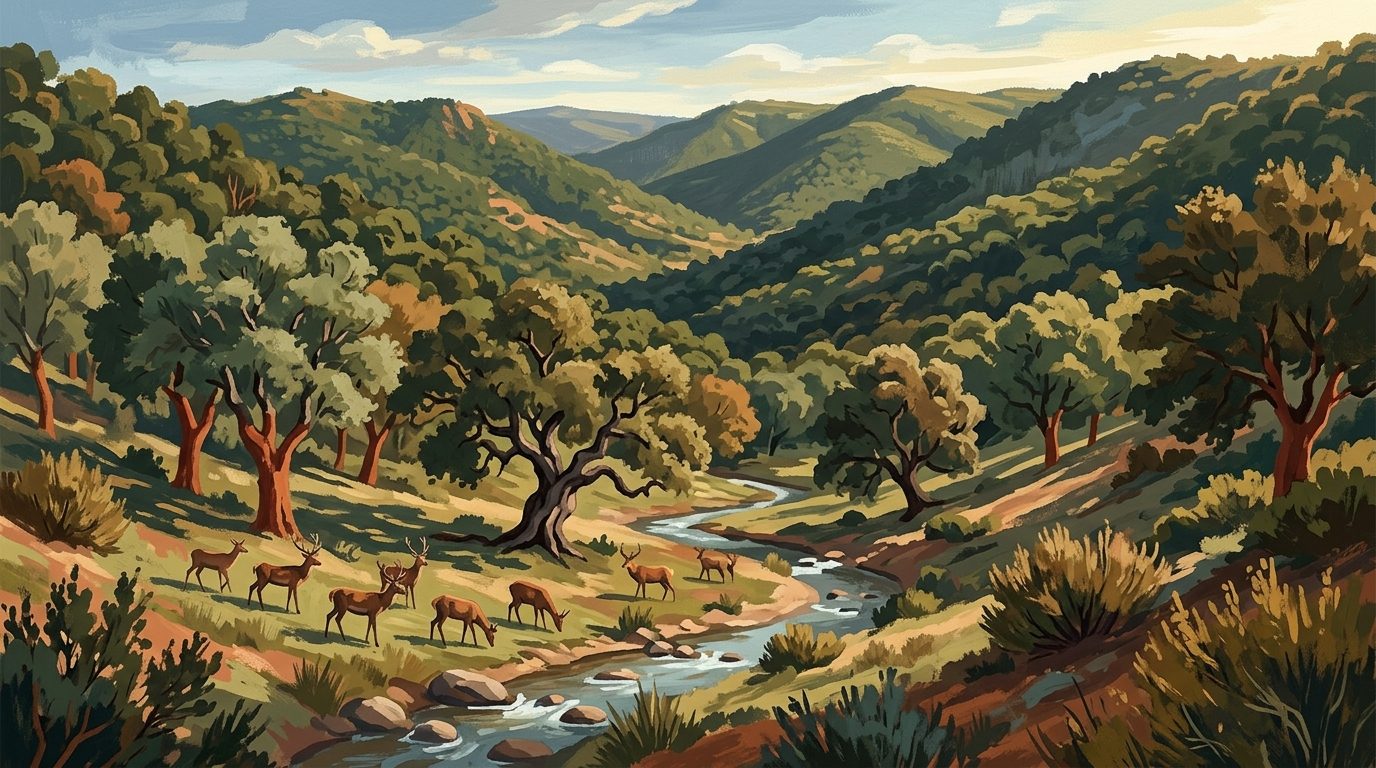
Spanning the southern reaches of the Cádiz mountains, Los Alcornocales Natural Park represents the largest and best-preserved cork oak forest in the world. Its deep, humid ravines harbour the last remnants of Europe’s subtropical cloud forests, ecosystems that have survived here since the Tertiary period.
To enter Los Alcornocales is to step into a landscape that feels fundamentally different from the sun-scorched plains typically associated with southern Spain. Stretching over 170,000 hectares from the interior mountains of Cádiz down to the Strait of Gibraltar, this natural park functions as a massive green sponge. It captures the humid Atlantic winds, known locally as the levante, creating a microclimate of high rainfall and persistent mists. This humidity sustains a prehistoric landscape of shadows, ferns, and moss-covered stone that has remained largely unchanged for millennia.
While the park is named after its dominant tree species, the Cork Oak (Quercus suber), its biological importance extends far beyond commercial timber. It is a critical corridor for bird migration, a refuge for rare Mediterranean carnivores, and a botanical museum containing plant species found nowhere else on the European continent. For the naturalist, it offers an opportunity to experience a wilderness that feels both ancient and vital, where the traditional human industry of cork stripping exists in a delicate, sustainable balance with high-level biodiversity conservation.
The Ecosystem: Sandstone, Mist, and Canutos
The unique character of Los Alcornocales is dictated by its geology and climate. Unlike the limestone peaks of the nearby Sierra de Grazalema, much of this park is composed of Aljibe sandstone (arenisca). This acidic soil, combined with exceptionally high rainfall, reaching 1,500mm annually in some areas, creates the perfect conditions for the Cork Oak. These trees form vast, open woodlands that support a complex understorey of Strawberry trees (Arbutus unedo), Heather (Erica arborea), and Mastic (Pistacia lentiscus).
However, the park’s most extraordinary feature is the canutos. These are narrow, deep river valleys carved into the sandstone where humidity is trapped year-round. Inside these valleys, the temperature remains stable and the air stays saturated with moisture. This creates a "relict" forest of laurisilva: a type of vegetation that covered most of the Mediterranean basin millions of years ago but disappeared elsewhere as the climate became more arid. Here, you will find the Algerian Oak (Quercus canariensis) and the rare Pontic Rhododendron (Rhododendron ponticum subsp. baeticum), which produces spectacular purple blooms in late spring.
Key Species: From Sky to Forest Floor
The Raptors: Masters of the Thermals
Due to its proximity to the Strait of Gibraltar, Los Alcornocales is a primary landmark for migratory birds. However, its resident raptor populations are equally impressive. The park is a stronghold for the Black Vulture (Aegypius monachus), Europe’s largest bird of prey. Unlike the more common Griffon Vulture, the Black Vulture prefers to nest in trees, specifically the crowns of large cork oaks, rather than on cliffs. Sighting probability is high year-round, particularly in the central areas of the park near Jimena de la Frontera.
The Bonelli’s Eagle (Aquila fasciata) also patrols the limestone ridges that punctuate the sandstone landscape. This agile hunter is often seen in pairs. In the summer months, the Short-toed Eagle (Circaetus gallicus) is a frequent sight, hovering over open glades in search of snakes, which form the bulk of its diet.
Mammals: The Ghostly Carnivores
While Red Deer (Cervus elaphus) and Fallow Deer (Dama dama) are easily spotted, especially during the autumn rut, the park’s smaller carnivores require more patience. The Egyptian Mongoose (Herpestes ichneumon) is a unique inhabitant here; it is the only mongoose species found in Europe. Unlike most carnivores, it is diurnal, meaning it is active during the day. Look for them crossing forest tracks in family groups, often walking nose-to-tail in a line.
More elusive is the Common Genet (Genetta genetta), a slender, spotted nocturnal climber that thrives in the dense canopy. The Wildcat (Felis silvestris) also maintains a presence here, though sightings are extremely rare and usually confined to the twilight hours in remote areas. In the rivers and canutos, the Eurasian Otter (Lutra lutra) has seen a significant recovery and can often be found in the upper reaches of the Rio Hozgarganta.
Flora: The Ancient Ferns
In the depths of the canutos, the vegetation is almost tropical. The park is famous for its rare ferns, including Culcita macrocarpa and Diplazium caudatum. These species are survivors from the Tertiary period and are highly sensitive to changes in humidity. Seeing them requires hiking into the heart of the ravine systems, such as the Rio de la Miel near Algeciras. The sight of these giant ferns, some with fronds over two metres long, growing alongside moss-draped Alder trees (Alnus glutinosa), is one of the most distinctive botanical experiences in Spain.
Best Time to Visit
October to May: This is the prime window for hikers. The temperatures are cool enough for the steep ascents, and the forest is at its most atmospheric, often shrouded in cloud. Late September and October bring 'La Berrea' (the rut), where the bellows of Red Deer stags echo through the cork oaks.
Spring (March to May): This is the best time for botany enthusiasts. The canutos are filled with wildflowers, and the Rhododendrons bloom in April and May. It is also the peak for the spring bird migration as hundreds of thousands of birds cross the Strait from Africa.
Summer (June to August): While the interior can be hot, the summer is the time of 'La Saca', the cork harvest. This traditional practice involves skilled workers stripping the bark from the oaks by hand. The stripped trunks turn a vivid, ox-blood red, a striking sight against the green leaves. It is also the best time to see the Short-toed and Booted Eagles soaring on the heat thermals.
How to Explore
Exploring Los Alcornocales requires some planning, as the park is divided into different zones with varying levels of protection. Many of the most beautiful canutos and mountain peaks are located within 'Zona de Reserva' (Reserve Zones), which require a free permit from the Ministry of Environment (Junta de Andalucía).
Self-Guided Routes
- Sendero del Río de la Miel: Starting in Algeciras, this trail leads directly into a classic canuto forest with waterfalls and ancient stone bridges. No permit required.
- Sendero de la Calzada Romana: A historic route near Benaocaz that offers a mix of limestone scenery and cork forest. Excellent for seeing Griffon Vultures.
- Subida al Aljibe: The highest peak in the park. This requires a permit and offers views across the entire forest to the Rock of Gibraltar and the coast of Africa.
Guided Tours and Hides
For those seeking specific wildlife sightings, several local companies in Jimena de la Frontera and Los Barrios offer 4x4 tours into the heart of the private estates. These are often the best way to see the more elusive mammals and to learn about the intricacies of the cork industry. Photo hides are also available in certain areas for those wishing to photograph vultures and eagles at close range.
Practical Information
Getting There: The main gateways to the park are the towns of Jimena de la Frontera, Castellar de la Frontera, and Los Barrios. The A-381 motorway (the 'Ruta del Toro') bisects the park and provides excellent access, though you must exit onto smaller tracks to truly see the forest.
Access and Permits: To access restricted trails, you should apply for permits via the Junta de Andalucía's 'Ventana del Visitante' online portal or email the park office (infonatura.capma@juntadeandalucia.es) at least two weeks in advance, providing your passport number and the date of your intended hike.
What to Bring: Even in summer, the humidity can make the forest floor damp and slippery. Sturdy waterproof hiking boots are essential. In winter and spring, a waterproof shell is necessary as the mist can turn to heavy rain very quickly. Binoculars are a must for raptor spotting.
Conservation Note
While Los Alcornocales is a protected Natural Park, it faces significant challenges. The most pressing is la seca (dieback), a complex disease involving the fungus-like pathogen Phytophthora cinnamomi, which attacks the roots of the cork oaks. This is exacerbated by climate change and periods of prolonged drought. Furthermore, the lack of natural regeneration (where young trees are eaten by high populations of deer and livestock) threatens the long-term future of the forest. Visiting the park and supporting local eco-tourism helps demonstrate the economic value of preserving this ecosystem beyond its cork production alone.
Last reviewed: 21 June 2026 · Editorial policy
Related guides
Tabernas Desert: Europe's Only True Desert
Explore the unique ecology of the Tabernas Desert, Europe's only true desert, where Saharan-style badlands provide a sanctuary for rare Trumpeter Finches and specialist flora.
7 min read
Cabo de Gata Natural Park: Wild Coast Guide
Discover the volcanic cliffs, salt lagoons, and crystalline waters of Cabo de Gata-Níjar Natural Park, Europe’s only warm desert landscape and a haven for rare Mediterranean wildlife.
7 min read
The Gibraltar Strait: Europe's Greatest Bird Migration
Discover the biological funnel where millions of raptors and storks cross between Europe and Africa, creating one of the world's most significant wildlife spectacles.
7 min read
Odiel Marshes: Huelva's Overlooked Wetland
Discover the Marismas del Odiel, a tidal powerhouse in Huelva that hosts Europe's largest spoonbill colony and a spectacular array of flamingos and ospreys.
7 min read
Fuente de Piedra: Andalucía's Flamingo Lake
Discover the vital breeding grounds of the Greater Flamingo at the Laguna de Fuente de Piedra, a hypersaline wetland in the heart of Málaga province.
7 min read
Where to See the Iberian Lynx: Andújar and Beyond
Discover the best ways to see the world's rarest cat in the Sierra de Andújar. This guide covers the best viewing spots, seasonal timing, and the diverse wildlife of Jaén's rugged Mediterranean scrubland.
6 min read
More from Cádiz

Newsletter
More stories from Andalucía
Weekly notes, seasonal picks, and the next guides worth bookmarking.