
Nature & wildlife · Granada
Snorkelling & Marine Life of the Costa Tropical
Discover the underwater world of Granada's Costa Tropical, where clear Alborán waters host octopus, peacock wrasse, and protected seagrass meadows.
By Dan · Updated 16 July 2026 · 6 min read
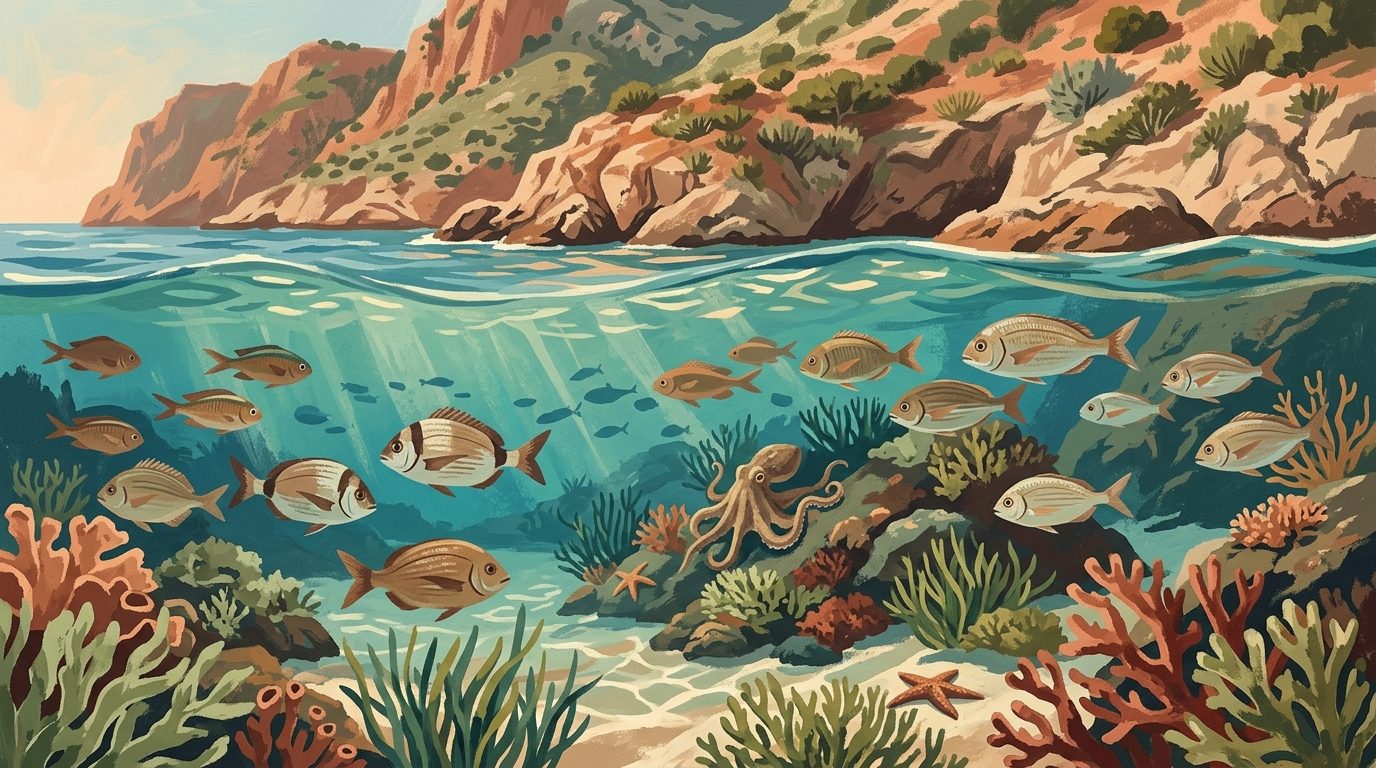
The Costa Tropical offers some of the most biodiverse snorkelling in the Mediterranean, where steep cliffs dive into crystal-clear waters sheltering protected seagrass meadows. From the intricate camouflage of the common octopus to the electric blues of the peacock wrasse, the marine life here is accessible yet surprisingly wild.
While much of the Spanish Mediterranean coastline has been reshaped by urban development, the Costa Tropical in Granada province retains a rugged underwater topography that supports an extraordinary array of marine life. This stretch of coast, specifically the area between Almuñécar and the Maro-Cerro Gordo cliffs, sits at a biological crossroads. Here, the inflow of nutrient-rich Atlantic water through the Strait of Gibraltar meets the warmer Mediterranean, creating a high-energy environment known as the Alborán Sea.
For the snorkeller, this means exceptional water clarity and a density of species rarely found further north. Unlike the sandy shelves of the Costa del Sol, the Granada coastline is defined by dramatic schist and limestone cliffs that plunge vertically into the sea. These submerged rock faces, combined with expansive meadows of protected seagrass, provide the complex architecture required for a healthy marine food web. For visitors floating over a shallow reef or exploring the edges of a sea cave, the encounter with wildlife is immediate and frequently surprising.
The Ecosystem: Lungs of the Mediterranean
The ecological backbone of the Costa Tropical is the Posidonia oceanica seagrass. Often mistaken for seaweed, Posidonia is a flowering terrestrial plant that migrated back to the sea millions of years ago. These meadows act as the 'lungs of the Mediterranean', producing massive amounts of oxygen and serving as a vital nursery for countless fish species. In the Paraje Natural Acantilados de Maro-Cerro Gordo, these meadows are particularly well-preserved, creating a carbon-sink that is fundamental to the health of the local waters.
Complementing the seagrass are the rocky reefs and the occasional 'forest' of kelp. While kelp is typically associated with colder Atlantic waters, species like Laminaria ochroleuca persist here due to deep-water upwellings that bring cool, nutrient-dense water to the surface. This overlap of temperate and subtropical conditions allows species with different thermal requirements to coexist, resulting in a reef system that feels significantly more 'alive' than many other Mediterranean holiday spots.
Key Species: What to Look For
The Masters of Disguise: Cephalopods
The Common Octopus (Octopus vulgaris) is a frequent sight along the rocky sections of La Herradura and Marina del Este. Look for 'middens' - piles of empty crab shells or stones arranged unnaturally outside a crevice - which often signal an occupied den. Sightings are highly likely year-round if you move slowly and observe the rock formations closely. You may also encounter the Common Cuttlefish (Sepia officinalis), particularly in the spring and early summer when they move into shallower water to breed. Their ability to ripple colours across their skin for communication and camouflage is one of the great spectacles of the Granada coast.
The Reef Community
The most conspicuous fish is the Peacock Wrasse (Thalassoma pavo), identifiable by its striking green and blue markings and a vertical red bar behind the head in dominant males. They are inquisitive and often approach snorkellers. Schools of Two-banded Bream (Diplodus vulgaris) and Salema (Sarpa salpa) - easily recognised by their horizontal gold stripes - graze on the algae-covered rocks. In the crevices, look for the Mediterranean Parrotfish (Sparisoma cretense); the females are a startling red with a yellow patch, while the males are a more muted grey-blue.
Pelagic Visitors and Rarities
While snorkelling is primarily a nearshore activity, the steep drop-offs mean larger species occasionally venture close to the rocks. Bottlenose Dolphins (Tursiops truncatus) are frequently seen from the cliffs of Cerro Gordo and occasionally pass by snorkellers in the outer reaches of the bays. The Loggerhead Turtle (Caretta caretta) is a rarer visitor, though sightings have increased in recent years during the summer months. If you see a turtle, maintain a distance of at least five metres and never attempt to touch it, as this causes significant stress to the animal.
Best Time to Visit
The window for snorkelling on the Costa Tropical is surprisingly wide, but the experience changes significantly with the seasons:
- June to August: The water temperature rises from 18°C to 24°C. Visibility is usually excellent, often exceeding 15 metres. However, these months are the busiest with boat traffic and beachgoers.
- September: This is arguably the best month. The water remains at its maximum warmth (around 25°C), the summer crowds have thinned, and the autumn winds that can stir up sediment haven't yet arrived.
- October to November: The 'second summer'. Water temperatures stay above 20°C well into October. This is a fantastic time for seeing larger schools of juvenile fish.
- Winter and Spring: Only recommended for those with a full 5mm or 7mm wetsuit. While the water is cold (14-15°C), the clarity can be world-class, and you will have the reefs entirely to yourself.
How to Explore
The Costa Tropical offers both easy-access shore entries and more remote spots accessible only by water.
Self-Guided Routes
Marina del Este (Los Berengueles): This is perhaps the most famous snorkelling spot in the region. The rock known as 'La Mona' sits just offshore and is surrounded by a wealth of life. Access is via the beach next to the marina. It is sheltered from the prevailing westerly winds, making it a safe choice when other spots are choppy.
Cantarriján: Located within the Maro-Cerro Gordo Natural Park, this beach has restricted vehicle access in summer (a shuttle bus operates from the main road). The rocky headlands on either side of the bay are exceptional. The eastern side features small caves and overhangs where you can find sponges and anemones.
Guided Tours and Kayaking
To reach the most pristine areas of the cliffs, a kayak-snorkelling tour from La Herradura is highly recommended. Local outfitters lead small groups out to the 'Cueva de las Palomas' and other inaccessible coves. These guides provide essential context on the marine protected area and can point out camouflaged species like scorpionfish (Scorpaena scrofa) that an untrained eye would likely miss.
Practical Information
Access and Permits: No specific permits are required for recreational snorkelling. However, the Maro-Cerro Gordo area is a Special Protected Area of Mediterranean Importance (SPAMI). Motorised craft are strictly regulated, and anchoring in Posidonia meadows is prohibited. If you are bringing your own kayak or paddleboard, ensure you do not drop anchor.
Equipment: Even in summer, a 2mm or 3mm neoprene 'shorty' wetsuit is recommended. It provides buoyancy, protection from the sun, and insulation against the thermoclines (sudden drops in temperature) that occur in these waters. A bright tow-float is essential for safety, as small boats and jet skis are common in the summer months.
Parking: In La Herradura and Almuñécar, parking is difficult during July and August. Arrive before 10:00 or use the paid parking at Marina del Este. For Cantarriján, use the designated car park at the top of the cliff and take the official shuttle.
Conservation Note
The marine ecosystems of the Costa Tropical face ongoing pressure from climate change - manifesting as rising sea temperatures - and localised pollution. Overfishing remains a concern, though the establishment of the Natural Park has provided a refuge where populations can recover. As a visitor, the most impactful thing you can do is practice 'neutral buoyancy' - ensure you are not kicking the seabed or standing on rocks. Every time a fin strikes the reef, it can destroy years of growth or kill the delicate invertebrates that form the base of this underwater world.
Last reviewed: 21 June 2026 · Editorial policy
Related guides
A Guide to Water Sports in Granada: From Reservoirs to the Tropical Coast
Discover the best spots for diving, kayaking, and reservoir swimming in Granada, from the marine reserves of La Herradura to the turquoise waters of Los Bermejales.
6 min read
Playa de Cantarriján: A Comprehensive Guide to Granada's Premier Naturist Beach
Playa de Cantarriján is a protected naturist-friendly cove on the Granada coast, offering crystal-clear water and a tranquil escape from the busier resorts.
7 min read
A Guide to Water Sports in Andalucía: Where to Surf, Dive, and Paddle
From the windswept Atlantic coast to the calm waters of the Mediterranean, Andalucía offers world-class conditions for surfing, diving, and kayaking.
5 min read
A Guide to the Odiel Marshes: Huelva’s Coastal Wilderness
Discover the sprawling tidal wetlands of the Odiel Marshes, a UNESCO Biosphere Reserve home to Europe’s most significant spoonbill colonies and striking pink flamingos.
6 min read
Mastering the Atlantic: A Guide to Water Sports in Huelva
From the Atlantic swells of Islantilla to the rust-coloured waters of the Río Tinto, Huelva offers a distinct maritime playground for kayaking, surfing, and sailing.
6 min read
The Best Water Sports in Almería: A Coastal Guide
Discover the rugged volcanic coastline of Almería through world-class diving, kayaking, and paddleboarding in the protected waters of Cabo de Gata.
6 min read
More from Granada

Newsletter
More stories from Andalucía
Weekly notes, seasonal picks, and the next guides worth bookmarking.