
Nature & wildlife · Málaga
Fuente de Piedra: Andalucía's Flamingo Lake
Discover the vital breeding grounds of the Greater Flamingo at the Laguna de Fuente de Piedra, a hypersaline wetland in the heart of Málaga province.
By Dan · Updated 7 June 2026 · 7 min read
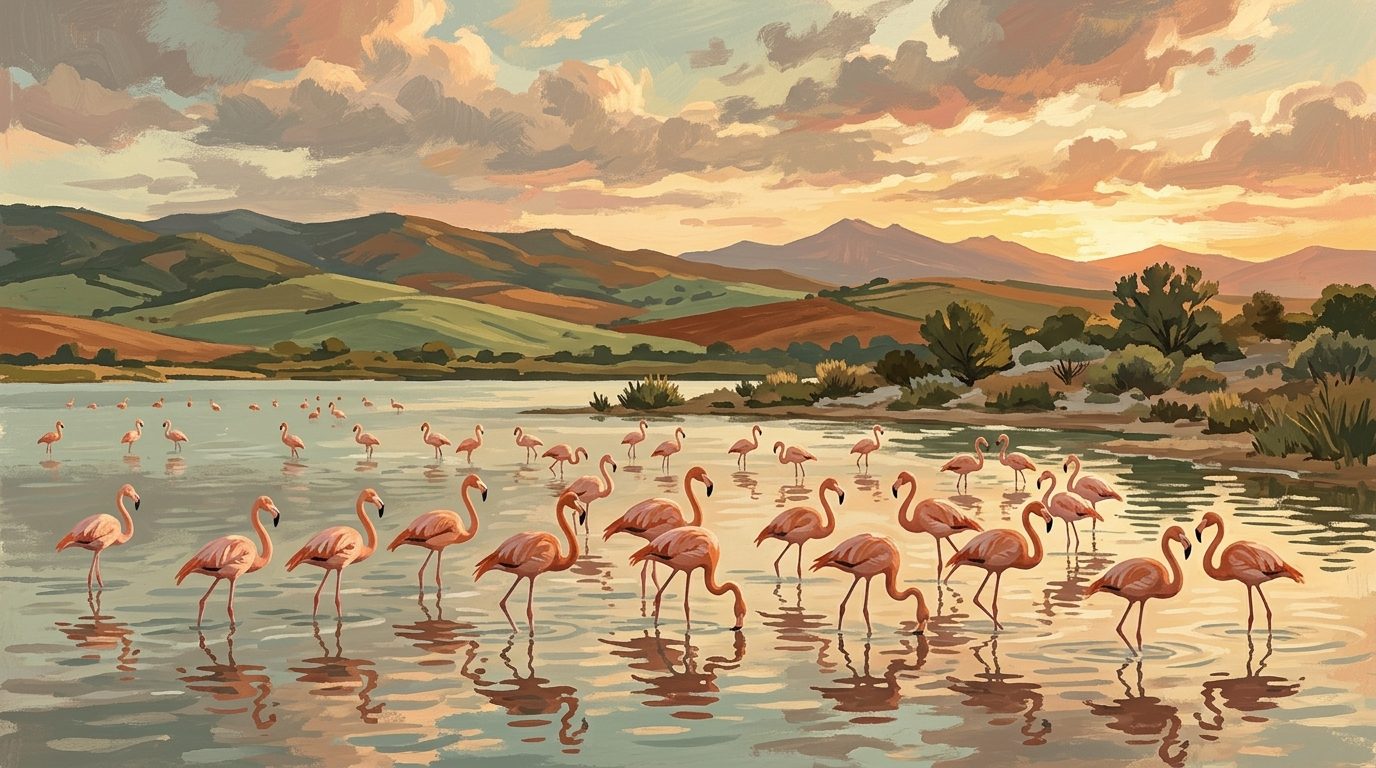
A seasonal stronghold for tens of thousands of Greater Flamingos, this endorheic lake represents one of Europe’s most significant wetland ecosystems. Its hypersaline waters provide a specialised habitat that dictates the rhythm of life for one of the continent's most iconic avian spectacles.
In the northern reaches of Málaga province, the landscape transitions from the rugged limestone peaks of the Subbetic ranges into a rolling expanse of olive groves and cereal fields. In the centre of this agricultural basin lies the Laguna de Fuente de Piedra, a vast, shallow sheet of water that serves as the primary breeding ground for the Greater Flamingo (Phoenicopterus roseus) in the Iberian Peninsula. Covering 1,364 hectares, it is the largest natural lake in Andalucía and the second most important breeding site for flamingos in Europe, surpassed only by the Camargue in France.
What makes Fuente de Piedra unique is not just its scale, but its chemistry. As an endorheic basin, the lake has no outlet to the sea; water leaves only through evaporation, leaving behind high concentrations of salts and minerals. This creates a hypersaline environment where only specialised organisms can thrive, forming the base of a complex food web that supports thousands of nesting birds. For the naturalist, the lake offers a raw, unfiltered look at the cycles of Mediterranean hydrology, where the presence of life is inextricably linked to the autumn and winter rains.
The Ecosystem: A Hypersaline Stronghold
The Laguna de Fuente de Piedra is a remnant of a geological era when much of this region was covered by sea. It sits within a closed drainage basin where groundwater and surface runoff accumulate. Because the underlying geology is rich in gypsum and salt, the water becomes increasingly saline as it evaporates under the intense Andalucían sun. By late summer, the lake often transforms into a blinding white salt crust, a stark transformation from the shimmering blue-grey expanse of the spring.
The primary driver of the ecosystem is the brine shrimp (Artemia salina). These tiny crustaceans thrive in high-salinity water and are the principal food source for the flamingos. It is the carotenoid pigments within these shrimp that provide the flamingos with their distinctive pink plumage. Beyond the water’s edge, the lake is fringed by salt-tolerant vegetation, or halophytes, such as Glasswort (Salicornia europaea) and Shrubby Sea-blite (Suaeda vera). These plants are adapted to excrete excess salt through their leaves and provide vital nesting cover for shorebirds.
The surrounding agricultural land acts as a buffer zone, though it also introduces challenges regarding pesticide runoff and water extraction. Small satellite lagoons, such as the Laguneto, are often maintained with more stable water levels, providing a reliable refuge even when the main lake begins to recede in the summer heat.
Key Species
Greater Flamingo (Phoenicopterus roseus)
The defining species of the reserve, the Greater Flamingo, arrives in late winter. Sighting likelihood is extremely high from February to July, provided there has been sufficient winter rainfall. In a good year, up to 25,000 pairs may gather to breed on the "Isla de la Colonia," a low-lying island in the centre of the lake. From the observation points, they appear as a shimmering pink haze. Using binoculars, you can observe their complex courtship displays: a synchronised "marching" and wing-saluting. By May, the first grey, fluffy chicks appear, eventually forming large "crèches" while the adults fly to the Doñana wetlands or the Odiel marshes (over 150 kilometres away) to forage for food to bring back to their young.
Lesser Flamingo (Phoeniconaias minor)
A much rarer visitor, the Lesser Flamingo is occasionally spotted among the thousands of Greater Flamingos. Sighting likelihood is low, but for the patient birder with a high-quality spotting scope, they are a prized find. They are smaller, with a much deeper, dark red bill and more saturated pink plumage. They do not breed here every year, but Fuente de Piedra is one of the few places in Europe where they are regularly recorded attempting to nest within the larger colony.
Audouin's Gull (Ichthyaetus audouinii)
Once one of the rarest gulls in the world, the Audouin's Gull has established a presence at the lake. Unlike the more common Yellow-legged Gull (Larus michahellis), which is a generalist scavenger, the Audouin's Gull is a specialist, identifiable by its dark red bill with a black band near the tip and its elegant, grey-toned wings. They are frequently seen around the main colony during the spring breeding season.
Waders and Waterfowl
The muddy margins of the lake are excellent for observing waders. The Black-winged Stilt (Himantopus himantopus) is a permanent fixture, easily identified by its impossibly long pink legs and needle-like bill. You are also likely to see the Pied Avocet (Recurvirostra avosetta) with its distinctively upturned bill, and the Kentish Plover (Charadrius alexandrinus), which nests in the salty crust. In the reedbeds of the smaller lagoons, look for the Eurasian Spoonbill (Platalea leucorodia) and the elusive White-headed Duck (Oxyura leucocephala), a globally threatened species with a distinctive swollen blue bill in males.
Best Time to Visit
The experience at Fuente de Piedra is entirely seasonal and water-dependent. In years of severe drought, the flamingos may choose not to breed at all, though some non-breeding birds usually remain.
- February to March: The arrival of the adults. This is the best time for courtship displays. The weather is cool, and water levels are typically at their highest.
- April to June: Peak breeding season. The hatching of chicks in May is a highlight. This period offers the highest diversity of migratory waders passing through.
- July to August: The lake begins to dry. This is when the "Anillamiento" (ringing) often takes place, a massive conservation effort where chicks are tagged. Sighting likelihood for flamingos remains high, though they may be more concentrated in the remaining wet areas.
- September to January: The lake may be entirely dry during the autumn. While some resident birds remain, the spectacle is significantly diminished until the rains return.
How to Explore
The reserve is well-equipped for visitors, with infrastructure designed to minimise disturbance to the sensitive breeding colonies. The José Antonio Valverde Visitor Centre, located on a hill overlooking the lake, should be your first stop. It provides up-to-date information on water levels and bird counts, which you can also check online before visiting via the official Ventana del Visitante portal.
Viewpoints and Hides
There are several strategic viewpoints (miradores) and hides accessible via marked trails:
- Mirador del Cerro de la Vicaría: Located near the visitor centre, this offers the broadest panorama of the lake. A telescope is highly recommended here as the flamingo island is roughly 2 kilometres away.
- Mirador de las Albinas: This viewpoint looks over the northern end of the lake and is excellent for spotting waders in the shallow margins.
- Laguneto Hide: This is arguably the best spot for photography. It overlooks a small, permanent lagoon right next to the visitor centre. Because the birds here are accustomed to the hide, you can get remarkably close views of White-headed Ducks, Grebes, and Stilts.
Guided Tours
While you can explore the perimeter trails independently, a guided tour can provide access to restricted areas and expert identification of distant species. Local operators offer 4x4 tours that cover the wider basin, which is particularly useful for seeing steppe birds like the Little Bustard (Tetrax tetrax) in the surrounding fields.
Practical Information
Access: The reserve is easily reached via the A-92 motorway, taking the exit for the village of Fuente de Piedra. Follow the signs to the "Centro de Visitantes."
Distances: The lake is approximately 50 minutes from Málaga city and 1 hour 15 minutes from Sevilla. The walk from the car park to the main viewpoints is short (less than 500 metres), but the full perimeter of the lake is over 18 kilometres and is not fully accessible by foot.
Facilities: The visitor centre has a small shop, toilets, and educational exhibits. There is a café in the village of Fuente de Piedra, just a 5-minute drive away. For overnight stays, look for rural guest houses in Fuente de Piedra or the nearby town of Antequera.
What to Bring: High-magnification binoculars or a spotting scope are essential here due to the vast distances across the water. In spring and summer, the sun is fierce and there is little shade; bring a wide-brimmed hat, high-factor sunscreen, and plenty of water.
Conservation Note
Fuente de Piedra is a strictly protected Natural Reserve and a Ramsar site. While the flamingo population is currently stable, the ecosystem is fragile. The primary threat is the over-extraction of groundwater from the surrounding aquifer for intensive agriculture, which can cause the lake to dry out prematurely, leading to the abandonment of nests. Climate change is also increasing the frequency of drought years. Visitors are reminded to stay on the designated paths and respect all seasonal closures of the interpretive trails to ensure the birds remain undisturbed during the critical nesting period.
Last reviewed: 21 June 2026 · Editorial policy
Related guides
Odiel Marshes: Huelva's Overlooked Wetland
Discover the Marismas del Odiel, a tidal powerhouse in Huelva that hosts Europe's largest spoonbill colony and a spectacular array of flamingos and ospreys.
7 min read
The Gibraltar Strait: Europe's Greatest Bird Migration
Discover the biological funnel where millions of raptors and storks cross between Europe and Africa, creating one of the world's most significant wildlife spectacles.
7 min read
Where to See the Iberian Lynx: Andújar and Beyond
Discover the best ways to see the world's rarest cat in the Sierra de Andújar. This guide covers the best viewing spots, seasonal timing, and the diverse wildlife of Jaén's rugged Mediterranean scrubland.
6 min read
Where to Find Andalucía’s Most Remarkable Wildlife
Discover the best spots in Andalucía to see rare species like the Iberian lynx, migratory whales in the Strait of Gibraltar, and pink flamingos in natural lagoons.
6 min read
Sierra de Aracena: Huelva's Green Highland
An ancient managed landscape where holm oak and chestnut forests meet rare raptors and the iconic Iberian pig. This northern Huelva highland provides one of Andalucía's most intact examples of the dehesa ecosystem.
8 min read
Sierra Morena: The Forgotten Wild of Andalucía
Discover the rugged beauty of the Sierra Morena, a vital sanctuary for the Iberian lynx and Europe's rarest raptors in the heart of northern Sevilla.
8 min read
Newsletter
More stories from Andalucía
Weekly notes, seasonal picks, and the next guides worth bookmarking.