
Practical guide
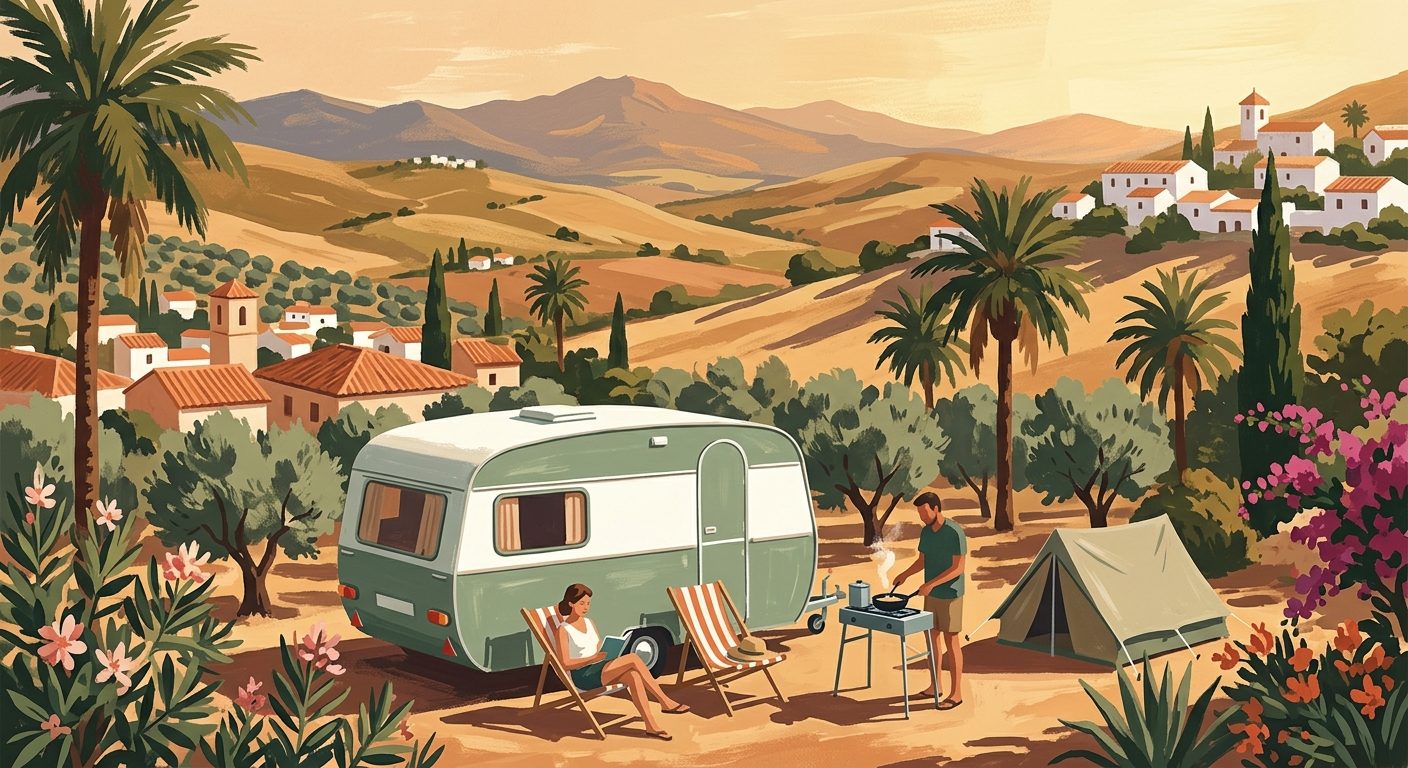
Camping and Caravanning in Andalucía: A Practical Guide
A practical camping and caravanning guide to Andalucía, covering wild-camping rules, motorhome areas, protected land, fire risk, waste disposal and official checks.
By Dan · Updated 24 July 2026 · 7 min read
This article contains affiliate links. If you book through them, we may earn a small commission at no extra cost to you.
Camping and caravanning in Andalucía: legal overnight stops, motorhome areas, protected land, wildfire restrictions, waste disposal and official checks.
Camping and caravanning in Andalucía can be excellent, but the legal distinction between a campsite, a motorhome service area, simple parking and illegal camping matters. Wild camping for leisure is tightly restricted, protected areas have their own rules, and coastal municipalities may enforce parking limits differently. Use this guide as a planning checklist, then verify the local bando, campsite terms and protected-area rules before you stop overnight.
Before you stop overnight
- Check the category: campsite, official motorhome overnight area, service point, private parking and ordinary street parking are not the same thing.
- Keep parking as parking: if you are not in an authorised camping area, avoid awnings, tables, chairs, levelling legs, pop-tops and outdoor cooking.
- Watch protected areas: natural parks, beaches, forests and national parks can add stricter access, fire and overnight rules.
- Ask locally: town halls, local police, campsite staff and park visitor centres are better sources than app comments when enforcement changes.
Wild Camping Rules (Acampada Libre)
Wild camping is illegal in Andalucía under Decree 26/2018. This applies to tents, caravans, and motorhomes. Law enforcement, particularly the Seprona unit of the Guardia Civil, actively patrols coastal areas and national parks.
- Parking vs. Camping: A legally parked motorhome is usually treated differently from camping, but municipal signs, traffic rules and protected-area limits still apply.
- What constitutes camping: Extending awnings, setting out tables and chairs, opening pop-top roofs, or lowering stabilising legs. If you do any of these outside a designated campsite, you are camping illegally.
- Fines: Penalties vary by offence, municipality and environmental status. Do not rely on old forum examples; check official rules if you are near beaches, forests or protected areas.
Motorhome Areas (Áreas de Autocaravanas)
Andalucía has a growing network of dedicated motorhome areas. These are categorised into three types:
- Public/Municipal Areas: Often free or low-cost, but prices and stay limits change. These usually provide a grey water drain, chemical toilet disposal, and fresh water. Stay limits are typically 48 to 72 hours.
- Private Areas: Costs and services vary. Check whether electricity, water, grey-water disposal and toilet-emptying are included. They are more secure than public car parks.
- Gas Stations and Restaurants: Some businesses offer overnight parking and services under their own posted conditions.
Top Recommended Campsites
Campsites in Andalucía are rated by category (1st, 2nd, and 3rd class). Most 1st class sites include swimming pools, restaurants, and shops.
Coastal Regions
- Camping Valdevaqueros (Tarifa): Popular with kitesurfers. Large pitches with plenty of shade. Check the operator directly for seasonal prices and pitch rules.
- Camping Cabo de Gata (Almería): Located near the salt flats. Excellent for bird watching and access to remote beaches. Check the operator directly for seasonal prices and pitch rules.
- Camping Cabopino (Marbella): Open year-round with an indoor pool for winter. Facilities are high standard. Check the operator directly for seasonal prices and pitch rules.
Inland and Mountains
- Camping Las Lomas (Güéjar Sierra): Near the Sierra Nevada National Park. Offers views of the Genil valley. Check the operator directly for seasonal prices and pitch rules.
- Camping La Sierrecilla (Humilladero): Central location near Antequera, ideal for visiting the Caminito del Rey. Check the operator directly for seasonal prices and pitch rules.
Camping in National and Natural Parks
Andalucía’s protected areas, including Doñana, Sierra Nevada, and Grazalema, have the strictest regulations in Spain.
- No Wild Camping: This is strictly enforced. You must stay within the boundaries of an official campsite.
- Bivouacking: High-altitude bivouacking (sleeping in a sleeping bag without a tent) is sometimes permitted in the Sierra Nevada above 2,500m, but you must notify the park office via email at least 15 days in advance.
- Fire Restrictions: Fire-risk periods and restrictions are set by the authorities and can tighten during heatwaves or high wind. Check Junta wildfire information and campsite rules before lighting barbecues, using gas outdoors or entering forest tracks.
Glamping Options
For those seeking comfort, Andalucía has a high concentration of glamping sites. These remove the need for your own equipment.
- Yurts: Common in the Alpujarra mountains and near Grazalema. Prices vary widely by season, location and facilities.
- Safari Tents: Primarily found in the Cádiz province near Tarifa and Caños de Meca.
- Geodesic Domes: Available in inland Málaga, offering stargazing opportunities.
Practical Logistics
Electricity and Gas
- Plugs: Campsites use the standard European CEE 2-pin or 3-pin (blue) industrial connectors.
- Gas: Repsol and Cepsa are the main providers. If you have a foreign bottle, you will need an adapter. Buying a Spanish orange Repsol bottle requires a contract, though many second-hand bottles are found at flea markets (rastros).
Seasonal Timing
- Winter (November to March): Ideal for the coast. Many Northern Europeans spend the winter in Almería or Málaga. Some campsites offer monthly winter rates, but availability and rules should be checked directly.
- Summer (July and August): Extremely hot inland (40°C+). Coastal sites are crowded and require booking months in advance.
- Shoulder Season (May, June, September, October): The best time for mountain camping and hiking.
Overnight Parking Without Camping
Motorhome travellers often talk about sleeping in a vehicle as if it is one rule, but in practice the details matter. If you are in an ordinary legal parking space, keep the vehicle looking parked. Do not put anything outside, do not drain water, do not run a generator, and do not use levelling blocks or stabilisers unless the site specifically allows them. If a local sign bans motorhomes, overnight stays or sleeping in vehicles, move on rather than arguing from an app comment.
- Arrival: Arrive in daylight so you can read signs, check slope, see neighbours and identify the exit route.
- Noise: Coastal promenades and beach car parks can be lively late into the night. Earplugs are sensible even in legal spots.
- Services: Plan water and toilet disposal before you need them. Never assume a beach shower or public toilet is an acceptable service point.
Summer Pressure And Winter Snowbirds
July and August are hard months for casual camping on the coast. Pitches near Tarifa, Cádiz, Nerja and Cabo de Gata can book out well ahead, shaded spaces go first, and some sites impose minimum stays. Inland campsites may have availability, but heat can make tents and vans uncomfortable unless there is reliable shade, a pool and good ventilation.
Winter is different. The Costa de Almería and parts of the Costa del Sol attract long-stay motorhome travellers from northern Europe. Monthly deals can be good value, but ask exactly what electricity allowance, parcel delivery, dog rules and pitch changes are included. If you need quiet, avoid pitches beside reception, bars and service points.
Choosing A Pitch In Heat And Wind
The pitch matters as much as the campsite. In summer, ask where the afternoon shade falls, not just whether the site has trees. A pitch that is pleasant at 10:00 can be unbearable from 16:00 if the van door faces west. On the Atlantic coast, wind exposure is just as important. Tarifa and parts of Cádiz can be rough on awnings, loose chairs and lightweight tents during Levante conditions.
- Shade: Natural shade is better than a thin shade cloth, but check for resin, birds and low branches before parking under pines.
- Slope: A flat pitch saves time and avoids relying on levelling equipment in places where it may be treated as camping outside the rules.
- Facilities: Near the toilet block is convenient for children, but it also means foot traffic, doors and lights late at night.
Frequently Asked Questions
Can I sleep in my car in Andalucía?
Technically, you can sleep in a vehicle parked in a legal parking space as long as you do not set up camp (no chairs outside, no open windows that protrude). However, local police in coastal towns like Nerja or Tarifa often move people on regardless of the law to prevent long-term settlements.
Where can I empty my chemical toilet?
You must use designated disposal points (punto limpio) found in campsites and motorhome areas. Emptying waste into storm drains or the countryside is a serious offence and can lead to serious environmental penalties.
Are dogs allowed on campsites?
Most campsites in Andalucía are dog-friendly but require them to be on a lead. Some charge extra or restrict breeds, size, vaccination records or peak-season access. Note that dogs are generally banned from most public beaches in Andalucía during the summer season (June to September), except for designated "Playas Caninas."
Summary
- Wild camping is illegal; stay in official campsites or motorhome areas to avoid fines.
- Distinguish between parking and camping; keep all equipment inside the vehicle when in public spaces.
- Book coastal sites well in advance for July and August.
- Use the Park4Night or Caramaps apps to find verified legal spots and service points.
Official checks before camping
Before stopping overnight, check the BOJA entry for Decree 26/2018, Junta wildfire information, Junta protected-area information, DGT traffic guidance, and national park pages for Doñana and Sierra Nevada. Also check the town-hall bando and campsite terms for the exact place you plan to stop.
Last reviewed: 14 July 2026 · Editorial policy
Related guides
A Guide to Water Sports in Andalucía: Where to Surf, Dive, and Paddle
From the windswept Atlantic coast to the calm waters of the Mediterranean, Andalucía offers world-class conditions for surfing, diving, and kayaking.
5 min read
The Best Water Sports in Almería: A Coastal Guide
Discover the rugged volcanic coastline of Almería through world-class diving, kayaking, and paddleboarding in the protected waters of Cabo de Gata.
6 min read
Where to Stay in Andalucía on a Budget
How to choose budget hostels, hostales and pensions in Andalucía, with verified stays, city-by-city strategy, booking checks and local sources.
4 min read
The Best Beaches in Andalucía
From the Atlantic dunes of Huelva to the volcanic coves of Almería, the coastline of southern Spain offers an unparalleled variety of maritime landscapes.
6 min read
Coastal Drive: Cádiz to Almería
Driving the coastline of southern Spain is an exercise in geological and cultural whiplash, taking you from the wind-whipped Atlantic shores of Cádiz to the scorched volcanic deserts of Almería. This route traces the very edge of the continent, offering a masterclass in coastal navigation along the legendary N-340 and beyond.
10 min read
Carboneras: An Authentic Maritime Gateway to Cabo de Gata
Carboneras offers an authentic look at Almería's fishing traditions and serves as a gateway to the spectacular Playa de los Muertos.
5 min read
More guides
Using a VPN in Andalucía: A Practical Guide for Travellers and Residents
A comprehensive guide to using a VPN in Andalucía for security, accessing UK streaming services, and maintaining privacy on public Wi-Fi.
6 min read
Sevilla Airport (SVQ) Guide: Transport, Facilities and Tips
A practical guide to Sevilla Airport (SVQ) covering the EA bus, taxi flat rates, terminal facilities, car hire, and connecting to wider Andalucía.
9 min read
Practical Guide to Almería Airport (LEI)
A practical logistics guide to arriving at Almería Airport (LEI). Discover how to navigate terminal facilities, use the Surbus Line 30, connect to intercity buses, and avoid common transport mistakes.
7 min read
Practical Guide to Gibraltar International Airport (GIB)
A practical guide to using Gibraltar Airport (GIB) for trips into Andalucía, covering border logistics, avoiding vehicle queues, Spanish transport options, and how to handle wind diversions.
8 min read
Málaga-Costa del Sol Airport (AGP) Travel Guide
A deep practical guide to navigating Málaga-Costa del Sol Airport (AGP). Learn the realities of arrivals, transport connections, parking rules, and common mistakes.
8 min read
Federico García Lorca Granada-Jaén Airport Guide: Transport, Costs and Tips
A complete practical guide to Granada-Jaén Airport (GRX), covering airport buses, taxi fares, car hire friction, terminal facilities, and the step-by-step reality of arriving and departing.
7 min read
Jerez Airport (XRY): The Complete Guide to the Gateway of Cádiz
A deep-dive practical guide to using Jerez Airport (XRY). Learn the realities of onward transport to Cádiz province, car hire friction, train timetables, and how to avoid the most common arrival mistakes.
8 min read

Understanding Spanish Festival Culture in Andalucía
A deep dive into Andalucían festival culture for residents and visitors. Understand Semana Santa, ferias, local holidays, etiquette, administrative friction and how to survive the local party season.
9 min read
Driving in Andalucía: Rules, Tolls, and Parking Guide
A practical guide to driving in Andalucía, covering road rules, ZBE checks, AP-7 toll choices, parking, roundabouts, breakdown equipment and official sources.
9 min read
Newsletter
More stories from Andalucía
Weekly notes, seasonal picks, and the next guides worth bookmarking.