
Practical guide
Shopping Hours and Siesta Guide for Andalucía
A practical guide to shopping hours in Andalucía, covering the afternoon siesta, Sunday trading laws, and bank and pharmacy schedules.
By Dan · Updated 16 July 2026 · 7 min read
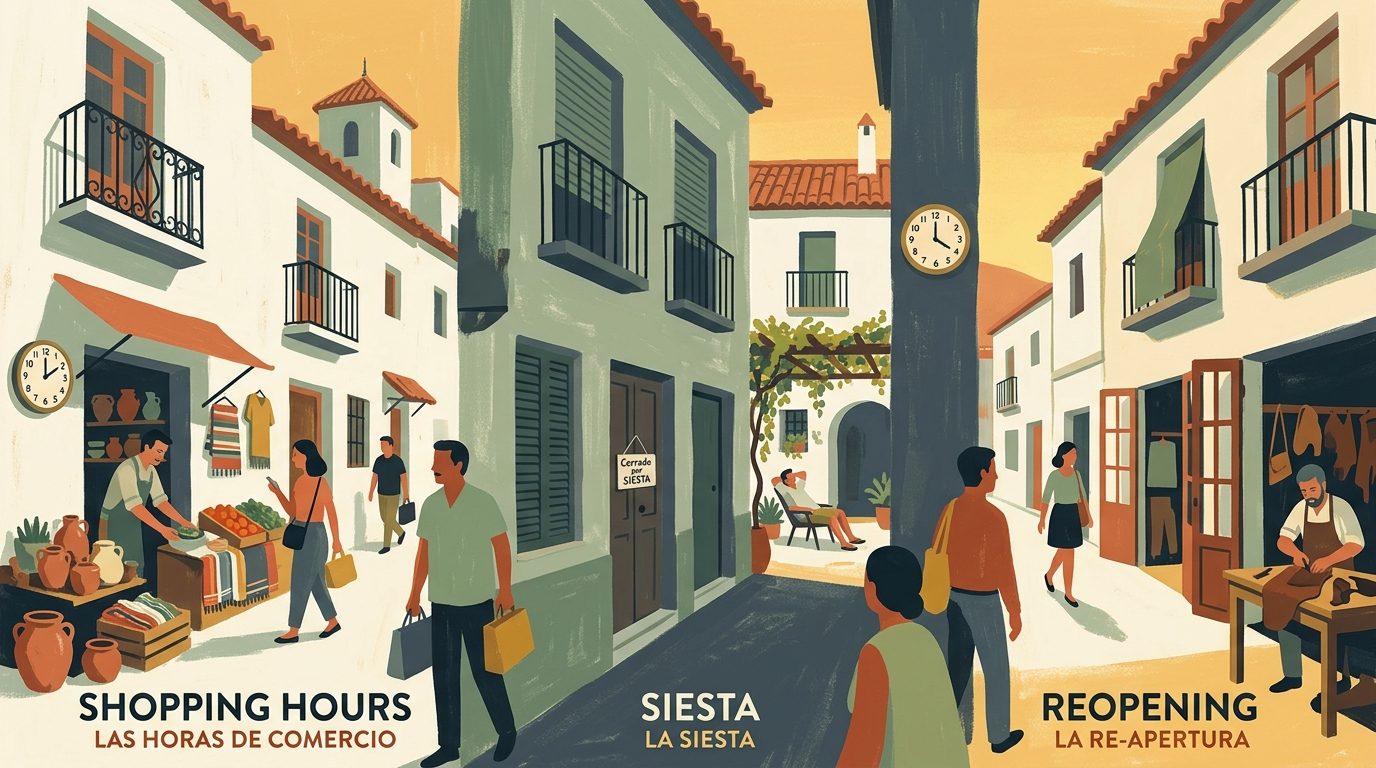
Navigate the specific opening times and afternoon closures across Southern Spain with this guide to local retail habits, bank hours, and pharmacy schedules.
Retail hours in Andalucía follow a different rhythm to northern Europe or North America. Most independent businesses and small shops operate on a split-shift system, closing for several hours in the afternoon. Large department stores and shopping centres stay open all day, while Sundays remain strictly regulated. Understanding these patterns is essential for planning daily errands, grocery shopping, or banking.
Quick Answer: Standard Opening Times
Most independent shops in Andalucía open from 10:00 to 14:00 and 17:00 or 18:00 to 20:30 or 21:00. Large supermarkets, shopping malls, and department stores (like El Corte Inglés) typically open from 09:00 or 10:00 to 21:30 or 22:00 without a midday break. Most shops close on Sundays, though exceptions apply to coastal tourist zones and specific dates in the Christmas season.
Small Businesses and Independent Shops
High street shops and family-run businesses adhere to the traditional Spanish schedule. This is particularly true in inland cities like Sevilla, Granada, and Córdoba, and even more pronounced in smaller white villages (pueblos blancos).
- Monday to Friday: 10:00 to 14:00 and 17:00 to 20:30 (summer hours may push the evening opening to 18:00 and closing to 21:00).
- Saturday: 10:00 to 14:00. Most independent shops close on Saturday afternoons and do not reopen until Monday morning.
- Sunday: Almost universally closed.
Note: In July and August, some small shops may not reopen in the afternoon at all, or may stay closed for the entire month for annual holidays. Check for signs saying "Cerrado por vacaciones".
The Siesta: Understanding the Midday Pause
The siesta period is not necessarily a nap for the workers, but a practical response to the midday heat. Between 14:00 and 17:00, many town centres become quiet as residents return home for the main meal of the day. During these hours, expect small hardware stores, clothing boutiques, and professional services (lawyers, architects) to be locked. Bars and restaurants remain open during this time to serve lunch, typically peaking between 14:30 and 16:00.
Supermarkets and Large Retailers
Large-scale retail follows a non-stop schedule (horario ininterrumpido). These establishments do not close for the siesta.
- Mercadona: 09:00 to 21:30 (Closed Sundays and public holidays).
- Carrefour / Alcampo / Hipercor: 09:00 or 10:00 to 22:00.
- El Corte Inglés: 10:00 to 22:00.
- Shopping Malls (Centros Comerciales): 10:00 to 22:00. Restaurants and cinemas within these malls often stay open until midnight or later.
Small local grocery stores (often referred to as fruterías or ultramarinos) usually follow the split-shift independent shop hours.
Sunday and Public Holiday Trading
Andalucía has strict laws regarding Sunday trading. Generally, shops are permitted to open only on a set number of Sundays and holidays per year (usually around 16 dates, often concentrated in December and January). These exact dates can be verified on the Junta de Andalucía's official commercial calendar. However, there are two major exceptions:
- Tourist Zones (ZEP): Areas designated as "Zones of High Tourist Influx" (including parts of Málaga city, Marbella, and other coastal towns) are permitted to open on Sundays between June and September and during Easter week (Semana Santa).
- Small Convenience Stores: Shops under 300 square metres, petrol stations, and shops in transport hubs (airports and train stations) are allowed to open every Sunday.
Bank Opening Hours
Banks have the most restricted hours in Spain and can be a source of frustration for expats. Most branches operate only in the morning.
- Standard Hours: Monday to Friday, 08:30 to 14:00 or 14:30.
- Thursday Exceptions: Some banks (like CaixaBank) may offer afternoon hours on Thursdays from October to May, typically until 18:30.
- Weekends: Banks are closed on Saturdays and Sundays.
Most administrative tasks must be done before 11:00 or 12:00, as staff may focus on internal work later in the morning. Cash machines (ATMs) are available 24/7.
Pharmacies (Farmacias)
Pharmacies generally follow the split-shift schedule: 09:30 to 14:00 and 17:00 to 20:30. Many in city centres now stay open all day (09:30 to 21:30 or 22:00).
Farmacia de Guardia
For emergencies outside of regular hours, Andalucía uses a rotational system called the Farmacia de Guardia (Duty Pharmacy). Every town must have at least one pharmacy available 24 hours a day for urgent prescriptions. You can find the location of the nearest duty pharmacy by:
- Checking the list posted on the front door of any pharmacy.
- Searching the local newspaper or the official "Colegio de Farmacéuticos" website for your province (e.g., COF Málaga, COF Sevilla).
Post Offices (Correos)
Opening times for Correos vary significantly by the size of the town:
- Main City Offices: 08:30 to 20:30 (Monday to Friday) and 09:30 to 13:00 (Saturday).
- Smaller Town Offices: 08:30 to 14:30 (Monday to Friday) and occasionally 09:30 to 13:00 on Saturdays.
- Village Offices: May only open for one or two hours a day (e.g., 11:00 to 12:00).
Seasonal Rhythms: Summer Hours and the August Effect
Opening hours in Andalucía are not fixed year-round. Many independent shops switch to a horario de verano (summer timetable) between roughly mid-June and mid-September: the morning session starts and finishes slightly earlier, and the evening session shifts later, often 6pm to 9.30pm, to dodge the worst of the heat.
August deserves its own warning. It is the traditional holiday month, and in inland cities you will see hand-written cerrado por vacaciones ("closed for holidays") signs on bakeries, hardware shops and family businesses for two to four weeks. Coastal towns are the opposite: everything stays open and hours stretch late into the night to serve the summer crowds. If you need something specific from a small shop in Sevilla or Córdoba in August, call ahead.
Market Days and Mercadillos
Two kinds of market punctuate the shopping week, and both are strictly morning affairs:
- Food markets (mercados de abastos): The covered municipal markets, such as Triana in Sevilla and Atarazanas in Málaga, run roughly 8am to 2.30pm, Monday to Saturday. Go before noon for the full display; stalls start packing up soon after lunch begins.
- Street markets (mercadillos): Each town has a weekly open-air market for clothes, household goods and produce, typically 9am to 2pm on a fixed weekday. Ask locally or check the town hall website; market day changes the parking situation in the whole neighbourhood.
The Rebajas: Sale Seasons
Spain's two traditional sale periods are worth planning around if shopping is part of your trip. The winter rebajas begin in early January (right after the Three Kings gifts on 6 January) and run to late February; the summer sales start on 1 July and continue through August. Discounts deepen as the weeks pass. The best combination of stock and price is usually the second week. Since deregulation, chains also run Black Friday and mid-season promotions, but the January and July sales remain the deepest.
Late-Night and 24-Hour Options
Genuine 24-hour shopping barely exists outside petrol stations, but the gaps are covered better than you might expect:
- Petrol station shops: The reliable late-night source of drinks, snacks and basics; larger ones on main roads never close.
- Convenience stores: In city centres and resort areas, small independent shops (often called badulaques colloquially) stay open until midnight or later, seven days a week.
- Pharmacy de guardia: As covered above, one pharmacy per district is always on duty overnight.
- Delivery apps: Glovo and similar apps deliver supermarket basics until late in the major cities, and are often the easiest answer at 11pm.
Frequently Asked Questions
Do shops close during the siesta in Málaga and Sevilla?
In the city centres of Málaga and Sevilla, many large retail brands (Zara, H&M, Mango) stay open all day. However, smaller boutiques and traditional shops located just one or two streets away from the main shopping thoroughfares will still close between 14:00 and 17:00.
What happens on public holidays?
Andalucía celebrates several regional and national holidays (festivos). On these days, almost all shops, including large supermarkets, will close. If a holiday falls on a Sunday, the holiday is often moved to the following Monday (lunes festivo). A "bridge" (puente) refers to taking a single working day off when a holiday falls on a Tuesday or Thursday to create a long weekend. Always check the local calendar for the specific town, as each municipality has two local holidays per year in addition to regional ones.
Can I buy groceries on a Sunday?
Your best options on a Sunday are "Supercor" (the convenience arm of El Corte Inglés), which stays open until 02:00 in some locations, or small "Tiendas de Alimentación" (often run by international owners) which remain open late and on holidays. Petrol station shops also carry basic supplies like milk, bread, and water.
Are opening hours different in winter?
Yes. During the winter months, evening opening times for small shops often shift earlier (opening at 16:30 and closing at 20:00) because it gets dark earlier. In summer, the evening shift starts and ends later to account for the extreme heat.
Summary
- Independent shops: Open 10:00 to 14:00 and 17:00 to 20:30; closed Saturday afternoons and Sundays.
- Malls and Supermarkets: Open 09:00 or 10:00 to 21:30 or 22:00; closed Sundays (except in tourist zones/summer).
- Banks: Mornings only (08:30 to 14:00), Monday to Friday.
- Emergencies: Look for the Farmacia de Guardia for 24-hour medical supplies.
Last reviewed: 21 June 2026 · Editorial policy
Related guides
Retiring to Andalucía: A Practical Guide to Residency, Healthcare, and Finance
Retiring to Andalucía requires careful planning across residency, healthcare, and tax. This practical guide covers non-lucrative visas, the TIE process, S1 healthcare registration, pensions, and common administrative hurdles.
8 min read

Using a VPN in Andalucía: A Practical Guide for Travellers and Residents
A comprehensive guide to using a VPN in Andalucía for security, accessing UK streaming services, and maintaining privacy on public Wi-Fi.
6 min read
Opening a Bank Account in Spain: A Practical Guide for Expats
A comprehensive guide to opening a bank account in Andalucía, covering the crucial differences between resident and non-resident accounts, anti-money laundering documentation, hidden fees, account freezes, and digital banking.
7 min read

Where to Live in Andalucía: A Practical Guide for Expats
A deep, practical guide to choosing where to live in Andalucía. Compare the coasts, inland cities, and rural villages while navigating the realities of climate, healthcare access, housing legality, and local administration.
7 min read
Purchasing Property in Andalucía: A Practical Guide
A practical, step-by-step guide to buying property in Andalucía. Learn how to navigate legal due diligence, the AFO process for rural homes, deposit contracts, purchase taxes, and common pitfalls.
8 min read

Property Taxes and Running Costs in Andalucía: A Practical Guide
A safer guide to property taxes and running costs in Andalucía, covering purchase taxes, IBI, Cadastre, non-resident filings, rental income, community fees and official AEAT/Junta sources.
8 min read
More guides
Sevilla Airport (SVQ) Guide: Transport, Facilities and Tips
A practical guide to Sevilla Airport (SVQ) covering the EA bus, taxi flat rates, terminal facilities, car hire, and connecting to wider Andalucía.
9 min read
Practical Guide to Almería Airport (LEI)
A practical logistics guide to arriving at Almería Airport (LEI). Discover how to navigate terminal facilities, use the Surbus Line 30, connect to intercity buses, and avoid common transport mistakes.
7 min read
Practical Guide to Gibraltar International Airport (GIB)
A practical guide to using Gibraltar Airport (GIB) for trips into Andalucía, covering border logistics, avoiding vehicle queues, Spanish transport options, and how to handle wind diversions.
8 min read

Málaga-Costa del Sol Airport (AGP) Travel Guide
A deep practical guide to navigating Málaga-Costa del Sol Airport (AGP). Learn the realities of arrivals, transport connections, parking rules, and common mistakes.
8 min read
Federico García Lorca Granada-Jaén Airport Guide: Transport, Costs and Tips
A complete practical guide to Granada-Jaén Airport (GRX), covering airport buses, taxi fares, car hire friction, terminal facilities, and the step-by-step reality of arriving and departing.
7 min read
Jerez Airport (XRY): The Complete Guide to the Gateway of Cádiz
A deep-dive practical guide to using Jerez Airport (XRY). Learn the realities of onward transport to Cádiz province, car hire friction, train timetables, and how to avoid the most common arrival mistakes.
8 min read

Understanding Spanish Festival Culture in Andalucía
A deep dive into Andalucían festival culture for residents and visitors. Understand Semana Santa, ferias, local holidays, etiquette, administrative friction and how to survive the local party season.
9 min read
Driving in Andalucía: Rules, Tolls, and Parking Guide
A practical guide to driving in Andalucía, covering road rules, ZBE checks, AP-7 toll choices, parking, roundabouts, breakdown equipment and official sources.
9 min read
Getting to Andalucía: A Practical Transport Guide
A comprehensive practical guide to reaching Andalucía. Learn how to navigate airports, high-speed rail transfers, road tolls, and cross-strait ferries, including solutions for common travel friction points.
7 min read
Newsletter
More stories from Andalucía
Weekly notes, seasonal picks, and the next guides worth bookmarking.