
Nature & wildlife · Huelva
Doñana National Park: A Guide to Europe’s Great Wetland Wilderness
A vital sanctuary for the Iberian lynx and millions of migratory birds, Doñana National Park is a landscape of shifting dunes and vast seasonal marshes.
By Dan · Updated 26 May 2026 · 7 min read
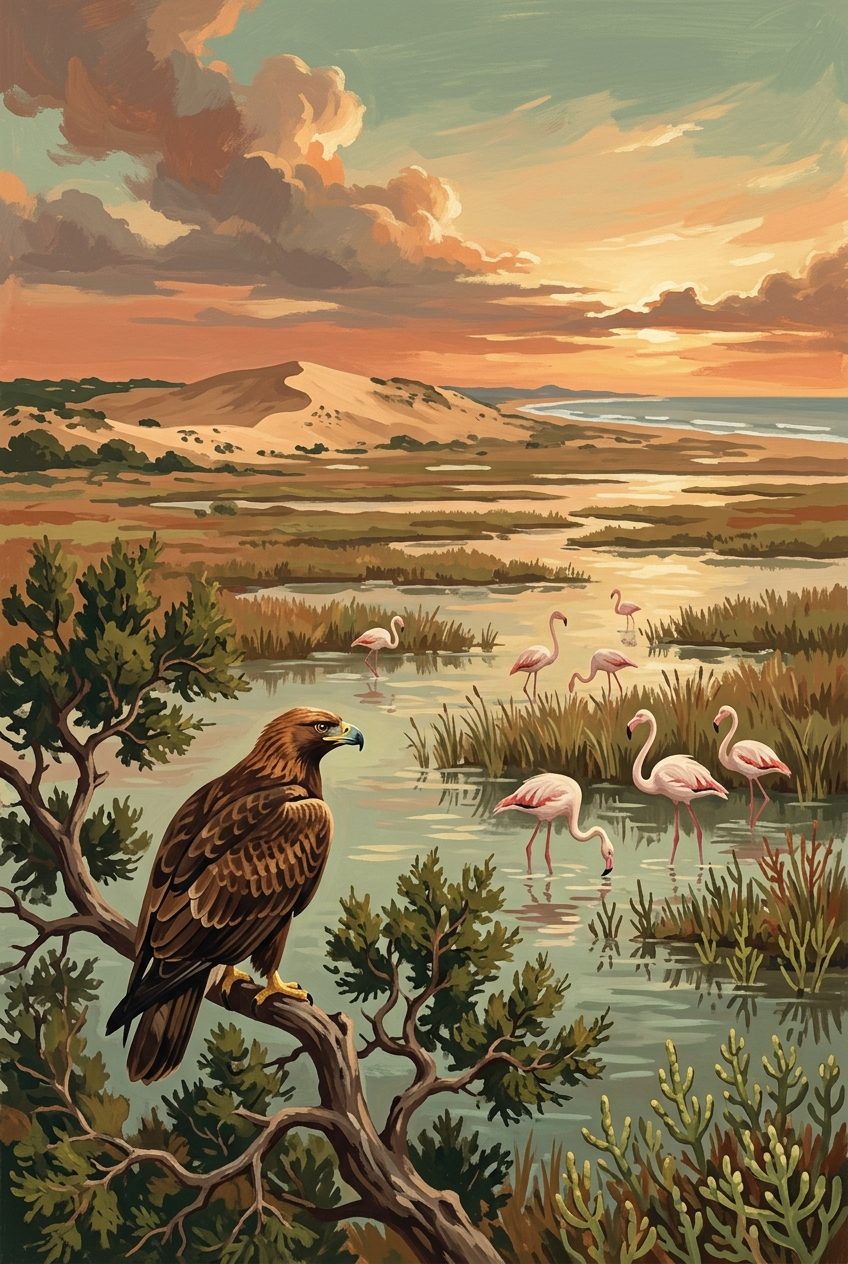
One of Europe’s most significant wetlands, Doñana provides a vital bridge for migratory birds between Africa and the North. Its mosaic of shifting dunes and seasonal marshes creates a refuge for some of the continent's rarest carnivores and raptors.
Doñana National Park is a landscape defined by water and its absence. Situated on the Atlantic coast of Huelva, where the Guadalquivir River meets the sea, this 54,000-hectare wilderness (expanding to over 100,000 when including the Natural Park buffer zone) represents one of the most important biological reservoirs in Europe. Its location at the southwestern tip of the continent makes it a critical bottleneck for millions of birds migrating along the East Atlantic Flyway. Here, the North African climate meets the European landmass, creating a unique biological crossroads.
For the naturalist, Doñana is a place of intense seasonal rhythms. In winter, the vast clay flats of the marismas (marshes) flood, attracting hundreds of thousands of waterfowl. By mid-summer, the same ground cracks under a relentless sun, and life retreats to the permanent lagoons and the shade of the Mediterranean scrub. It is a demanding environment that requires patience and local knowledge to navigate, but for those who understand its cycles, it offers some of the finest wildlife viewing on the continent.
The Ecosystem: A Mosaic of Four Worlds
The ecological importance of Doñana stems from the proximity of four distinct habitats, each supporting a specific suite of species. Understanding these zones is essential for planning a productive visit.
The Marismas (Marshes)
The marismas are the heart of the park. These vast, flat seasonal wetlands are filled by autumn and winter rains. When flooded, they become a nursery for fish and invertebrates, which in turn support massive colonies of herons, egrets, and spoonbills. As the water recedes in spring, the mudflats provide foraging grounds for thousands of passage waders. By August, the marshes are typically dry, appearing as a scorched, saline desert until the autumn rains return.
The Mediterranean Scrub (Cotos)
Inland from the marshes lie the cotos, areas of stable sands covered in Mediterranean vegetation. These are divided into 'Monte Blanco' (white scrub), dominated by various species of Cistus (rockrose) and Rosemary (Salvia rosmarinus), and 'Monte Negro' (black scrub), where the water table is higher, allowing for the growth of Heather (Erica) and Myrtle (Myrtus communis). This scrubland provides the primary cover and hunting grounds for the Iberian lynx.
The Moving Dunes (Médanos)
Between the Atlantic beach and the marshes lies a spectacular system of mobile dunes. These are some of the largest in Europe, driven inland by the prevailing southwesterly winds. As the dunes move, they bury everything in their path, including entire groves of Stone Pine (Pinus pinea), creating 'tree graveyards' where only the bleached tops of the pines remain visible. Small valleys between the dunes, known as corrales, provide sheltered micro-habitats for reptiles and deer.
The Ecotone (La Vera)
Perhaps the most biodiverse strip in the park is 'La Vera', the narrow boundary where the scrubland meets the marsh. Large Cork Oaks (Quercus suber) grow here, providing nesting sites for colonial birds. Because it sits at the interface of two habitats, it allows animals to move between the cover of the forest and the food sources of the wetlands. This is the most reliable place to observe large mammals at dawn and dusk.
Key Species
Iberian Lynx (Lynx pardinus)
Once the world's most endangered feline, the Iberian lynx has seen a remarkable recovery, though it remains a specialist predator of the Mediterranean scrub. Doñana is home to one of the few original remnant populations. Sighting success is low for casual visitors; these cats are crepuscular, active mostly at dawn and dusk. The best chance of a sighting is during the winter mating season (December to January) or when the cubs begin to move with their mothers (July to August, despite the heat). Look for them in the transition zones between the scrub and the marshes.
Spanish Imperial Eagle (Aquila adalberti)
This massive raptor is endemic to the Iberian Peninsula and Doñana is one of its last strongholds. With fewer than 10 pairs usually nesting within the park boundaries, a sighting is never guaranteed. They are most frequently seen soaring over the cotos or perched in the tall pines on the edge of the marshes. Their white shoulders are a diagnostic feature for adults. They are resident year-round, but late winter is a good time to see their dramatic aerial displays.
Greater Flamingo (Phoenicopterus roseus)
Flamingos are almost synonymous with Doñana. While they move between various wetlands in Andalucía (such as Fuente de Piedra), they are often present in the thousands in the marismas. Sighting likelihood is extremely high from October through May. During dry years, they may abandon the park to find deeper water elsewhere, so checking recent rainfall levels is recommended before a trip specifically for them.
Spoonbill (Platalea leucorodia) and Waders
The 'Pajarera de Doñana' is a famous colony of Cork Oaks near the El Rocío marshes where hundreds of Spoonbills, Cattle Egrets (Bubulcus ibis), and Black-crowned Night Herons (Nycticorax nycticorax) nest together. The sight and sound of this colony in March and April is a highlight of the park. In the mudflats, look for the rare Marbled Teal (Marmaronetta angustirostris), a shy, sandy-coloured duck that is a flagship species for the park's conservation efforts.
Best Time to Visit
The character of Doñana changes drastically with the seasons. Timing your visit is critical to what you will see.
- October to February: The wet season. The marshes fill up, and thousands of Greylag Geese (Anser anser) and Common Cranes (Grus grus) arrive from Northern Europe. The weather is cool and perfect for long days in the field.
- March to May: The peak for birdwatchers. The heronries are active, spring migration is in full swing, and the Mediterranean scrub is in bloom. The weather is generally pleasant, though rain is possible.
- June to September: The dry season. Most of the marshes dry out, and the heat can exceed 40°C in July and August. Wildlife activity is restricted to the earliest hours of the morning and late evening. Some specialist birds, like the Greater Flamingo, may still be found at permanent water holes.
How to Explore
Access to the core National Park is strictly controlled to protect the fragile ecosystems. You cannot drive your private vehicle into the heart of the park.
Guided 4x4 Tours
The only way to see the various ecosystems (marshes, dunes, and forest) in a single day is via an official guided tour. The Cooperativa Marismas del Rocío operates the official 4x4 tours from the El Acebuche visitor centre. It is advisable to book at least several weeks in advance, especially during the spring migration. These tours last about four hours and cover a large distance. While not 'private' birding tours, they offer the best overview of the park's scale. For a more tailored experience, several private companies offer small-group tours in 4x4 vehicles, focusing specifically on lynx spotting or photography.
Visitor Centres and Walking Trails
Several visitor centres offer excellent self-guided walking routes on boardwalks. These are free and do not require permits.
- El Acebuche: The main centre near Matalascañas. It features several hides overlooking a lagoon where you can see Purple Swamphens (Porphyrio porphyrio) and various ducks. It also houses the Iberian Lynx captive breeding centre (though the lynx here are not on public display for conservation reasons).
- La Rocina: Located near the village of El Rocío, this centre has a beautiful walk through umbrella pines and freshwater marshes. It is excellent for woodland birds and nightingales in spring.
- Palacio del Acebrón: An old hunting lodge set in a damp forest of cork oaks and ferns. The walk here is distinct from the rest of the park, feeling more temperate and shaded.
El Rocío
The village of El Rocío itself is a unique wildlife destination. The village streets are sand, and the 'marisma' begins right at the edge of the town. You can stand on the promenade with a telescope and see flamingos, spoonbills, and gloss ibis feeding just metres away. This is the best 'free' birding spot in the region.
Practical Information
Access: Most visitors enter via the A-483 from Sevilla or Huelva, heading towards Almonte and El Rocío. The main visitor centres are clustered around the southern end of the park near Matalascañas.
Facilities: Visitor centres have toilets, small exhibits, and sometimes cafes. However, once inside the park on a tour, there are no facilities. Bring plenty of water, especially from April onwards.
Equipment: A pair of 8x42 or 10x42 binoculars is essential. A spotting scope is highly recommended for the open marshes. Mosquito repellent is vital if visiting near sunset or sunrise, particularly in the wetter months.
Accommodation: El Rocío offers the most atmospheric stay, with several hotels and guesthouses overlooking the marsh. Matalascañas provides standard coastal hotels, while Almonte offers a more traditional Spanish town experience.
Conservation Note
Doñana is an ecosystem under severe pressure. The primary threat is water scarcity, driven by both climate change and the over-extraction of the aquifer for intensive strawberry farming in the surrounding areas. In recent years, most of the park's permanent lagoons, including Santa Olalla, have dried up during the peak of summer, a significant event in the park's recorded history. While protection efforts are significant, the park's future depends entirely on the restoration of its natural water cycles. Visitors are encouraged to stick to marked paths and support local operators who prioritise ecological education over mere sightseeing.
Last reviewed: 21 June 2026 · Editorial policy
Related guides
Doñana National Park Guide: Marshes, Lynx, and Restricted Zones
A shifting landscape of tidal marshes, ancient pine forests, and wind-sculpted dunes, Doñana is Europe's most crucial wetland reserve. Navigating its restricted zones requires planning, but the reward is encountering Iberian lynx and thousands of migratory flamingos in total wilderness.
9 min read
Where the Sands Shift and the Marismas Breathe: A Guide to Doñana
Discover the wild Atlantic coast of Huelva, where the shifting dunes of Doñana meet the sand-paved streets of El Rocío and the pristine beaches of Mazagón.
8 min read
Odiel Marshes: Huelva's Overlooked Wetland
Discover the Marismas del Odiel, a tidal powerhouse in Huelva that hosts Europe's largest spoonbill colony and a spectacular array of flamingos and ospreys.
7 min read
A Guide to El Rocío: Andalucía’s Sandy Pilgrimage Village
Discover El Rocío, a unique Andalucían village where the streets are made of sand and the traditional horse-and-carriage still reigns supreme on the edge of Doñana.
6 min read
Huelva in February: Almond Blossom and Atlantic Solitude
Experience Huelva in February, from the blooming almond orchards of the Sierra de Aracena to the flamingo gatherings in Doñana National Park.
6 min read
Huelva in January: Birdlife and Mountain Mist
January in Huelva offers the peak of the Doñana bird migration, atmospheric mountain escapes in the Sierra de Aracena, and the freshest Jamón Ibérico of the year.
6 min read
More from Huelva
Newsletter
More stories from Andalucía
Weekly notes, seasonal picks, and the next guides worth bookmarking.