
Practical guide
Money and Costs in Andalucía: A Practical Guide
A practical guide to money, daily costs, and banking in Andalucía. Discover typical prices for meals and transport, plus expert tips on avoiding ATM fees and navigating local banks.
By Dan · Updated 18 July 2026 · 9 min read

A practical guide to money, daily costs, and banking in Andalucía. Discover typical prices for meals and transport, plus expert tips on avoiding ATM fees and navigating local banks.
Andalucía remains one of the most affordable regions in Spain and Western Europe. While prices in major hubs like Sevilla, Málaga, and Marbella have risen steadily over recent years, your money still goes much further here than in Madrid, Barcelona, or London. This guide provides specific costs and practical advice to help you manage your finances efficiently.
Quick Answer: What You Need to Know
Expect to spend around €100 to €130 per day for a comfortable mid-range trip including accommodation, though this varies by season. Contactless card payments are the norm in cities, but you must carry cash for small mountain villages and transactions under €5. Tipping is not mandatory, as service is typically included, but rounding up the bill or leaving 5% to 10% for excellent service aligns with local etiquette and social customs. To avoid excessive charges, always use bank-owned ATMs and decline their dynamic currency conversion.
Monthly Living Costs for Residents
For those relocating to southern Spain, daily travel budgets do not tell the whole story. Your cost of living will depend heavily on which province and neighbourhood you choose.
- Rent: A two-bedroom apartment in Málaga centre or Sevilla can cost €1,200 to €1,800 per month, while inland cities like Jaén or Córdoba offer similar properties for €600 to €900 per month, subject to market fluctuations.
- Utilities: Expect to pay roughly €100 to €180 per month for electricity, water, and rubbish collection, depending on usage and current energy tariffs. Running air conditioning continuously in July and August will push electricity bills to the higher end of this scale.
- Internet and Mobile: A reliable fibre-optic broadband package bundled with two mobile SIM cards typically costs around €40 to €60 per month, subject to provider offers.
Average Daily Budgets for Travellers
Costs vary significantly between rural inland villages and coastal hotspots. The following estimates include accommodation (per person, based on double occupancy), meals, and local transport.
- Budget Traveller (estimated €50 to €75 per day): Staying in hostels or basic pensions, eating tapas or the fixed-price lunch menu, and using public buses.
- Mid-range Traveller (estimated €100 to €160 per day): Staying in comfortable 3-star or 4-star hotels, enjoying a mix of casual and sit-down dining, and visiting one or two paid attractions daily.
- High-end Traveller (estimated €250+ per day): Staying in boutique hotels or 5-star resorts, fine dining, private tours, and renting a premium car.
Cash vs Card: Payment Methods
Spain is a modern economy where digital payments are standard, but the transition to a completely cashless society is not yet total.
Card Payments
- Acceptance: Visa and Mastercard are accepted almost everywhere, including supermarkets, pharmacies, hotels, and most restaurants.
- American Express: Often declined in smaller establishments due to high merchant fees. Always carry a Visa or Mastercard as a backup.
- Contactless: Tap-to-pay via physical cards or Apple/Google Pay is available in 95% of retail outlets.
- Minimum Spends: Some traditional shops or rural bars may enforce a minimum spend of €5 to €10 to use a card. While this is discouraged by card networks, the Banco de España notes it remains legally permitted if clearly displayed to the customer.
When You Will Need Cash
You will need physical Euros for:
- Small purchases in traditional local bars, such as a €1.50 morning coffee.
- Local produce markets (mercados de abastos) and street vendors.
- Public buses in smaller towns where card machines frequently lose mobile signal.
- Tips and small service gratuities, which waiters prefer in cash.
ATMs and Currency Exchange
Avoiding unnecessary banking fees is the easiest way to save money in Andalucía.
How to Withdraw Cash Without Excessive Fees
- Find a bank ATM: Look for branches of CaixaBank, BBVA, Santander, or Unicaja. Avoid standalone machines labelled Euronet, CashZone, or ATM, which are often placed in tourist hotspots and charge exorbitant fees.
- Insert your card: The machine will detect a foreign card and offer you an English menu.
- Select your amount: Choose the amount you wish to withdraw. The machine will notify you of the local bank fee, typically ranging from €1.80 to €3.00, though fees are subject to change.
- Decline the conversion: The screen will offer to convert the withdrawal into your home currency at a "guaranteed" exchange rate. Always press "Decline Conversion" or "Continue without conversion". This forces the transaction through at the wholesale Visa or Mastercard rate, which is significantly cheaper.
Currency Exchange Booths
Avoid exchanging physical cash at airports or "Cambio" booths in city centres, as they offer the worst exchange rates. If you must exchange physical banknotes, use a local bank branch during their morning opening hours, usually between 08:30 and 14:00 on weekdays.
Navigating Local Banks for Expats
If you are moving to Andalucía, dealing with local banks presents its own set of unique challenges. While digital banking is growing, traditional branch banking still dominates administrative life. Please note that this is general information; for specific financial or tax advice, consult a registered professional or the relevant Spanish authority.
- Opening an Account: To open a resident bank account, you will need a Foreigner Identity Number (NIE) and proof of address (empadronamiento). You can open a non-resident account with just a passport, but the monthly maintenance fees will be noticeably higher.
- Paying Local Taxes: Local councils often issue paper bills for property tax or vehicle tax. If you do not have a direct debit set up, you must pay these at a local bank branch. Be warned that banks heavily restrict the hours they accept bill payments from non-customers. This is often restricted to specific mornings, such as Tuesdays and Thursdays between 08:30 and 10:30, depending on the bank's policy. The Banco de España confirms that banks are permitted to set these schedules.
- The Appointment System: Most major banks require a prior appointment (cita previa) to speak to a manager or handle anything beyond a simple cash deposit at the machine. Book via the bank's app before visiting a branch.
Food and Drink Costs
Dining out is a fundamental way of life in Andalucía and offers exceptional value for money. Be aware of the "cubierto" or bread charge. Waiters will often drop a basket of bread on your table, which typically adds €1.00 to €2.00 per person to the bill. It is perfectly acceptable to say "sin pan, por favor" if you wish to decline it.
Prices fluctuate, but you can generally expect:
- Coffee (Café con leche): Around €1.30 to €2.00.
- Beer (Caña): Around €2.00 to €3.50 depending on the city and venue.
- Tapa: Around €2.50 to €5.00. In provinces like Granada and Almería, a free tapa is still served with every alcoholic drink.
- Menu del Día: Around €12.00 to €18.00. This fixed-price three-course lunch includes a drink and bread. It is served on weekdays between 13:30 and 16:00 and remains the most cost-effective way to eat well.
- Dinner for two (Mid-range): Around €40.00 to €60.00 including a shared starter, two mains, and local wine.
- Glass of house wine: Around €2.50 to €4.50.
Transport Costs
Public transport across the region is efficient, reliable, and heavily subsidised.
- Trains (RENFE): As detailed in our guide to train travel, high-speed AVE tickets from Sevilla to Málaga vary significantly depending on how far in advance you book. Short-distance commuter trains generally cost a few euros.
- Buses: Often the only public way to reach the mountain villages. Operators like ALSA provide extensive regional coverage. A typical two-hour journey costs between €10 and €20, depending on the route and time of booking.
- Car Hire: Expect to pay around €25 per day in winter and up to €70 per day during the summer peak, though rates fluctuate wildly by season. Petrol prices also vary, sitting at roughly €1.55 to €1.65 per litre.
- Taxis and Rideshare: Licensed local taxis are metered and strictly regulated. A standard 15-minute city trip usually costs around €10 to €15, subject to official meter rates. Uber and Cabify operate extensively in Málaga and Sevilla but are virtually non-existent in smaller towns. For a comprehensive look at all options, read our guide on getting around Andalucía.
What Catches People Out: Common Financial Mistakes
- Paying in Pounds on a Card Machine: Just like at ATMs, card terminals in shops and restaurants will often ask if you want to pay in GBP or EUR. Always choose EUR to ensure you get your own bank's exchange rate.
- Trying to pay for a bus with a large note: Local urban bus drivers carry very little change. If your fare is €1.50 and you hand over a €20 note, they are legally permitted to refuse you entry. Transport authorities like EMT Málaga and TUSSAM Sevilla generally do not require drivers to accept notes larger than €5 or €10. Always keep €1 and €2 coins for public transport.
- Assuming small towns take cards for everything: If you are driving into the remote mountains, take physical cash. Card terminals often lose connection, and family-run bakeries may refuse cards for minor purchases.
- Expecting to split the bill by item: In Spain, splitting a restaurant bill item by item is highly uncommon and frustrates service staff. Groups usually split the total equally or take turns paying for the whole table.
Frequently Asked Questions
Is Andalucía cheaper than the rest of Spain?
Generally, yes. Aside from the high-end coastal areas of Marbella and central Sevilla, Andalucía is significantly more affordable for food, drink, and property than Madrid, Catalonia, or the Basque Country.
Can I use Revolut, Monzo, or Starling in Andalucía?
Yes. Digital challenger banks work flawlessly across Spain. They are highly recommended because they do not charge foreign transaction fees on weekday spending and offer the true wholesale exchange rate. Just remember to decline any currency conversion prompts on Spanish card machines.
What are the supermarket prices like?
Supermarkets like Mercadona, Carrefour, and Lidl offer highly competitive prices. A litre of milk is approximately €1.00, a bottle of decent local wine starts at €4.00, and a loaf of fresh bread is around €0.80, though inflation can affect these estimates. Buying fresh produce from the local municipal market will save you even more money.
Do I need to pay for water in restaurants?
By law (Ley 7/2022), restaurants in Spain must offer free tap water (agua del grifo) if requested. You can read more in our practical guide to tap water in Andalucía. However, many locals still choose to order bottled mineral water, which costs around €1.50 to €2.50.
Summary
- Budget €120 per day for a standard mid-range travel experience.
- Use official bank ATMs and always press decline when the machine offers its own currency conversion rate.
- Look for the Menu del Día at lunchtime for the best quality and value.
- Carry some small change for independent bars, rural areas, and local buses, but use your contactless card for the majority of your trip.
Note: Prices and exchange rates are subject to change. Figures provided are based on market averages across the region. Check official local council and bank websites for specific tax and fee variations.
Last reviewed: 18 July 2026 · Editorial policy
Related guides
A Practical Guide to Bus Travel in Andalucía with Alsa
A comprehensive guide to using Alsa buses in Andalucía, covering booking tips, major routes, luggage rules, and station facilities.
7 min read

Guide to Train Travel in Andalucía: Renfe, AVE, and Regional Routes
A practical guide to train travel in Andalucía, covering AVE, Avant, Media Distancia, Cercanías, airport rail, booking checks, accessibility and operator links.
8 min read

Hiring a Car in Andalucía: A Practical Guide
A practical guide to hiring a car in Andalucía, covering rental contracts, deposits, insurance exclusions, parking, tolls, cross-border rules and official driving checks.
7 min read

Tipping Culture in Andalucía: A Practical Guide
Tipping in Andalucía is an appreciation for good service rather than a mandatory requirement. Discover how much to leave in restaurants, bars, and hotels across the region.
7 min read

Travelling with Kids in Andalucía: A Practical Guide
A practical family guide to Andalucía, covering rooms, car seats, trains, meal times, pushchairs, heat, beaches, child health and official planning checks.
8 min read

Airports in Andalucía: A Practical Guide for Travellers
A practical guide to Andalucía's five international airports, covering transport links, airlines, and transfer costs for Málaga, Sevilla, Jerez, Granada, and Almería.
7 min read
More guides

Using a VPN in Andalucía: A Practical Guide for Travellers and Residents
A comprehensive guide to using a VPN in Andalucía for security, accessing UK streaming services, and maintaining privacy on public Wi-Fi.
6 min read
Sevilla Airport (SVQ) Guide: Transport, Facilities and Tips
A practical guide to Sevilla Airport (SVQ) covering the EA bus, taxi flat rates, terminal facilities, car hire, and connecting to wider Andalucía.
9 min read
Practical Guide to Almería Airport (LEI)
A practical logistics guide to arriving at Almería Airport (LEI). Discover how to navigate terminal facilities, use the Surbus Line 30, connect to intercity buses, and avoid common transport mistakes.
7 min read
Practical Guide to Gibraltar International Airport (GIB)
A practical guide to using Gibraltar Airport (GIB) for trips into Andalucía, covering border logistics, avoiding vehicle queues, Spanish transport options, and how to handle wind diversions.
8 min read

Málaga-Costa del Sol Airport (AGP) Travel Guide
A deep practical guide to navigating Málaga-Costa del Sol Airport (AGP). Learn the realities of arrivals, transport connections, parking rules, and common mistakes.
8 min read
Federico García Lorca Granada-Jaén Airport Guide: Transport, Costs and Tips
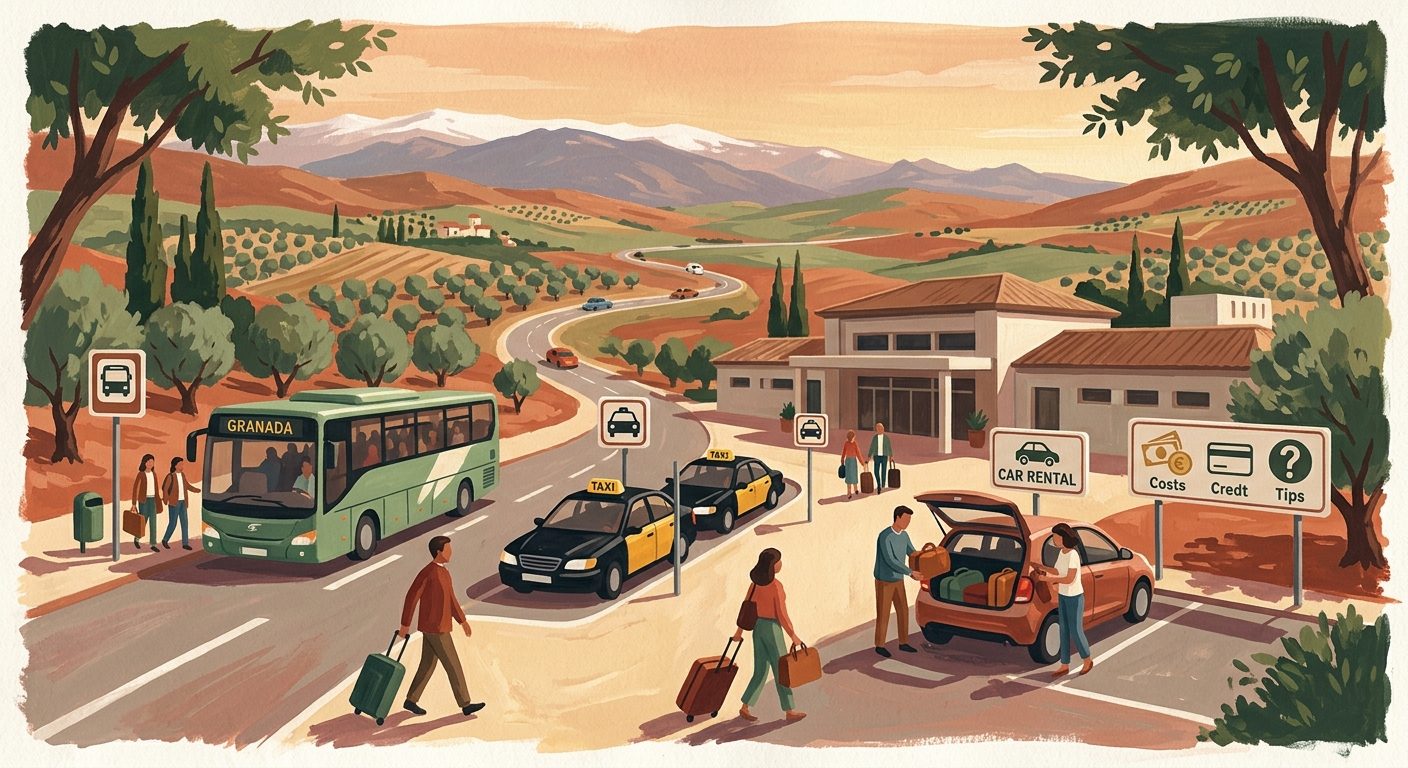
A complete practical guide to Granada-Jaén Airport (GRX), covering airport buses, taxi fares, car hire friction, terminal facilities, and the step-by-step reality of arriving and departing.
7 min read

Jerez Airport (XRY): The Complete Guide to the Gateway of Cádiz
A deep-dive practical guide to using Jerez Airport (XRY). Learn the realities of onward transport to Cádiz province, car hire friction, train timetables, and how to avoid the most common arrival mistakes.
8 min read

Understanding Spanish Festival Culture in Andalucía
A deep dive into Andalucían festival culture for residents and visitors. Understand Semana Santa, ferias, local holidays, etiquette, administrative friction and how to survive the local party season.
9 min read
Driving in Andalucía: Rules, Tolls, and Parking Guide
A practical guide to driving in Andalucía, covering road rules, ZBE checks, AP-7 toll choices, parking, roundabouts, breakdown equipment and official sources.
9 min read
Newsletter
More stories from Andalucía
Weekly notes, seasonal picks, and the next guides worth bookmarking.