
attraction · Huelva
Casa Museo Zenobia-Juan Ramón Jiménez
Andalucía 365 · Updated 18 July 2026
Our Verdict
“An intimate and beautifully preserved literary house museum that offers essential context for the life and work of one of Spain's greatest poets and his brilliant wife.”
Last verified: July 2026
Located in the historic centre of Moguer, the Casa Museo Zenobia-Juan Ramón Jiménez is the former residence of the 1956 Nobel Prize-winning poet Juan Ramón Jiménez and his wife, the writer and translator Zenobia Camprubí. Housed in a traditional 19th-century Andalusian townhouse, the museum preserves the couple's extensive personal library, original furnishings, and handwritten manuscripts. For literature enthusiasts and those exploring the Columbus Route, the building offers an intimate look at the environment that shaped Platero y yo, one of the most translated works in the Spanish language. It is an essential stop for understanding Moguer's literary heritage and the profound, collaborative partnership between Juan Ramón and Zenobia.
Why It Matters
Built in 1885, the house is a classic example of Andalusian domestic architecture and was declared a Site of Cultural Interest because it served as the poet's residence during his childhood and adolescence. The building's spaces, light, and atmosphere are frequently referenced throughout his poetry and prose. Beyond preserving the physical architecture of a prosperous 19th-century Moguer family, the museum serves a vital cultural function by highlighting the crucial role of Zenobia Camprubí. Her own literary contributions, translations, and meticulous management of their shared legacy are central to the exhibition, ensuring the museum tells the story of a remarkable intellectual partnership rather than just a solitary genius.
What to See and Do
The Ground Floor and Courtyards
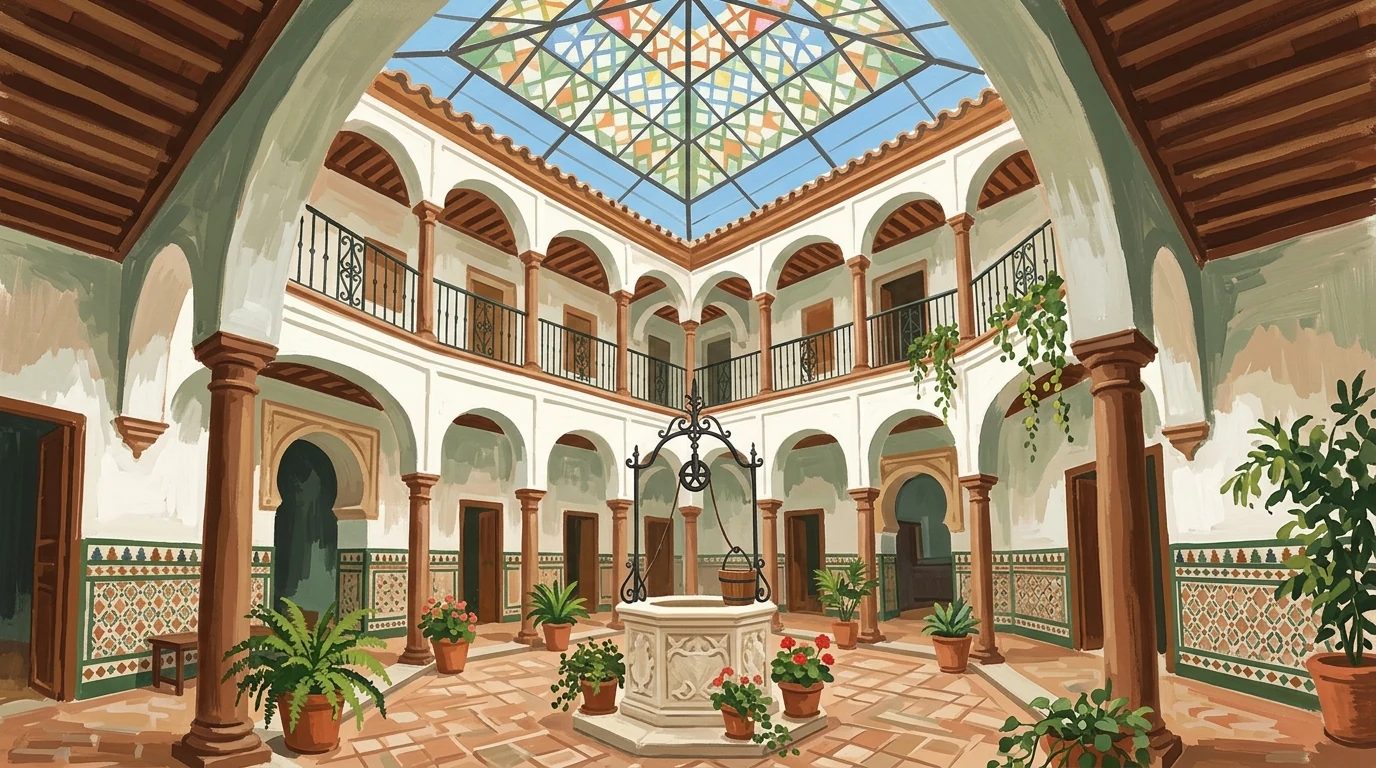
The ground floor features the couple's extraordinary personal library and newspaper archive, housing thousands of volumes and magazines that reflect their broad intellectual interests. Visitors pass through the main interior patio, which is illuminated by a colourful glass skylight. The focal point of this courtyard is a central cistern, or aljibe, carved from a single piece of alabaster marble, a feature immortalised by the poet in chapter XXVI of Platero y yo. Towards the rear of the property, an exterior courtyard contains a traditional corral, a stable area, and a life-sized bronze statue dedicated to the beloved donkey, Platero.
The Upper Floor and Madrid Collection
A spacious marble staircase leads to the upper floor, which contains nine distinct rooms displaying original furniture, paintings, and personal effects. Many of these items were relocated from the couple's later residence in Madrid, meticulously arranged to recreate their working and living environments. These rooms offer a poignant insight into their daily routines, creative processes, and their eventual exile. The visit concludes with access to the roof terrace, or azotea, which provides sweeping panoramic views over the white-washed roofs and bell towers of Moguer, a landscape that deeply influenced the poet's early work.
Planning Your Visit
Getting There
The museum is located on Calle Juan Ramón Jiménez in the historic heart of Moguer, approximately 20 kilometres from the city of Huelva. Moguer is easily reached by car via the A-49 motorway and the A-494. Street parking in the immediate vicinity is limited due to the narrow, historic streets, so visitors should look for public parking areas on the edge of the town centre and walk the short distance to the museum.
How Long to Allow
Allow approximately one hour to explore the two floors, the courtyards, and the roof terrace at a leisurely pace, or slightly longer if you plan to listen to the complete audioguide.
When to Go
Morning visits are recommended to avoid the peak heat of the Andalusian afternoon, particularly during the summer months. The museum operates on a seasonal timetable, with extended evening hours in the summer and closures on Mondays, Sunday afternoons, and local holidays. Always check the official website for current opening times before travelling.
While walk-ins are accepted, the museum has a maximum capacity of 25 people per group. Booking in advance by telephone is highly recommended, especially for groups or during peak tourist seasons, to secure your preferred entry time.
Good to Know
- An official audioguide is available to download directly to your smartphone via a QR code at the entrance.
- The building is equipped with a lift, making the upper floors accessible to visitors with reduced mobility.
- Photography is permitted, but the use of flash is strictly prohibited to protect the delicate manuscripts, books, and textiles.
- Visitors are asked to keep mobile phones on silent and must refrain from touching the exhibits or sitting on the antique furniture.
- Food, drinks, and animals, with the exception of registered guide dogs, are not allowed inside the museum.
Nearby worth your time
A few well-placed stops for extending the day without turning it into a checklist.
Continue through Columbus Route
Step back into the wider landscape with local guides, nearby places and the province overview.
Place guide · 7 min
Playa de Castilla: The Wild Frontier of the Doñana Coastline
Playa de Castilla is a vast, 20-kilometre stretch of wild Atlantic coastline bordered by the spectacular orange cliffs of the Doñana National Park.
Place guide · 7 min
Playa de Isla Canela Beach Guide: Huelva Coastline
Playa de Isla Canela is a vast stretch of fine sand where the Guadiana River meets the Atlantic, famous for its shallow lagoons and family-friendly atmosphere.
Itinerary · 12 min
5 Days in Huelva: Atlantic Coast, Doñana and Sierra
A realistic five-day driving route through Huelva province, linking the maritime history of the capital with the tidal wetlands of Doñana and the chestnut forests of the Sierra de Aracena.