
Practical guide
Etiquette and Social Customs in Andalucía
A practical guide to navigating social interactions, dining habits, and local traditions in Southern Spain to ensure a respectful and seamless visit.
By Dan · Updated 16 July 2026 · 9 min read
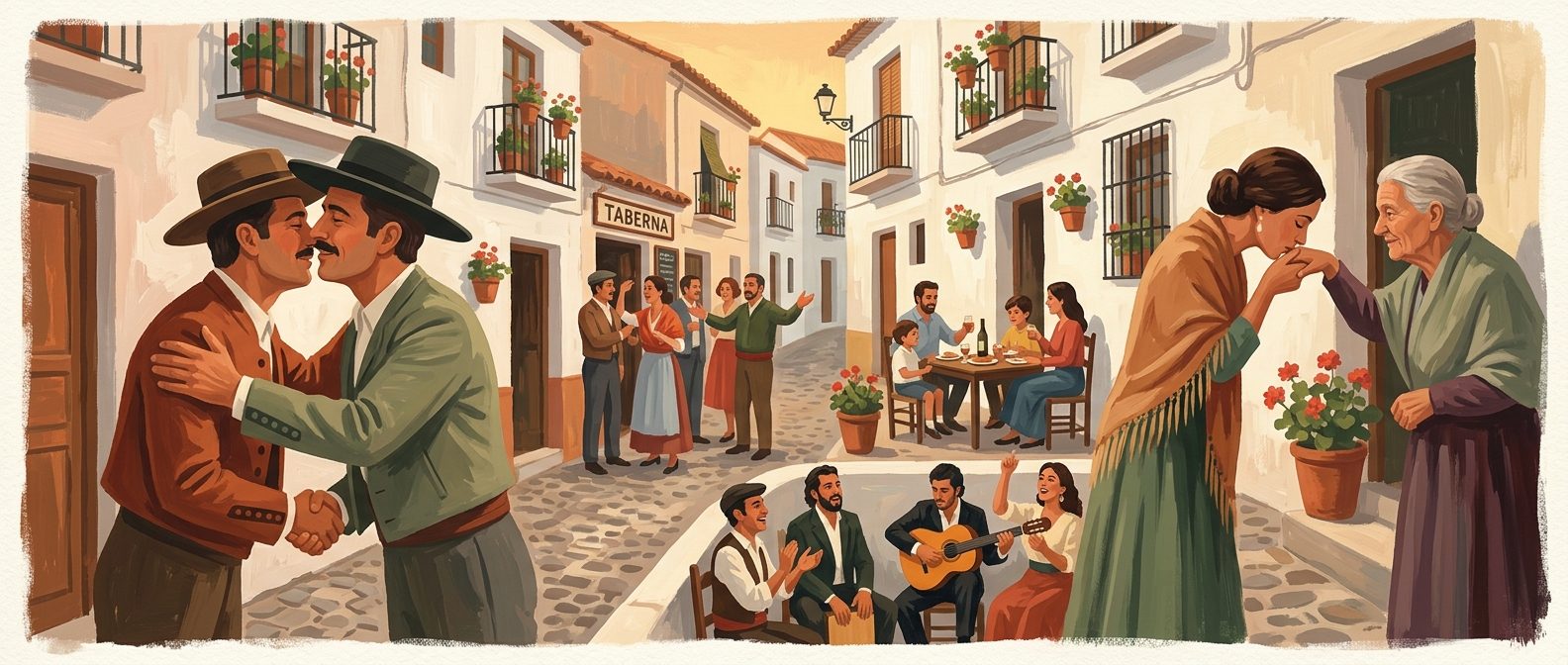
Social interactions in Andalucía are governed by a distinct set of informal rules that prioritise personal connection and a relaxed approach to time. Understanding these norms is essential for anyone looking to integrate or visit without causing accidental offence.
Andalucía is known for its open and friendly atmosphere, but this informality has its own structure. To navigate social situations successfully, you must understand the "dos besos" greeting, the importance of the "sobremesa" during meals, and the local perspective on punctuality. While locals are generally forgiving of tourists, adhering to these customs demonstrates respect and facilitates better service and social integration.
The Quick Answer: Key Rules
In Andalucía, greetings involve two kisses on the cheeks (right then left) between women, or men and women. Men usually shake hands. Dining occurs much later than in Northern Europe, with lunch at 14:00 and dinner after 21:00. Tipping is modest, usually rounding up the change or leaving 1€ to 2€. Use tú for almost everyone except the elderly or officials, and always cover your shoulders and knees when entering churches.
Greetings and Physical Contact
Physical contact is a standard part of communication in Southern Spain. Personal space is often smaller than in the UK or North America.
- Dos Besos: This is the standard greeting between women, and between men and women. It is not a literal kiss; you touch cheeks and make a kissing sound in the air. Always start with the right cheek.
- Men Greeting Men: A firm handshake is standard for first meetings. Between friends or family, a brief hug (un abrazo) and a pat on the back are common.
- Formal Situations: In a professional environment, such as a bank or a lawyer's office, stick to a handshake unless the other person initiates the besos.
Dining Etiquette
Dining is the centre of social life in Andalucía. It is rarely a quick affair.
- Mealtimes: Lunch (la comida) is the main meal, served between 14:00 and 16:00. Dinner (la cena) starts at 20:30 at the earliest, though 21:30 is more common. Attempting to eat dinner at 18:00 will usually find you in an empty restaurant or one catering exclusively to tourists.
- La Cuenta (The Bill): Waiters will never bring the bill until you specifically ask for it ("La cuenta, por favor"). It is considered rude in Spanish culture to rush guests out of a restaurant.
- Tipping: Tipping 10 to 15% is not expected. In a café, leave the small change (copper or 5 to 10 cents). In a restaurant, for a meal costing 50€, a tip of 2€ to 3€ is perfectly acceptable. If the service was exceptional, 5€ is considered generous.
- The Bread (El Pan): Often, a basket of bread and picos (breadsticks) is placed on the table. This is rarely free. Expect to see a charge of 1.00€ to 2.00€ per person on the bill if you eat it.
- Sobremesa: This refers to the period after a meal spent talking, drinking coffee or digestifs. It can last for an hour or more. Do not feel pressured to leave as soon as the plates are cleared.
Dress Codes
Andaluces generally take pride in their appearance. While beach towns are casual, there are clear boundaries.
- Churches and Cathedrals: These are active places of worship. You must cover your shoulders and thighs. Some major sites, like the Sevilla Cathedral, may refuse entry to those in tank tops or very short shorts (check the official visitor guidelines). Men should remove hats.
- Beachwear: Bikinis and swimming trunks should be confined to the beach or poolside. Walking through a town centre or sitting in a non-beachfront restaurant without a shirt is considered low-class and may be subject to local fines under the municipal ordinance in cities like Málaga.
- Evening: When going out for dinner or drinks, locals tend to dress up. Smart casual is the safest bet. Flip-flops are rarely worn in the evening unless you are at a beach bar (chiringuito).
Volume and Social Noise
If you find a restaurant or bar extremely loud, it is usually a sign that it is popular. Andaluces speak loudly and often over one another; this is not considered aggressive or rude, but rather a sign of engagement and "animación." Do not be surprised by the volume of televisions in bars or the shouting of orders between staff.
Time-keeping and Punctuality
The concept of time in Andalucía is flexible, particularly in social contexts.
- Social Events: If invited to a party at 20:00, arriving at 20:15 or 20:20 is considered being "on time." Arriving exactly at 20:00 might find the host still in the shower.
- Business and Appointments: For doctor appointments, tours, or business meetings, you are expected to be punctual. However, do not be surprised if the other party is 5 to 10 minutes late.
- The Siesta: While the traditional three-hour nap is less common in modern cities, many small shops still close between 14:00 and 17:00. Plan your errands for the morning (09:30 to 13:30) or late afternoon.
Tú vs. Usted
Andalucía is significantly more informal with language than Central or Northern Spain. The use of tú (the informal "you") is widespread.
- Use Tú: For people of your own age, younger people, colleagues, and even shopkeepers or waiters in casual settings.
- Use Usted: For the elderly (typically 70+), police officers, or in very formal settings like a hospital or a court of law. When in doubt, start with Usted; if they reply using tú, you should switch.
Social Media and Photography
Spain has strict privacy laws under the Organic Law on Data Protection (LOPDGDD) and the EU-wide GDPR. While taking photos of monuments is fine, be cautious about including locals in your shots.
- Children: Never take photos of local children. This is a sensitive issue and can lead to confrontations.
- Private Property: Avoid filming into private homes or courtyards without permission.
- Street Performers: If you take a photo or video of a street performer (like a flamenco dancer), it is expected that you leave a small tip (1€ or 2€).
Bar Rituals Worth Knowing
The bar is the centre of Andalucían social life, and it runs on a few unwritten rules:
- Napkins on the floor: In traditional tapas bars, tossing your used serviette onto the floor by the bar is not littering. It is the custom, and a carpeted floor of napkins is historically the sign of a good bar. Follow the locals' lead; if everyone is using the bin, do the same.
- Rounds, not bills: Groups of friends rarely split each round. Someone says hoy invito yo ("today it's on me") and pays, with the understanding that it evens out over time. If a local buys you a drink, accept graciously; insisting on paying them straight back can read as rejecting the gesture.
- Pagar a escote: When a group does divide a restaurant bill, it is split equally per head, never itemised. Producing a calculator to work out who had the extra croqueta is deeply un-Spanish.
- Standing at the bar is often cheaper than a table, and always cheaper than the terrace. Nobody minds how long you linger either way.
Churches, Processions and Semana Santa
Andalucía's religious heritage is living culture, not just architecture, and a little care goes a long way:
- In churches: Covered shoulders and lowered voices are expected; avoid wandering during Mass, and check whether photography is permitted; flash is almost always banned.
- During processions: Never cut through a Semana Santa procession or step into the path between the brotherhood and the float. Wait for a marshal to indicate a crossing point, or walk around. In Sevilla especially, treat the moments of silence as sacred, particularly when a saeta is sung from a balcony, because to the crowd they are.
- Dress for the occasion: Locals dress smartly for Semana Santa and ferias. You will never feel out of place for being slightly overdressed in Andalucía; the reverse is not true.
Visiting Someone's Home
An invitation to a private home is a bigger deal in Spain than in northern Europe; much socialising happens in bars precisely because the home is a family space. If you are invited:
- Bring something: A good dessert from a pastelería, a bottle of wine, or flowers. Nothing extravagant.
- Arrive a little late: Ten to fifteen minutes after the stated time is polite, not rude. Arriving exactly on time can catch your hosts unprepared.
- Compliment the food, and expect seconds: Refusing a second helping outright can disappoint; the graceful move is to accept a small amount, or plead fullness with visible regret.
A Word on Language
Any attempt at Spanish is warmly received. Andalucíans are patient with learners and quick to help. Do not be alarmed if you struggle to follow replies: the Andalucían accent famously softens or drops the letter "s" and shortens word endings, so even fluent Spanish speakers from elsewhere take time to attune. ¿Puede hablar más despacio, por favor? ("Could you speak more slowly, please?") works wonders. And if you hear yourself referred to as a guiri, the affectionate-ish slang for a northern European visitor, it is almost never meant unkindly.
Frequently Asked Questions
Do I need to tip for tapas?
No. If you are standing at a bar having a single drink and a tapa, you do not need to tip. If you have several rounds, leaving the small change is sufficient.
Is it rude to decline a drink?
It is not rude, but "no" can be met with persistence. If you do not want alcohol, simply order a "sin" (alcohol-free beer) or a "mosto" (grape juice). Simply saying you are full or have to drive is usually accepted.
How do I get a waiter's attention?
Do not snap your fingers or whistle. Catch their eye and raise your hand slightly, or say "Perdona" (Excuse me) as they walk past. It may take longer than in the UK; patience is expected.
Are shops open on Sundays?
In most of Andalucía, large supermarkets and shops are closed on Sundays. In coastal areas or major cities like Sevilla, some shops may open during peak tourist season, but generally, Sunday is a day for family and dining out.
Summary of Key Takeaways
- Greetings: Use two kisses (right cheek first) for women/mixed company and handshakes for men.
- Dining: Eat late (14:00 lunch/21:00 dinner) and always ask for the bill when you are ready.
- Dress: Cover up in churches and save swimwear for the beach.
- Tipping: Leave small change only; large percentages are not standard practice.
Note: Figures and times were accurate at the time of publication.
Last reviewed: 21 June 2026 · Editorial policy
Related guides
The Art of the Tapeo: A Local Guide to Tapas Culture in Andalucía
Discover the unwritten rules of the Andalucían tapeo, from the legendary free tapas of Granada to the historic tabernas of Sevilla.
6 min read
A Guide to the Wines and Sherries of Andalucía
Discover the bone-dry finos of Jerez and the bold high-altitude reds of Ronda in our comprehensive guide to Andalucían wine culture.
6 min read
Jamón Ibérico: The Ultimate Guide to Andalucía’s Cured Gold
Discover the art of Jamón Ibérico, from the acorn-fed pastures of Jabugo to the high-altitude curing rooms of Trevélez. Learn how to decode the colour-coded labels and where to find the finest hand-carved plates in Andalucía.
6 min read
The Ghost in the Garden: Searching for the Al-Andalus Within
Eight centuries of Al-Andalus did not vanish in 1492; they simply moved indoors, into the kitchens, and onto the tip of the tongue.
7 min read
Traditional Andalucían Pestiños Recipe
Crispy, honey-glazed, and scented with aniseed, pestiños are the essential taste of Easter in Andalucía. These golden fritters reflect centuries of tradition, combining simple pantry staples into a sophisticated, sticky treat.
4 min read

Authentic Sopa de Picadillo: A Comforting Andalucían Classic
A soul-warming chicken and mint soup from Andalucía, traditionally served with finely diced jamón and hard-boiled eggs for a comforting, protein-rich meal.
3 min read
More guides
Using a VPN in Andalucía: A Practical Guide for Travellers and Residents
A comprehensive guide to using a VPN in Andalucía for security, accessing UK streaming services, and maintaining privacy on public Wi-Fi.
6 min read
Sevilla Airport (SVQ) Guide: Transport, Facilities and Tips
A practical guide to Sevilla Airport (SVQ) covering the EA bus, taxi flat rates, terminal facilities, car hire, and connecting to wider Andalucía.
9 min read
Practical Guide to Almería Airport (LEI)
A practical logistics guide to arriving at Almería Airport (LEI). Discover how to navigate terminal facilities, use the Surbus Line 30, connect to intercity buses, and avoid common transport mistakes.
7 min read
Practical Guide to Gibraltar International Airport (GIB)
A practical guide to using Gibraltar Airport (GIB) for trips into Andalucía, covering border logistics, avoiding vehicle queues, Spanish transport options, and how to handle wind diversions.
8 min read
Málaga-Costa del Sol Airport (AGP) Travel Guide
A deep practical guide to navigating Málaga-Costa del Sol Airport (AGP). Learn the realities of arrivals, transport connections, parking rules, and common mistakes.
8 min read
Federico García Lorca Granada-Jaén Airport Guide: Transport, Costs and Tips
A complete practical guide to Granada-Jaén Airport (GRX), covering airport buses, taxi fares, car hire friction, terminal facilities, and the step-by-step reality of arriving and departing.
7 min read
Jerez Airport (XRY): The Complete Guide to the Gateway of Cádiz
A deep-dive practical guide to using Jerez Airport (XRY). Learn the realities of onward transport to Cádiz province, car hire friction, train timetables, and how to avoid the most common arrival mistakes.
8 min read
Understanding Spanish Festival Culture in Andalucía
A deep dive into Andalucían festival culture for residents and visitors. Understand Semana Santa, ferias, local holidays, etiquette, administrative friction and how to survive the local party season.
9 min read
Driving in Andalucía: Rules, Tolls, and Parking Guide
A practical guide to driving in Andalucía, covering road rules, ZBE checks, AP-7 toll choices, parking, roundabouts, breakdown equipment and official sources.
9 min read
Newsletter
More stories from Andalucía
Weekly notes, seasonal picks, and the next guides worth bookmarking.