
attraction · Granada
Centro de Interpretación Almazara La Erilla
Andalucía 365 · Updated 18 July 2026
Our Verdict
“A remarkably preserved medieval olive mill offering an authentic, highly specific look at pre-industrial agriculture and regional gastronomy.”
Last verified: July 2026
The Centro de Interpretación Almazara La Erilla in Nigüelas is one of Spain's oldest and most complete historic olive mills. Operating from the Nasrid period between the twelfth and fifteenth centuries right up until 1942, this restored almazara provides a tangible record of the agricultural industry that shaped the Lecrín Valley. Visitors can trace the physical evolution of olive oil extraction, walking past animal-drawn mills and massive hydraulic beam presses housed within their original architectural setting. Managed by the non-profit Fundación Zayas, the museum pairs industrial heritage with guided extra virgin olive oil tastings. It suits industrial history enthusiasts, culinary travellers and anyone seeking to understand the deep-rooted agricultural traditions of rural Andalusia.
Centuries of Milling History
The physical structure of the Almazara La Erilla dates back to the Nasrid era, making it a rare surviving example of medieval industrial architecture in southern Spain. While many historic mills were demolished or modernised during the twentieth century, this facility remained operational for over five hundred years. It ceased commercial production in 1942, preserving a continuous timeline of agricultural technology.
In 1991, the site was restored and opened to the public as a museum, designed to explain the context of olive oil production in the Lecrín Valley. The longevity of the mill highlights the enduring economic importance of olive cultivation in the region. Today, the property is owned and managed by Fundación Zayas, a private non-profit organisation. The foundation channels proceeds from the museum and its shop into social care programmes for vulnerable groups across the Granada province, adding contemporary civic value to the historic site.
The Architecture of Extraction
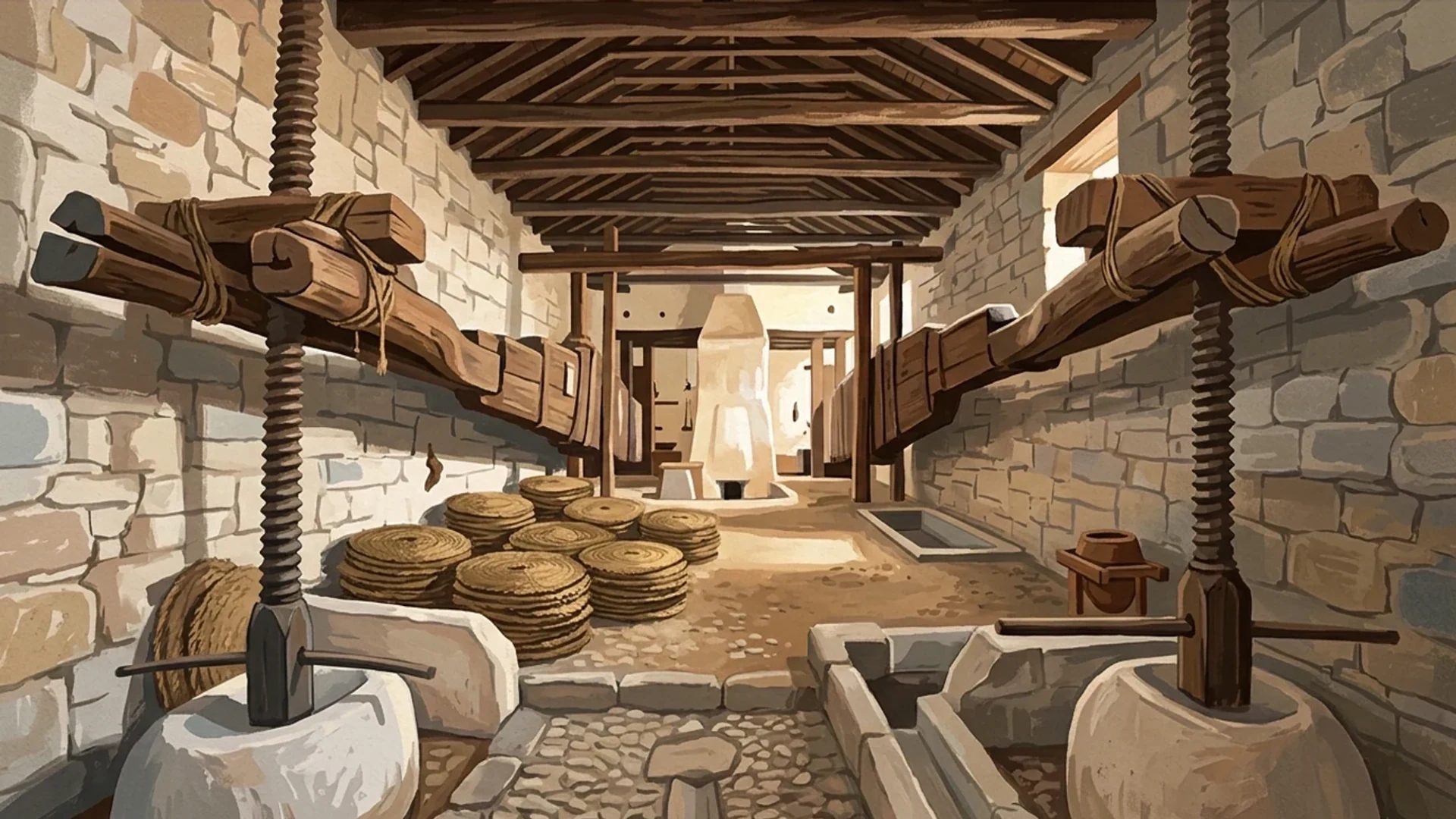
A visit to the interpretation centre follows the historical flow of the olive oil production process. The architecture was built around the massive machinery, with heavy stone walls and reinforced arches constructed to withstand the immense pressures of the presses.
The route begins in the patio de acarreo, or trojes. This was the primary courtyard where local farmers unloaded their harvested olives, sorting and storing them briefly before milling. From here, visitors move into the main milling rooms to observe the evolution of crushing technology:
- The Molino de Sangre: An animal-drawn mill representing an Ibero-Roman method of crushing olives using heavy conical stones.
- The Molino Hidráulico: An eighteenth-century hydraulic mill demonstrating the shift to water power, relying on the network of Moorish irrigation channels that still run beneath Nigüelas.
- The Aljibe: The internal water cistern, which was essential for powering these processes and separating the oil from the vegetable water.
The Beam and Weight Presses
The undisputed centrepieces of the Almazara La Erilla are its viga y quintal (beam and weight) presses. These massive wooden structures dominate the pressing room and represent a significant technological leap from the simpler lever presses used in antiquity. Their preservation is notable, as enormous wooden components often rotted away or were dismantled for timber once a mill closed.
The system relies on basic physics applied on an industrial scale. Massive wooden beams act as levers, weighed down by heavy stones known as quintales. The olive paste was spread onto circular esparto grass mats called capachos, which were stacked in a tall column beneath the beam. As the heavy stones were winched upwards, the massive wooden beam pressed down on the mats, squeezing the liquid from the paste. The sheer scale of the wooden beams and the mechanical ingenuity required to operate them provide a stark contrast to modern extraction facilities.
Olive Oil Tastings and Education
The interpretation centre operates as an active educational space. To bridge the gap between historical engineering and contemporary gastronomy, the venue offers guided tastings of extra virgin olive oil, known locally as catas de AOVE.
These sessions teach visitors how to identify the flavour profiles, aromas and quality indicators of different regional oils. Participants learn the fundamental differences between refined olive oils and cold-pressed extra virgin varieties, as well as the specific characteristics of the olives grown in the surrounding mountains. The educational programme also covers the role of the olive tree in the local ecosystem, explaining how traditional farming practices have shaped the valley over centuries.
Our verdict
The Almazara La Erilla is a highly specific, focused attraction. It lacks the broad entertainment of larger provincial museums, relying instead on the raw authenticity of its preserved machinery and the knowledge of its guides. The main limitation is access. Visits depend heavily on booking guided tours or navigating restricted opening windows, meaning spontaneous walk-ins will frequently find the doors locked.
However, for those who plan ahead, it offers an exceptionally grounded look at pre-industrial agriculture. The scale of the wooden presses is genuinely impressive, and the integration of the tasting sessions makes the historical information highly relevant. It is a rewarding, educational stop for anyone with a genuine interest in food history, traditional engineering or rural Andalusian culture.
Practical Arrival and Access
The mill is located in the upper part of Nigüelas, a village situated at the foot of the Sierra Nevada mountains. The streets surrounding the museum are narrow and not suited for visitor traffic.
To manage this, the municipality provides a dedicated parking area, the Parking Privado La Erilla, located at the entrance to the village just behind the main bus stop. This area accommodates both cars and coaches. From the car park, it is a straightforward five-minute walk through the village streets, heading towards the local church, to reach the mill.
The venue states that the ground floor spaces are accessible, though visitors with severe mobility constraints should contact the foundation in advance to confirm arrangements, as the historic building features uneven stone floors. Because opening hours fluctuate based on the season and the availability of guides, advance reservations through the official Almazara La Erilla website are strongly recommended to secure a spot on a tour or tasting session.
Nearby worth your time
A few well-placed stops for extending the day without turning it into a checklist.

Continue through The Lecrín Valley
Step back into the wider landscape with local guides, nearby places and the province overview.
Place guide · 7 min
Playa de Calahonda (Granada) Beach Guide
Playa de Calahonda in Granada offers deep, crystal-clear waters and a dramatic limestone cliff backdrop. This Blue Flag beach is a favourite for snorkelling and authentic Andalucían seafood.
Place guide · 7 min
A Guide to Playa de Salobreña on the Costa Tropical
Playa de Salobreña is a vast stretch of dark sand and clear water on the Costa Tropical, overlooked by a historic Moorish castle and dramatic cliffs.
Itinerary · 10 min
Two Days in Granada: A Step-by-Step Itinerary
Two days in Granada gives you just enough time to explore the Alhambra and lose yourself in the steep alleys of the Albaicín. This itinerary balances major monuments with the city's legendary free tapas culture.