Founded by Scipio Africanus to house veterans of the Second Punic War, Itálica was the first Roman city established in Hispania and the birthplace of emperors Trajan and Hadrian. Its monumental amphitheatre and remarkably intact floor mosaics provide a rare, direct connection to the imperial majesty of the second century.
Located just nine kilometres northwest of Sevilla in the town of Santiponce, Itálica offers a window into the Roman Empire at the height of its power. This was no ordinary provincial settlement; it was a city of prestige, designed to showcase the wealth and influence of its most famous sons. Walking through its wide, gridded streets today, you can still perceive the ambition of Emperor Hadrian, who expanded the city in the second century AD with grand public buildings and luxurious villas.
While the original core of the city, the Vetus Urbs, lies beneath the modern houses of Santiponce, the Nova Urbs - the "New City" built during Hadrian’s reign - has been extensively excavated and preserved. This archaeological ensemble allows you to explore the elite residential quarters, the intricate hydraulic systems, and one of the largest amphitheatres ever constructed by the Romans, all while the scent of wild rosemary and the dry heat of the Guadalquivir valley remind you of the site's enduring Mediterranean character.
What to See & Do
The Colossal Amphitheatre
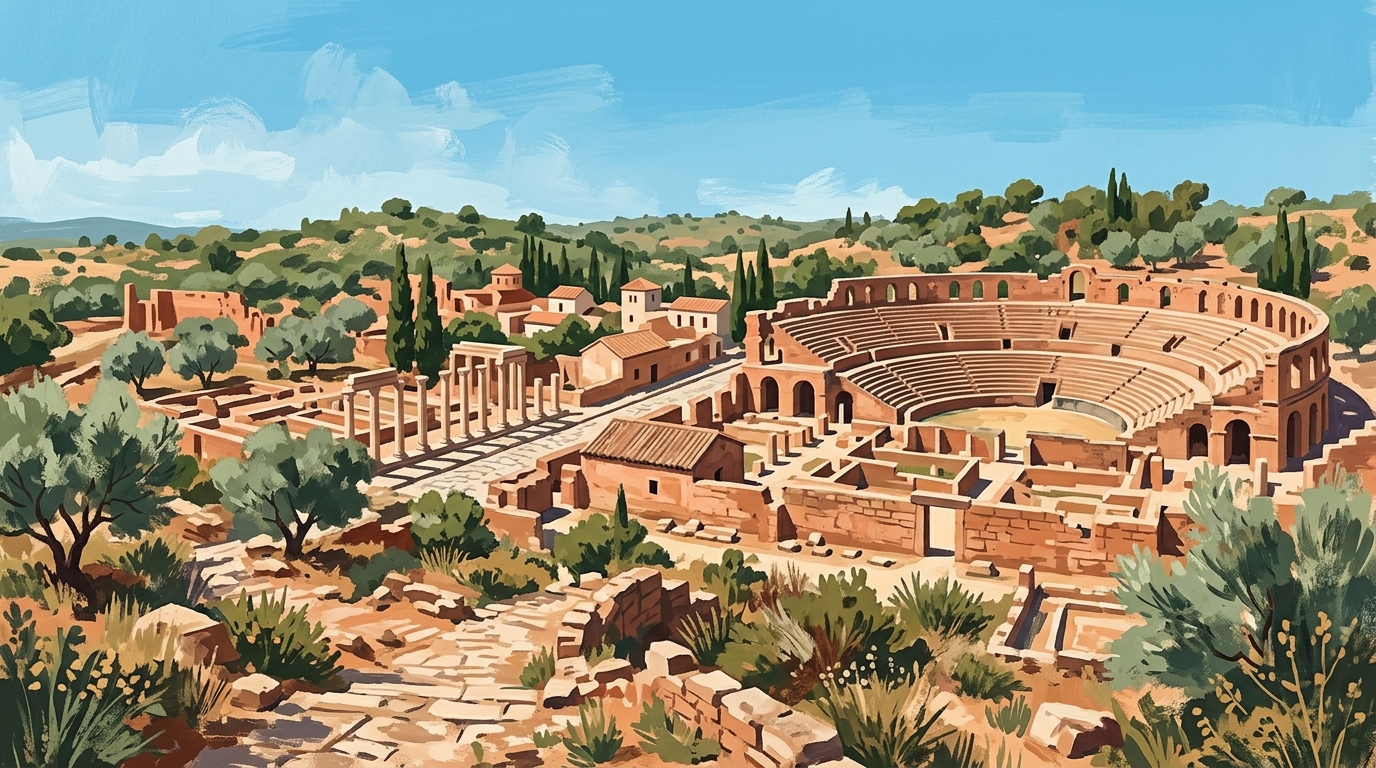
The undisputed highlight of any visit is the amphitheatre. In its prime, it could seat roughly 25,000 spectators, making it the third-largest in the Roman world. Its scale is even more impressive when you consider that the city’s population was likely significantly smaller, suggesting it served as a regional hub for major gladiatorial spectacles and animal hunts.
You can walk through the vaulted tunnels where gladiators once prepared and stand in the centre of the arena. Look for the fossa bestiaria, the central pit that was covered with wooden planks and used to house the cages for wild animals before they were hoisted into the arena. Modern culture fans may recognise these ruins as the 'Dragonpit' from the television series Game of Thrones, though the site’s real-world history is arguably more dramatic than the fiction filmed there.
The Mosaics of the Aristocratic Villas
Itálica is renowned for the quality of its floor mosaics, many of which remain in their original positions within the ruins of grand villas. The House of the Birds (Casa de los Pájaros) is a standout, featuring a courtyard surrounded by rooms decorated with detailed depictions of thirty-five different bird species. The precision of the tile work, using tiny tesserae of naturally coloured stone, is extraordinary.
Another essential stop is the House of the Planetarium. Here, a large mosaic depicts the seven Roman deities representing the days of the week, with Venus, Mars, and Jupiter still clearly visible. These villas were the homes of the city's elite, featuring central courtyards (peristyles) and sophisticated underfloor heating systems that were remarkably advanced for the era.
The Trajaneum and Thermal Baths
Dedicated to Emperor Trajan, the Trajaneum was a massive temple situated at the highest point of the New City. While only the foundations and some marble fragments remain, the sheer scale of the platform indicates how imposing this structure would have been. Nearby, you can find the ruins of the public thermal baths. Even in its ruined state, the complex reveals the Roman obsession with hygiene and socialising, with clearly defined areas for cold (frigidarium), tepid (tepidarium), and hot (caldarium) baths.
The Roman Theatre
Located slightly outside the main archaeological enclosure, within the modern town of Santiponce, the Roman Theatre is worth the short walk. Built during the reign of Augustus, it predates the larger amphitheatre and provided space for dramatic performances and musical events. Recent restoration work has made it possible to appreciate the semicircular seating area and the stage where performers once stood overlooking the valley.
Practical Information
Opening Times: Itálica operates on a seasonal schedule. Generally, from 21 September to 20 March, it is open Tuesday to Saturday from 09:00 to 18:00, and Sundays from 09:00 to 15:00. During the spring (21 March to 20 June), Saturday hours often extend until 21:00. In the peak summer months (21 June to 20 September), the site opens from 09:00 to 15:00 Tuesday to Sunday to avoid the afternoon heat. Note that the site is always closed on Mondays.
Ticket Prices: Entry is free for citizens of the European Union (proof of residency or a passport is required). For visitors from outside the EU, the entrance fee is a very modest €1.50.
How to Get There: The easiest way to reach Itálica from Sevilla is by bus. Lines M-170A and M-170B depart regularly from the Plaza de Armas bus station. The journey takes approximately 20 to 30 minutes, and the bus stops right outside the main entrance to the ruins in Santiponce. If you are driving, take the N-630 north from Sevilla; the route is well-signposted.
Parking: There is a dedicated, free parking area immediately adjacent to the entrance of the archaeological site, which usually has plenty of space on weekdays.
Where to Eat Nearby
After exploring the ruins, the town of Santiponce offers several excellent options for a traditional lunch. Ventorrillo Canario, located directly across from the site entrance, is a local institution famous for its charcoal-grilled meats and papas arrugás (wrinkled potatoes) served with authentic Canarian mojo sauce. It is a large, rustic space that handles crowds well.
For a more intimate experience, try Taberna La Romana. Situated just a few minutes’ walk from the main gate, it serves high-quality Andalusian tapas. Their homemade croquettes and solomillo al whisky (pork sirloin in a garlic and whisky sauce) are highly recommended. If you prefer a lighter bite, the bars along Avenida de Extremadura offer cold beer and simple montaditos (small sandwiches) that are perfect for a quick refuel.
Where to Stay
Most visitors choose to stay in Sevilla and visit Itálica as a half-day excursion. The Triana neighbourhood is particularly convenient, as it sits on the western side of the river, making the drive or bus journey to Santiponce very straightforward. For those who prefer to stay in the heart of the city, the Casco Antiguo offers a wide range of boutique hotels. If you want to remain closer to the ruins, there are a few simple guesthouses in Santiponce, though Sevilla provides significantly more variety in terms of dining and evening entertainment.