
Feature · Huelva
The Iron Vein: Life and Death on the Banks of the Río Tinto
In the copper-stained hills of Huelva, a river of acid and iron offers a glimpse into the deep history of human extraction and the possibilities of life on distant planets.
By Dan · Updated 7 June 2026 · 7 min read
Story context
This is a narrative feature, not a breaking-news report or a legal/practical guide. It is kept on the site because it adds local texture and reading value alongside the more practical Andalucía 365 guides.
Use the links below for planning details, current access, places to stay, transport or food guidance connected with the story.
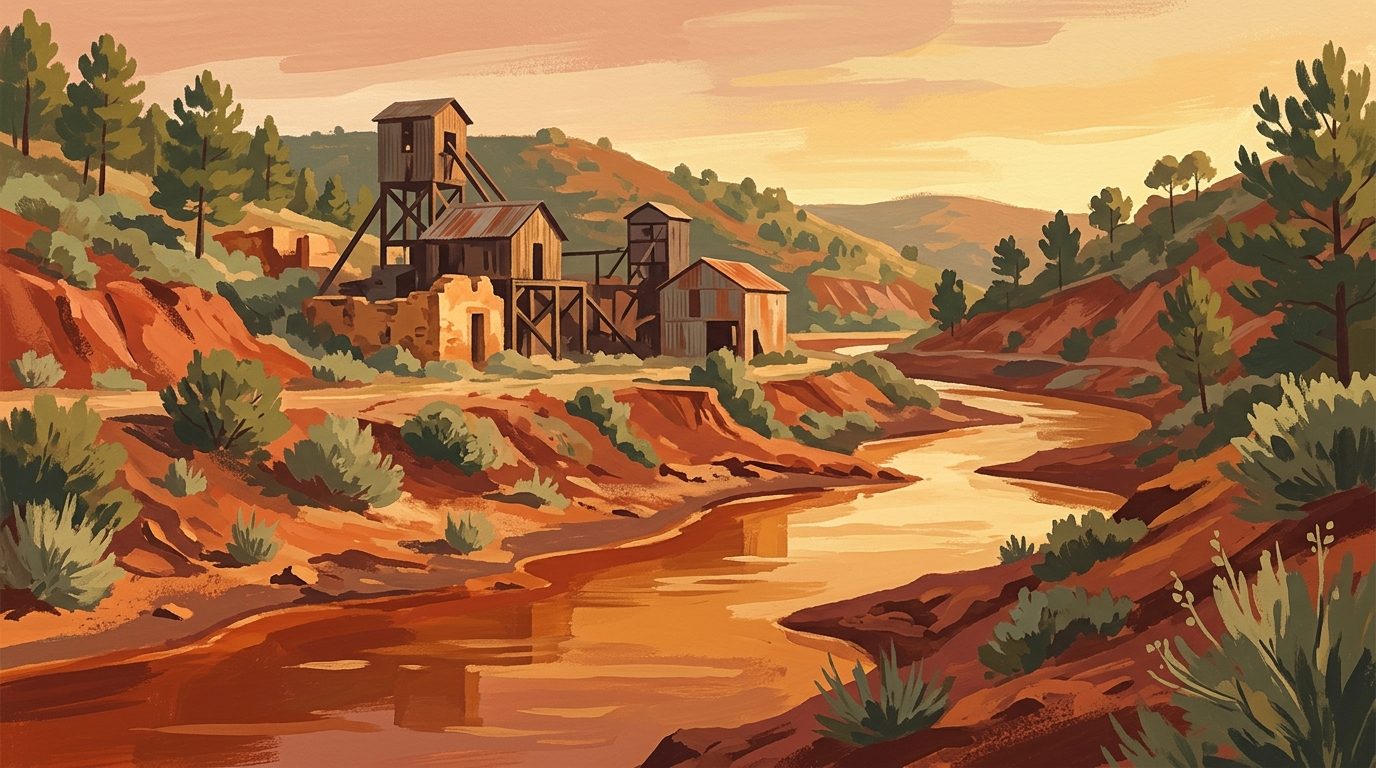
The water does not flow so much as it oozes, a thick, visceral crimson that defies the sapphire blue of the Andalucían sky. Here, the earth has been turned inside out, revealing a skeletal landscape where the rules of biology seem to have been rewritten in acid and iron.
There is a specific silence at the edge of the Corta Atalaya. It is not the peaceful hush of a pine forest or the expectant stillness of a village plaza at siesta. It is the silence of an empty cathedral, or perhaps a graveyard. Standing on the lip of this man-made crater, one of the largest open-cast mines in the world, the scale of human ambition becomes physical. The terraced walls of the pit spiral downward in concentric circles of ochre, mauve, and rust, plunging 350 metres into the gut of the Huelva province. At the very bottom, a pool of water sits motionless, its surface the colour of dried blood.
A few kilometres away, the river that gives this region its name begins its journey toward the Atlantic. The Río Tinto does not look like water. It looks like a tectonic haemorrhage. It is heavy with dissolved iron and copper, its pH levels hovering around a corrosive 2.2, roughly the acidity of lemon juice or stomach acid. If you were to dip your hand into the current, you would feel a distinct tingle, the chemical bite of a landscape that has been excavated, scorched, and leached for five millennia. Nothing grows on the banks. No fish swim in its depths. The rocks that line the shore are stained a permanent, shocking orange, as if the river has been cauterised into the earth.
To look at this landscape is to see a version of Earth that feels fundamentally alien. It is a place where the familiar green and gold of the Andalucían dehesa yields to a palette of bruised purples and metallic reds. For the people who live in the town of Minas de Riotinto, this is not a spectacle; it is the furniture of their lives. But for the scientists from NASA and the European Space Agency who frequent these banks, the river is a laboratory, a terrestrial gateway to the secrets of Mars.
The Ghost of the Roman Pickaxe
The story of the Río Tinto is not one of nature, but of the relentless collision between geology and human greed. This corner of south-western Spain sits atop the Iberian Pyrite Belt, a massive deposit of minerals formed 350 million years ago. For as long as humans have known how to smelt metal, they have been tearing at this ground. The Tartessians were here first, followed by the Phoenicians, who traded the copper and silver of Huelva across the Mediterranean. But it was the Romans who truly industrialised the destruction.
Under the Roman Empire, the mines of Río Tinto became the primary source of the silver that funded the legions and the copper that forged their weapons. The scale of their operation was staggering; archaeologists have found Roman slag heaps here containing over 20 million tonnes of waste. They used slaves and water wheels to drain the deeper galleries, working in conditions of unimaginable horror to pull wealth from the dark. When the Romans left, the mines fell into a long slumber, but the chemical process they had accelerated, the exposure of sulphide minerals to air and water, could not be stopped. The river began to turn red long before the modern age, a permanent scar left by the appetite of Rome.
The British Colony in the Sun
The modern identity of the region was forged in 1873, when the Spanish government, nearing bankruptcy, sold the mines to a British-led syndicate for 92 million pesetas. This was the birth of the Rio Tinto Company Limited. Within years, the sleepy hills of Huelva were transformed into a corner of Victorian Britain. The engineers brought with them steam engines, railways, and a rigid social hierarchy that saw the creation of Bella Vista, a gated residential colony for the British staff.
To walk through Bella Vista today is a disorienting experience. Amidst the scorched, Martian landscape of Huelva, you find yourself on a street of Victorian villas with manicured lawns, sash windows, and brick chimneys. There is a Presbyterian chapel and a lawn tennis club, the first in Spain. The British managers lived here in a state of self-imposed exile, drinking gin and tonics and playing cricket while thousands of Spanish miners laboured in the dust below. They built a private railway to transport the ore to the port of Huelva, a line that still snakes through the red valley, its rusted locomotives now serving as monuments to an era of industrial extraction that shaped the global economy.
This British period brought prosperity, but it also brought the "Año de los Tiros", the Year of the Shots. In 1888, thousands of workers and local residents marched to protest the "teleras", the practice of roasting copper ore in the open air, which released thick clouds of sulphuric acid smoke that choked the valley and destroyed crops. The military was called in, and they opened fire on the crowd in the Plaza de la Constitución. The official death toll was low, but local memory insists hundreds were killed. It remains a foundational trauma for the region, a reminder that the red water is not just a geological curiosity, but a symbol of the blood spilled to extract the treasure beneath the soil.
Life Where It Should Not Exist
For decades, the Río Tinto was considered an environmental disaster zone, a dead river killed by mining runoff. But in the 1990s, scientists began to look closer. They discovered that the river was not dead at all. In fact, it was teeming with life. The water was home to extremophiles, micro-organisms that thrive in conditions that would kill almost any other form of life. These bacteria, such as Acidithiobacillus ferrooxidans, actually eat the iron and sulphur minerals in the rocks, producing the river’s signature acidity as a byproduct.
This discovery turned the scientific world upside down. If life could thrive in the toxic, acidic environment of the Río Tinto, it could potentially survive in the subsurface oceans of Europa or the frozen deserts of Mars. NASA researchers began using the river to test the sensors and drills intended for Martian rovers. The riverbed, rich in jarosite, an iron sulphate mineral also found on the Red Planet, became a proxy for the Martian surface. The very thing that made the river look like a wasteland was what made it a beacon for astrobiology. The Río Tinto proved that life is not a fragile accident; it is a tenacious force that can carve out a home in the most hostile corners of the universe.
The Complexity of the Red Earth
Today, while the frenzy of the 19th-century copper boom has faded and the Victorian era is a memory, the earth is still being worked; modern mining operations continue to extract minerals from the Iberian Pyrite Belt alongside the growing tourism industry. This leaves behind a landscape that is caught between its heritage and its future. There is a tension here in how the land is perceived. To a tourist, the red river is a marvel of photography, a surreal backdrop for a holiday excursion. Those wishing to explore the Corta Atalaya and the historic railway can do so via the Riotinto Mining Park. To an environmentalist, it is a cautionary tale of acid mine drainage and the long-term cost of unregulated industry. To a local, it is simply home: a place of hard work, ancestral pride, and a specific kind of rugged beauty.
The contradiction lies in the fact that the river’s toxic nature is precisely what protects its unique ecosystem. If the water were cleaned, if the pH were raised to a neutral 7, the extremophiles would die. The scientific value of the Río Tinto depends on its continued "pollution". This creates a strange paradox: we are compelled to preserve a landscape that is, by almost any standard, an ecological ruin. The hills are scarred, the air sometimes carries the faint metallic tang of the pits, and the water remains undrinkable. Yet, there is a profound dignity in the way the land refuses to be ordinary.
As the sun begins to set over the hills of Minas de Riotinto, the light hits the water at an angle that turns the crimson into liquid gold. The shadows of the rusted iron bridges stretch long across the stained rocks, and the silence returns to the Corta Atalaya. It is a place that feels finished with humanity, even as we continue to probe its depths for answers about our place in the cosmos. The river continues its slow, acidic crawl toward the sea, indifferent to the empires that have mined it or the scientists who study it. It is a reminder that the earth has a memory, and here, in the red heart of Huelva, that memory is written in the indelible ink of iron.
A lone hawk circles over the rim of the pit, its wings catching the last of the heat. Below, the red water remains perfectly still, a mirror reflecting a sky that seems far too blue for a world so stained by the work of men. The river does not ask for forgiveness; it simply exists, a persistent, bloody pulse in the ancient stone.
Last reviewed: 21 June 2026 · Editorial policy
Related guides
The Ghost of the Outlaw in the Badlands of Almería
The dust in Tabernas does not merely sit on the surface; it inhabits the lungs, a fine, ochre silt that has tasted both Hollywood gunpowder and the silence of the ancient seabed.
6 min read
Geological Wonders: Caves and Karst Landscapes of Andalucía
Discover the subterranean wonders and prehistoric secrets preserved within the limestone massifs and gypsum deposits of southern Spain.
6 min read
Where to Stay: A Guide to Cave Accommodation in Andalucía
How to choose cave accommodation in Andalucía: Guadix, Sacromonte, the Altiplano and Cazorla, with named stays, access checks and official local links.
3 min read
The Ultimate Whale Watching Guide: Strait of Gibraltar
Fourteen kilometres of churning water separate Europe from Africa, creating a turbulent bottleneck that serves as one of the world's greatest pelagic highways. Here, in the Strait of Gibraltar, you can watch wild orcas hunt bluefin tuna and sperm whales dive into the abyss just miles from the Andalucían coast.
9 min read
The Complete Caminito del Rey Guide: How to Walk Spain's Most Famous Gorge
Walking the precipitous boardwalks of the Caminito del Rey is a thrilling encounter with sheer limestone cliffs and fascinating engineering heritage. This guide details exactly how to secure tickets, navigate the linear route, and plan your logistics.
10 min read
Tracing Leone and Eastwood: The Ultimate Almería Spaghetti Western Route
Drive the sun-baked stretches of the N-340a and you will quickly realise why 1960s filmmakers chose this arid pocket of Spain over the American West. Tracing the footsteps of Sergio Leone and Clint Eastwood through the Tabernas Desert offers an eerily precise journey into cinematic history.
11 min read
More from Huelva
Newsletter
More stories from Andalucía
Weekly notes, seasonal picks, and the next guides worth bookmarking.